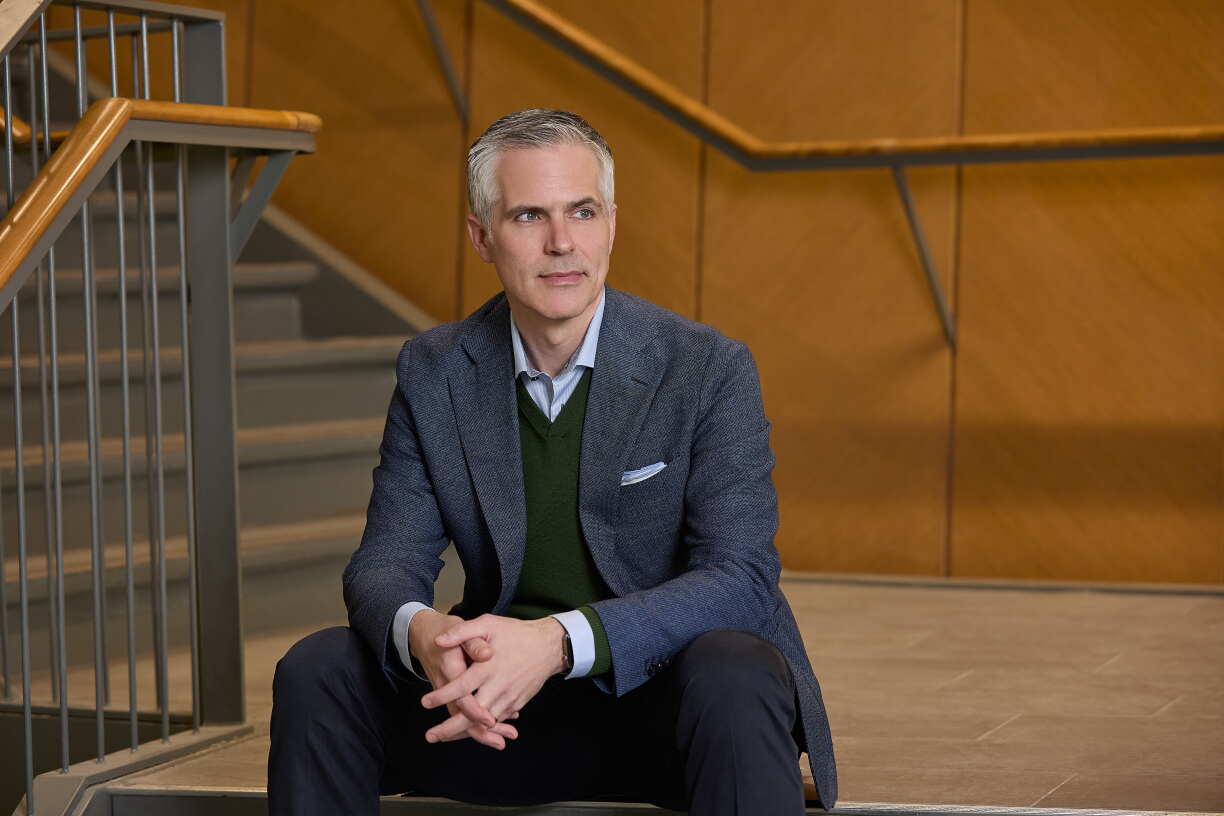
Luxembourg native Patrick Augustin has built an impressive international career in financial research. After starting his professional journey at the Ministry of Foreign Affairs and moving into the private sector, his drive for academic excellence took him abroad, where he pursued further studies and built an international profile.
Augustin completed a doctorate in finance at the Stockholm School of Economics and went on to conduct research at prestigious institutions, including New York University, the University of California, and the University of Sydney.
Reflecting on his career path, Augustin explains that after five years, he decided to pursue an academic career. Unlike in finance or other fields, academia is an international market; you apply globally, and you need to be open and flexible. Ultimately, Augustin was fortunate to have several options and his choice fell on Montreal, which he describes as a rewarding experience for the past 14 years.


He currently serves as Associate Professor of Finance at McGill University in Montreal, where he also holds the prestigious Canada Research Chair in Macrofinance and Derivatives. His research spans financial markets, risk analysis, and sovereign debt, and has been published in leading journals such as the Journal of Finance and the Review of Financial Studies.
Having charted a successful path from Luxembourg to the global stage, Augustin remains one of Luxembourg’s most influential academics in international finance research. He is also director of the McGill Luxembourg Centre for Finance, which serves as a bridge between North America and Europe.
Augustin notes that the beauty of being a university professor is the versatility; the main focus is research, but it also involves teaching and helping to run the university. One of his current projects is expanding McGill’s international footprint in Europe, and through its cooperation with Luxembourg, he is playing an active role in developing these initiatives.
For Augustin, returning to Luxembourg is not simply a career step, but a personal mission. After years abroad, he is bringing his experience and expertise back home, with a clear goal: to elevate finance education in Luxembourg to a new level.
Located in Montreal, McGill University is among North America’s best-known academic institutions, enjoying an international reputation for excellence, particularly in business and finance. McGill is renowned for its rigorous academic standards, international outlook, and strong connections between theory and practice.
With a diverse student body and a dynamic research culture, McGill has established itself as a leading university worldwide, especially in economics and finance.
Through its new initiative in Luxembourg, the university is taking an important step: exporting its expertise and educational model to Europe, building a bridge between global financial markets and academic excellence.


As part of his research, Patrick Augustin collaborated with the Association of the Luxembourg Fund Industry (ALFI) on a study examining the role of pension systems across Europe. The study found that, compared to countries such as Canada or Australia, Europe lags behind in transforming pension savings into productive investments.
A key reason, the study notes, is the structure of the system: in many European countries, including Luxembourg, pensions are based mainly on a pay-as-you-go model, where current contributions are used to fund current pensions, rather than being invested in capital markets.
By contrast, countries with capital-based systems have built up significantly more investment capital over time, which can be channelled into innovation, infrastructure, or businesses, providing a crucial engine for economic growth.
This highlights a central challenge for Europe: how to design future pension systems that not only ensure security for retirees, but also actively contribute to economic development.
More information on the study is available here.
The McGill Luxembourg Centre for Finance, launched by McGill University in partnership with major players from Luxembourg’s financial sector, including the Ministry of Finance, the Luxembourg Bankers’ Association (ABBL), and ALFI, aims to strengthen collaboration between academic research and the financial industry.
The centre’s mission extends far beyond the new master’s programme. In addition to training finance professionals, it serves as a platform for research, exchange, and innovation, allowing new ideas and insights to flow directly into financial sector practice.
It will also function as an international network, linking Luxembourg, Montreal, and other financial centres worldwide, and facilitating the sharing of knowledge and experience on a global scale.
For Luxembourg, this marks another step in developing its financial sector, not just as a strong industry hub, but increasingly as a centre for finance research and talent development.
Since August this year, McGill University has offered its Master of Management in Finance in Luxembourg. Unlike traditional full-time degrees, this is a part-time programme combining online sessions with intensive in-person courses in Luxembourg, usually held in the evenings or at weekends, allowing participants to balance studies with their careers.
The programme is primarily aimed at young professionals with a few years’ experience in finance who wish to deepen their expertise, but is also open to those with backgrounds in other quantitative fields, such as mathematics, engineering, or the natural sciences, who are looking to move into finance.
At the heart of the course is a blend of theory and practical application. Students engage with topics such as capital markets, asset management, private equity, and sustainable finance. A particular highlight is the strong practical orientation: participants have the opportunity to work directly with real investment funds, gaining concrete insights into decision-making processes within the sector.
According to Patrick Augustin, the need for such a programme is clear. Luxembourg is one of Europe’s leading financial centres, but faces a major challenge: competition for talent is becoming increasingly fierce. To stay attractive, investment in infrastructure and economic projects is not enough; targeted investment in talent development is essential to train, and retain, the skilled professionals Luxembourg needs for the long term.
This is where the new master’s comes into play. In contrast to many traditional programmes, McGill’s approach combines theory with practice, offering participants not just an understanding of financial markets, but also hands-on experience of the sector – from risk analysis to investment decisions. The aim is to train a new generation of finance professionals who think globally, not just locally. In an era of growing complexity in financial markets, this is a crucial skill set.
Crucially, the initiative is not just academic, but strategic. It is part of a broader collaboration between Luxembourg and Canada, united by a shared vision of innovation, knowledge, and international exchange. For McGill, this project fits within a wider strategy to expand its international presence and establish new sites. Luxembourg, with its vibrant financial industry and strong European ties, offers ideal conditions for such an expansion.
For Luxembourg, it is an opportunity to develop further, from a leading financial centre to a centre of expertise and education in finance. Demand for specialised skills is especially high in fields such as alternative investments and new financial models. Today, it is no longer enough to simply offer financial services; instead, building the expertise behind them is equally vital. Developing talent has become a decisive factor for the country’s future as a financial hub.
For Patrick Augustin, this is just the beginning. Beyond the master’s programme, the centre will also foster research, host conferences, and launch new initiatives in the finance sector. In the long run, it is about more than education: it is about building networks, fostering exchange, and shaping a new generation of finance professionals.
With these efforts, Luxembourg aims not only to maintain its role as an international financial centre, but to expand it even further.
Full details about the new master’s programme can be found here.





