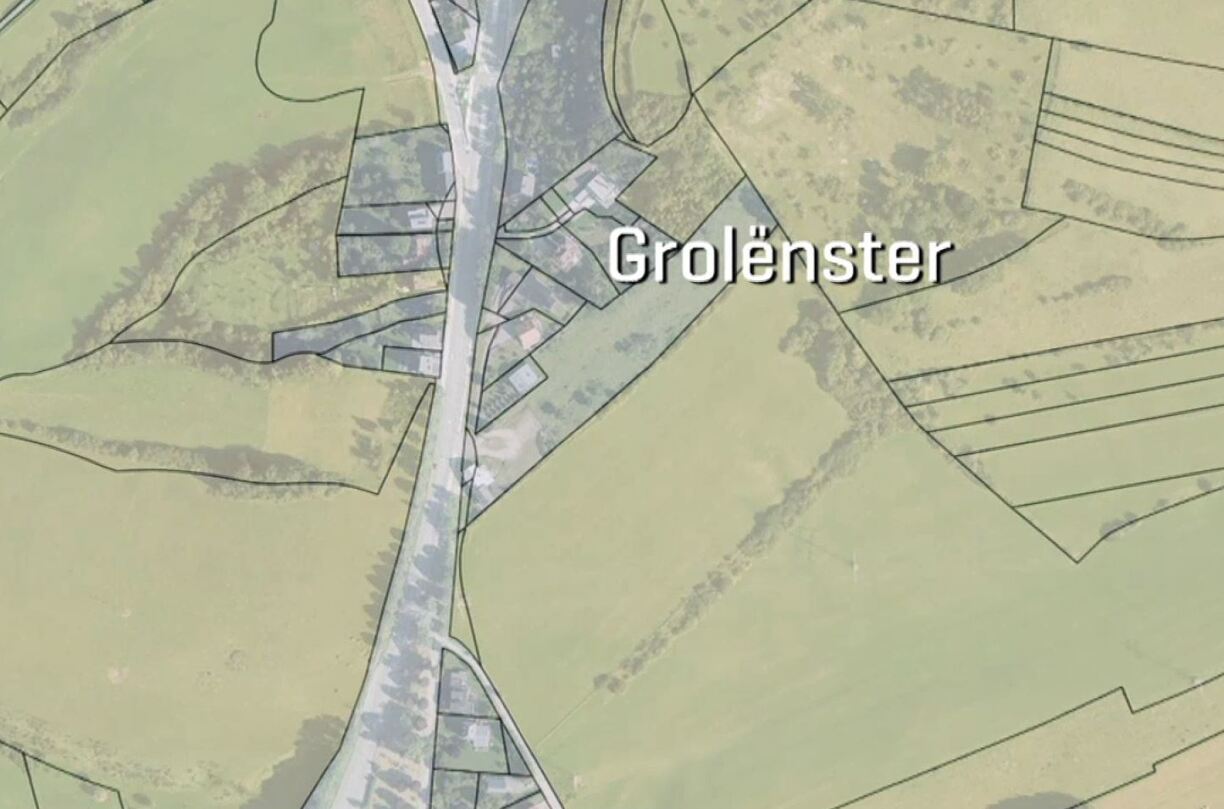
Although the respective land was reclassified in December last year, Graulinster residents still worry about the prospect of noise and waste in their municipality. Most of all, however, they lament that there has been no communication about the progress of the water bottling plant.
Sandra Schengen lives right next to the zone in question. She bought her house four years ago and only learned about the plans for the factory by chance.
In her eyes, many questions surrounding the project remain unanswered: "Where are we in the process? When will the headstone be placed? There simply has to be an exchange to avoid ambiguities for both parties. That is however difficult if there is no platform to conduct such an exchange."
The plant will be located next to the Rue d'Echternach. A private resident who discovered the mineral water source on his land 20 years ago is now finally closer to setting up a plant for commercial sales. However, since the source itself is still located three kilometres away in a Natura 2000 zone, water has to be pumped to a different location.
A maximum of 140 cubic metres of water can be extracted per day, which equals about ten lorry loads every day. However, it looks like it will still take some time before the plant becomes fully operational.
Councilwoman Michèle Goedert from the local Greens' faction commented: "You cannot simply argue that water will be lost if not exploited. There is a natural water cycle that eventually brings it back somehow. It should be kept in the hands of the municipality instead of those of a private citizen."
The politician further shared her view that there is still data missing on the environmental impact of the undertaking.
The owner of the land was unwilling to give an interview. Instead, our colleagues from RTL got to speak to hydrogeologist Badre Boumansour, who has been working for the owner for 20 years. The expert ensured that an exploitation of the water source is not harmful to the environment. He further explained that due to the water's high mineral concentration, it is not adequate to be fed into the municipality's potable water network.
The question around the lack of communication remains. Should the owner have been more transparent? Graulinster Mayor Roman Reitz noted: "I think that there has been communication. A sign was posted and we announced it as mandated by law. At the same time, the owners organised an information meeting at which many people were present."
In mid October, those opposing the mineral water bottling plant will convene for a closed meeting.





