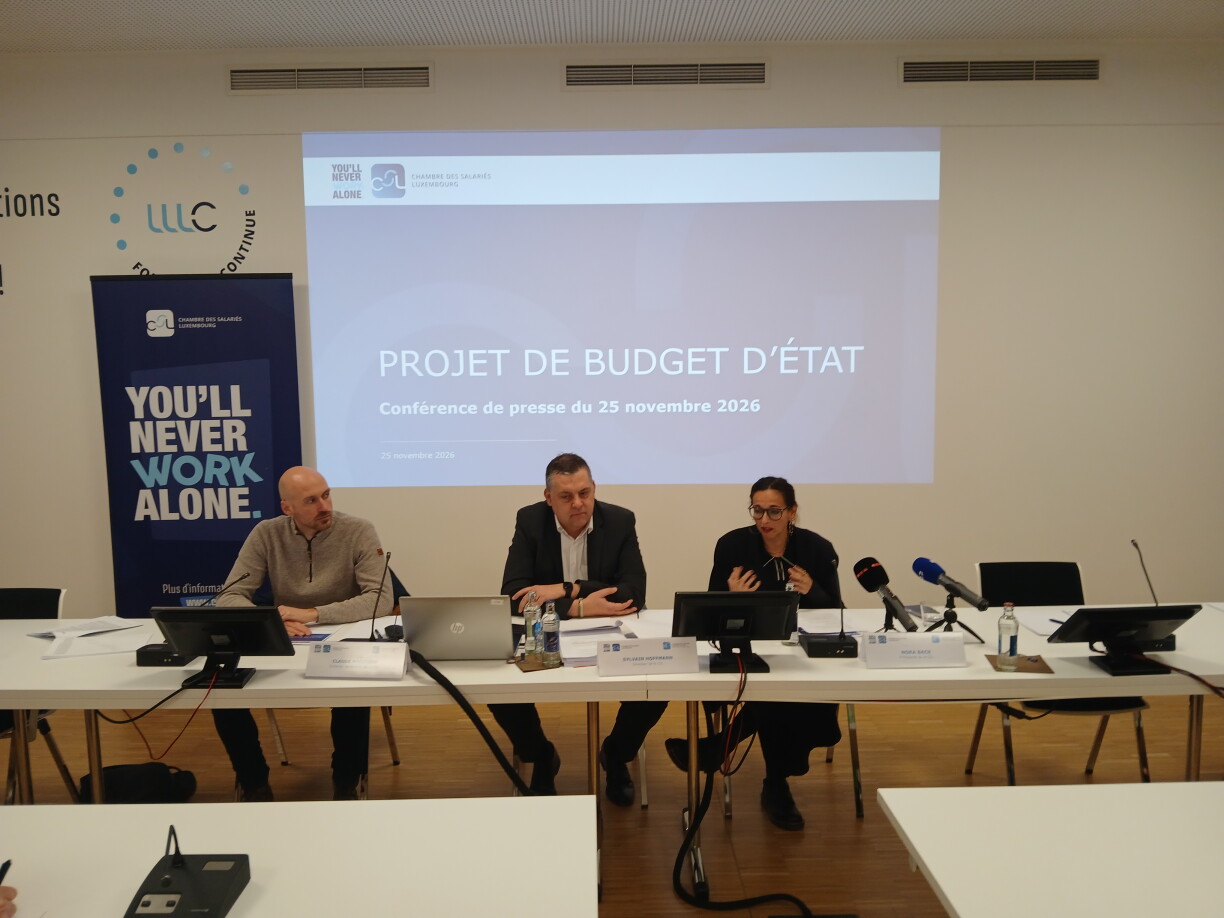
The Chamber of Employees (CSL) has expressed concern that the government is failing to prioritise social justice and urgent challenges in its proposed budget for 2027 and beyond.
In its annual evaluation, the CSL found that not enough funding is allocated to key areas such as housing and environmental protection, especially when compared to the significant sums set aside for defence.
Each year, the CSL analyses whether the government’s budget plan sets the right priorities. While this year's review does not condemn every aspect, it gives an overall assessment of average performance, with clear criticism in specific sectors.
Notably, the CSL considers the draft budget from the Christian Social People’s Party (CSV) and Democratic Party (DP) coalition government inadequate in areas such as social equity. According to the CSL, private individuals are at a disadvantage compared to companies, an ongoing issue that has not been sufficiently addressed.
A review of the accounts revealed that economic growth in 2024 and 2025 was €3bn higher than forecast. However, CSL Director Sylvain Hoffmann highlights that this additional growth was not shared equally.
Hoffmann explains that profits rose by more than €4bn, while employee remuneration lagged by €1.3bn compared to expectations, revealing that the extra growth was poorly distributed. Compared to 2019, before the recent series of crises, companies’ gross operating surplus – that is, their profits – rose by 53%, whereas the total wage bill grew by only 43%.
These findings suggest there is margin for higher wages in the collective agreement negotiations, though it depends on the sector. Banks, in particular, have made exceptionally high profits, largely due to interest margins paid by customers with loans.
Turning to public debt, the CSL notes that while Luxembourg’s debt levels are high by national standards, they remain sustainable. Debt is projected to reach €29.36bn in 2027, amounting to 29.2% of GDP. By 2030, the total is expected to climb to €33.7bn, but this would represent 'only' 28.6% of GDP, an improvement thanks to anticipated GDP growth.
“As with any household, the crucial question is not the absolute amount of debt, but what income you have to service it. If you owe €100,000 but earn €200,000 a year, it’s less problematic than if you earn only €30,000. So public debt must always be viewed in relation to GDP, which represents the country’s overall income.
The CSL welcomes the automatic adjustment of the tax scale to inflation as part of the upcoming tax reform but raises concerns over how this will be implemented.
The CSL warns that the proposed mechanism is somewhat misleading, since it will mean no further tax scale adjustments for four to five years. This is likely to generate significant extra tax revenues via income tax unless further measures are taken. The CSL concludes that, as a result, the imbalance is likely to persist.
The Chamber would have preferred an adjustment with every index-linked salary increase. During consultations ahead of the tax reform, several models for automatic adaptation were discussed, but the CSL considers the chosen mechanism to be the least effective.
CSL President Nora Back criticised the government for what she sees as insufficient investment in housing and environmental protection.
Back argues that the country would have needed a much greater and more sustainable effort to secure the future of its citizens, especially in times of multiple enduring crises. She criticises that major defence investments are made at the expense of other collective priorities that significantly impact future standards of living.