Police seized a staggering seventy pallets’ worth of equipment, including one hundred and ninety loudspeakers, industrial generators, amplifiers, mixing desks, stage elements, lighting, a chemical toilet, and even a foam machine, when they broke up an unauthorised rave on the edge of Heinerscheid at the end of July last year.
The chief commissioner, who led the initial on-site investigation, described it as "a huge operation, unlike anything we’ve ever experienced in the police".
The sheer scale of the logistics forced police to request assistance from the army to transport everything to the impound depot in Sanem.
The first alerts came in on Friday, 25 July, at around 11pm, as local residents noticed a continuous stream of traffic consisting of lorries and vans heading into the forest along Kierchestrooss.
Police responded and found an illegal gathering in a Natura 2000 protected area, also a designated bird sanctuary. Stages, tents, and numerous vehicles had been set up on farmer Bob Simon’s meadow, without his consent.
According to the commissioner, police initially told attendees to disperse. However, the festivities continued through the night, with fireworks set off despite police warnings.
One officer, who happened to own a nearby weekend cottage just 400 metres away, testified that he was unable to sleep due to the noise, a sentiment echoed by another witness four kilometres away.
The owner of a nearby campsite noted that some of the estimated five hundred partygoers crossed her property during the night and used it as a makeshift toilet.
On Saturday morning, police made another attempt to contact the organisers. Yet as four patrol cars approached the meadow, officers found themselves surrounded by revellers.
The officers were verbally abused and had beer thrown at them; some even displayed offensive gestures, according to the chief commissioner.
The atmosphere was openly hostile, with the commissioner reporting that a pig dressed in a police uniform had been displayed as a sign of contempt towards the officers. As they drove away, someone also waved a pirate flag at them.
Given the circumstances, police decided to break up the party. Shortly after 5pm, the special unit used a megaphone to announce in English that the event was unauthorised and explained the potential consequences if attendees did not leave.
Many complied, but not all. Those who remained are now facing court proceedings.
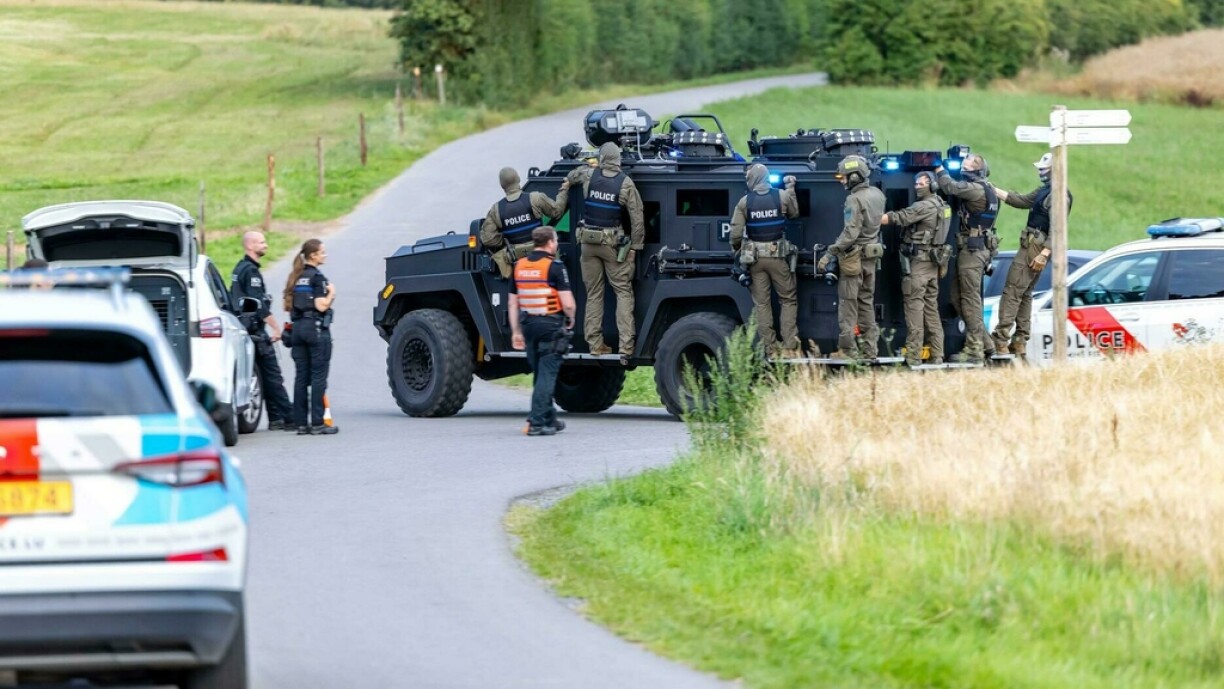
The operation involved twenty-seven patrols mobilised from across the country, with support from the canine unit, the special response unit, public order teams equipped with armoured vehicles, and traffic police.
Around one hundred officers were deployed to manage roughly five hundred ravers. Police also requested backup from German colleagues, including a riot unit and water cannon, in case the situation escalated.
Once the site was cleared, what remained was described as "a massive heap of rubbish". Farmer Simon and a group of volunteers filled a lorry and a van with garbage bags, mattresses, and refrigerators left behind.
The defendants challenged parts of the police account in court, claiming they needed time to pack up after being told to leave.
Others said they were stuck in traffic jams caused by police checkpoints, with one defendant asserting he waited four hours to be checked.
They also disputed that police had made it clear from Friday evening that the party was illegal and that they needed to leave.
Every item seized was meticulously listed in court, with each term translated into Dutch or Flemish for the accused, prolonging the proceedings. The interpreters struggled with technical vocabulary for items such as mixing desks, control panels, cables, and stage components.
The translation difficulties proved exhausting for witnesses and defendants alike. Some complained that misunderstandings arose as a result, despite the judge’s best efforts to keep the atmosphere positive.
The lead police investigator described the ravers as part of the "Free Tekno for Free People" movement, which she said is not only about music but also a political and lifestyle statement.
Entrance is free at such events, with voluntary donations accepted. Parties are organised via chat apps, and coordinates for the secret locations are shared only shortly before the event at so-called checkpoints.
Participants gather around their sound systems, which bear names like 'Sowieso Ungehorsam' ('disobedient anyway') or 'Unbegrenzt' ('unlimited') or are symbolised by a fabric tiger. DJs often remain hidden behind speaker walls while the crowd dances.
These parties are typically held in remote locations; the same group held a similar event at the Upper Sûre lake in August 2024, which passed without police intervention.
However, the investigator noted that choosing remote locations also reflects the group’s separation from mainstream society. Drug use is considered part of the scene, and police are seen as a threat to personal freedom.
Farmer Bob Simon did not hear the noise overnight, as he lives in the adjacent valley, but he spent the weekend cleaning up with twenty volunteers.
He reported finding faeces and metal objects everywhere, which one can’t get out with a metal detector.
He reploughed and replanted parts of the meadow where permitted, but due to the protected status of the area, part of the Natura 2000 network and bordering a national nature reserve and wildlife corridor, he could not treat the entire field. As a result, he suffered a threefold loss of hay production that year.
Over the past fifteen years, one hundred strictly protected animal species and a dozen protected plant species have been recorded at the site, according to Carole Back, head of the mobile unit of the Nature and Forest Agency.
She explained that birds and bats are particularly sensitive to noise and artificial light. In July, fledglings still depend on their parents, so the round-the-clock disturbance could have forced adult birds to abandon nests, leaving chicks to perish.
Bats, which navigate by echolocation, would have been disoriented by the music, while all wildlife would have experienced stress.
Frogs and toads also fail to hear each other’s calls and therefore cannot communicate or find a mate.
The fact that hundreds of people relieved themselves near the watercourse, so close to the River Our, was also problematic. Witnesses told the court the party had "more than a negative impact" on local habitats and wildlife.
The trial is set to continue on Wednesday.