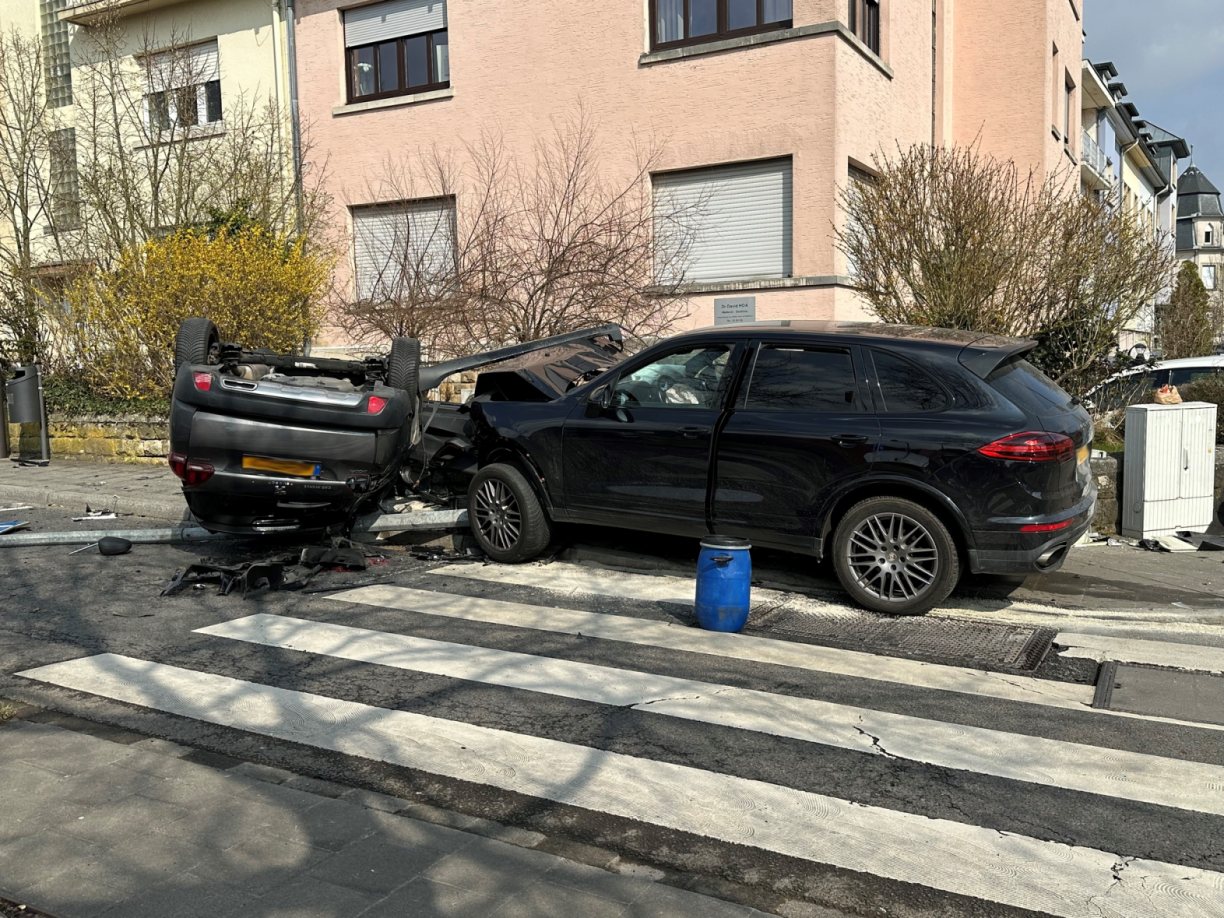
It is often brief, ill-thought-out actions that can turn into questions of life and death. The incident on 14 March of last year was one such case, involving a then-20-year-old student who drove his Porsche Cayenne at nearly 90 km/h through the Limpertsberg district at 12.20pm on a Friday.
All of that took place in a 30 km/h zone, with four schoolmates on board, some of whom were not even wearing seatbelts.
Near Rue Ermesinde, the Porsche collided with a small Peugeot. The woman at the wheel had not seen the young man coming, even though he technically had the right of way.
The impact caused her car to flip over and come to rest on its roof. In a small miracle, no one was seriously injured in the accident itself.
"I was driving a bit too fast", the now 22-year-old student told the judge on Monday morning. He had gone out to grab a bite to eat with four friends during their lunch break that day.
Because the break was so short, they had wanted to hurry back to school. Footage from two surveillance cameras captured the moment of the crash.
In one clip, the car can be seen speeding past a shop. After the accident, when the shop door opens, the loud music playing from the young man's wrecked car can be heard on the recording.
While no one had appeared to be seriously injured at the time of the accident, the woman, now 40, whose car was rammed by the defendant continues to suffer from lasting effects.
She found it difficult to explain quite how the accident had changed so many parts of her life. She had already been living with an autoimmune disease before the crash, but her condition had worsened afterwards, leaving her unable to sit in a chair for eight hours at a stretch, in part because of back pain.
Her life had been turned upside down, her lawyer said, seeking compensation of at least €50,000.
The defendant's lawyer countered that these alleged long-term effects of the accident still needed to be verified medically by an expert. She also pointed out that the victim had failed to yield the right of way to her client.
According to witness testimony, however, the whole incident had unfolded extremely quickly.
After hearing the victim's account, the defendant said he wished to apologise. "Of course, it wasn't intentional", he added, and he had not wanted to hurt anyone.
He had been on his way to school. It had also been his fault. At the request of the public prosecutor's representative, he then repeated the apology in French, looking the victim in the eye as he did so.
The prosecutor described the case as one of exceptional gravity. In Germany, he added, the charge would not have been "involuntary bodily harm" but "attempted murder".
The aim of the proceedings, the prosecutor pointed out, was not merely for the victim to have to face the person responsible for the lasting effects of the incident, but also for the perpetrator to engage in self-reflection and to show real remorse for his actions.
Only a small glimpse of that, in the prosecutor's view, had been on display in court.
It would not be far-fetched to say, he added, that more people could have lost their lives in this incident. At one point, the car had been travelling at 86 km/h, and the impact itself had occurred at a speed of between 80 and 85 km/h.
That, the prosecutor said, was insanity. In his view, the defendant had not sufficiently reflected on what had happened and still did not fully grasp the gravity of the situation.
The prosecution therefore called for a six-month prison sentence, fully suspended, along with a two-year driving ban, part of it also suspended. Confiscation of the vehicle was also requested.
When given the chance to make a final statement, the defendant said he had little left to add on the case. He was now awaiting the judge's verdict.
The judge, for her part, remarked: "When young people are young, they should not have a car that goes that fast." Had it not been possible, he would not have driven so fast, she said.
Parents, she added, were sometimes too lenient with their children in that respect. Many serious accidents, she noted, had been caused by young drivers lacking the necessary experience.
Speed bumps have since been installed on the road where the accident took place.
After the hearing, the defendant's mother also apologised once again to the victim. The verdict in the case is due on 15 October.