
The coldest nights are mostly behind us, but darkness still arrives early enough to make evening observing enjoyable.
In Luxembourg, this is the month when the sky begins to change character. The bright constellations of winter slide slowly westward, while Leo, Virgo, and Boötes take centre stage.
This is the season when the evening sky begins to open out beyond the Milky Way. The bright dust clouds and crowded star fields of our own galaxy slip aside, and the view turns toward a darker, cleaner window into the wider universe.
That is why April is one of the best months of the year for galaxy watching.
April begins under the glow of the Full Moon on the night of 1–2 April, traditionally known as the Pink Moon. The name has nothing to do with its colour; it comes from the early spring flowers that bloom around this time of year.
The Moon's glow will wash out the fainter stars for a few nights, though its presence over Luxembourg’s wooded hills offers a stunning subject for photographers and night-walkers.
Even through the moonlight, Orion is still visible in the west during the early evening, with Betelgeuse glowing reddish above the horizon and Rigel shining below. Nearby, Taurus continues to descend with Aldebaran, while Gemini holds on a little longer with Castor and Pollux still prominent.
It is the last comfortable stretch of the season to enjoy these familiar patterns before they disappear into the western twilight. The planets are quieter now than they were in winter. Jupiter is still visible low in the west, while Venus shines brightly in the evening twilight.
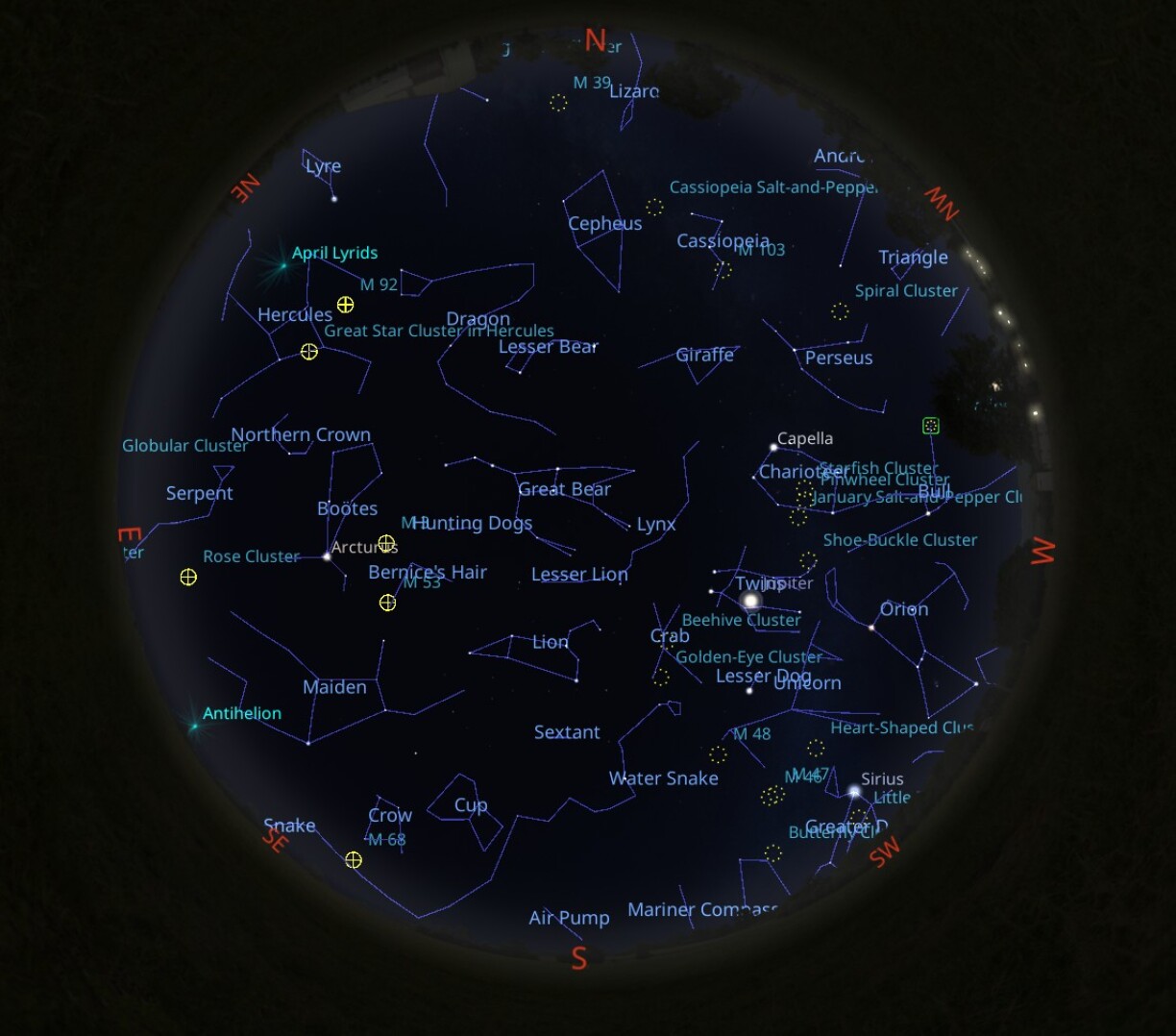
As the Moon wanes, the sky begins to deepen again. The central part of the month brings the darkest evenings, especially around the New Moon on 17 April, making it the best observing window of April.
If the weather cooperates, this is the time to leave the brightest lights behind and head toward darker parts of the country to reconnect with the stars. Now the sky begins to look unmistakably like spring.
Leo stands high in the south, its sickle-shaped head easy to recognise once you know where to look. Farther east, Virgo rises with Spica, while Boötes climbs steadily with the brilliant Arcturus.
As the Moon wanes, fainter deep-sky objects begin to emerge. In Ursa Major, two of the finest targets are M81 and M82, a famous pair of galaxies visible through binoculars under darker skies and more clearly in a small telescope. Both lie millions of light-years away, yet from darker skies in the Oesling region they can still be found with modest equipment.
For casual observers without a telescope, Cancer hosts the Beehive Cluster (M44), one of the easiest and most rewarding deep-sky objects for beginners. Later in the evening, the Great Cluster in Hercules (M13), begins to rise, offering an early glimpse of the richer summer sky still to come.
By the final third of the month, the sky has fully changed character. Ursa Major is high and perfectly placed, Leo now owns the south while Virgo and Boötes grow stronger with each passing night.
Together, the brightest stars of these constellations (Regulus in Leo, Spica in Virgo, and Arcturus in Boötes) form the "Spring Triangle", a celestial asterism that confirms the arrival of the spring skies.
This is when April’s best-known event arrives: the Lyrid meteor shower, active from 16 to 25 April and peaking on the night of 22 April.
The Lyrids are one of the oldest recorded meteor showers in history. They are not usually as abundant as the Perseids or Geminids, but they can still produce a graceful display, especially after midnight, when their radiant in Lyra climbs higher into the sky.
A dark location, a warm coat and patience are all you need to enjoy the show.
Moonlight this year will interfere somewhat, but not enough to spoil the shower entirely. Under a darker Luxembourg sky, it should still be worth stepping outside in the small hours. The planets offer a gentler closing act. Venus is now the most attractive planet in the evening sky, shining brightly in the west after sunset and becoming easier to notice as the month goes on.
Jupiter, by contrast, continues its slow retreat into twilight. It remains visible, but its season is clearly ending.
April is a transition month, and that is exactly what makes it interesting. Winter’s best-known constellations are on their way out, spring patterns are taking over, and the night sky begins to reveal some of its most distant objects.
For observers in Luxembourg, it is one of the best times to step outside and see the season shift above our head.





