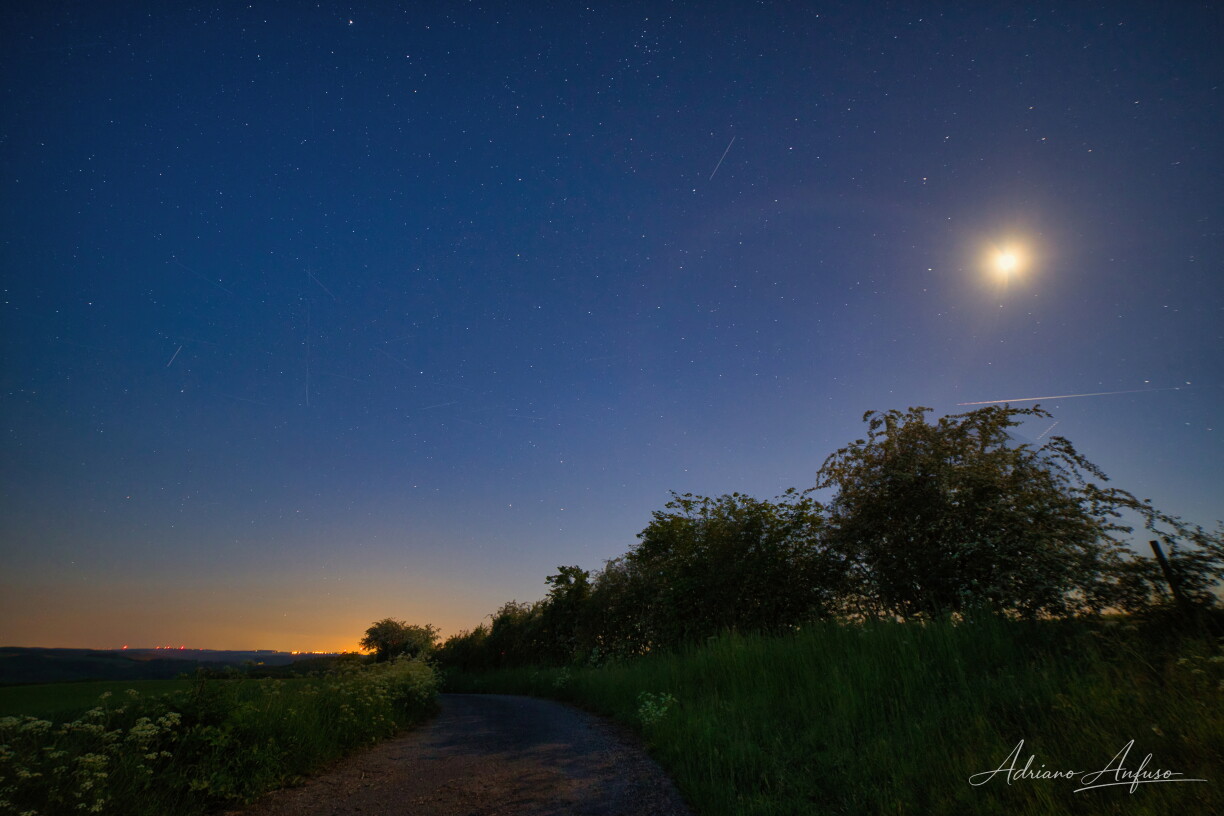
True astronomical night disappears, leaving the Grand Duchy under pale horizons and brief observing windows that reward timing more than patience. Even so, June still has plenty to offer, including a bright planetary meeting, a useful New Moon window and the first clear signs of the summer sky.
June begins with one of the month's most elegant naked-eye sights as Venus and Jupiter come within roughly 1.5 degrees of each other in the evening twilight. The two planets are among the brightest objects in the sky, clearly visible even in June's pale evenings.
Their closest apparent meeting comes around 8–9 June, roughly 30–45 minutes after sunset, when the sky is still glowing but the planets have already begun to shine through.
The pair will be low, so timing matters. Wait too long and they may sink into the haze near the horizon. Binoculars can help, especially if the twilight is bright or the air is not perfectly clear, but this is mostly a simple visual event.
The Moon reaches last quarter on 8 June, so it will not dominate the early evening sky. That leaves Venus and Jupiter to give the month its opening act: bright, brief and beautifully placed in the fading light.
The middle of June brings the best observing conditions of the month, although "best" needs to be understood in a summer sense. The New Moon falls on 15 June, removing lunar glare from the sky. This is the best time to enjoy the brighter stars of early summer. Vega begins to dominate the eastern sky, soon joined by Deneb and Altair to form the Summer Triangle.
This large pattern is one of the most useful guides of the season, and later in summer it becomes an easy signpost for finding the Milky Way. Beyond its usefulness as a seasonal guide, the Summer Triangle also carries one of the sky’s most beautiful traditional stories.
In East Asian tradition, Vega and Altair are two lovers separated by the Milky Way, imagined as a great river of stars. After falling in love, they neglect their duties and are placed on opposite sides of the river, close enough to see each other but unable to meet. Once a year, the story says, magpies form a bridge across the Milky Way so the lovers can be reunited.
Finally, around 17 June, the young crescent Moon returns to the evening sky and passes close to the same western planets that opened the month. This should create another beautiful twilight scene, especially if earthshine is visible on the dark part of the Moon.
The final third of the month belongs to the summer solstice. On 21 June, the Sun reaches its highest point in the yearly cycle for the Northern Hemisphere. This marks the longest day and the shortest night of the year. After this point, the nights slowly begin to grow longer again.
Late June also brings the June Bootids, a meteor shower known more for its unpredictability than for its reliability. Some years it produces very little; in rare cases it can become more active.
This year, expectations should remain modest, especially with the Moon growing brighter toward the end of the month. Even so, spending a summer night outside, looking up at the sky, is rarely wasted.
The Full Moon arrives on 30 June and is traditionally known as the Strawberry Moon, a name linked to the time of year when wild strawberries ripen and are ready to be harvested.
June may not offer the dark, deep skies of winter or spring, but it has a character all its own. It is a month of twilight planets, bright stars, short nights and careful timing.
The darkness holds back, but the sky still has something to say.
Moon phases: Last quarter on 8 June; New Moon on 15 June; first quarter on 22 June; Full Moon on 30 June
Best naked-eye event: Venus and Jupiter close together in the western evening twilight around 8–9 June
Main constellations: Boötes, Virgo, Hercules, Lyra, Cygnus, Aquila
Seasonal highlight: Summer solstice on 21 June
Wild card: June Bootids meteor shower around 27 June





