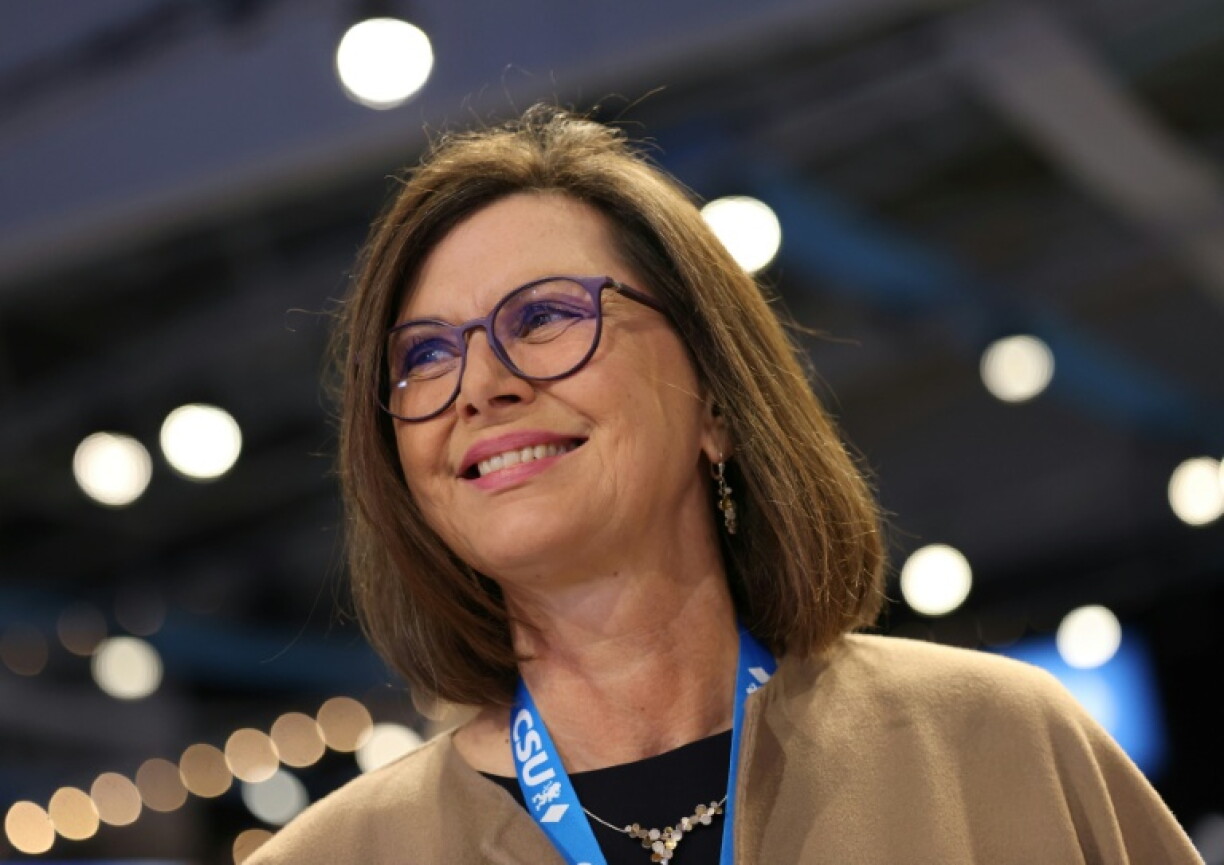
Bavarian politician Ilse Aigner is expected to become Germany's next president in 2027, the first woman to serve as its head of state, conservative ruling party sources said Friday.
Aigner, 61, now the speaker of the southern state's regional assembly, would replace outgoing President Frank-Walter Steinmeier, a Social Democrat, in the largely ceremonial post.
Steinmeier, who took office in 2017, will reach the limit of two five-year terms in March 2027.
Aigner belongs to the CSU, the Bavarian sister party of the centre-right CDU of Chancellor Friedrich Merz, who is supporting the choice of Aigner, the party sources told AFP.
If her nomination is confirmed at a CDU/CSU meeting on Monday, she would be all but certain to be formally elected on January 30 by both houses of parliament and civil society representatives.
Aigner's political appeal owes much to a trademark Bavarian warmth, and her appearances in a traditional dirndl dress at beer festivals have made her a familiar figure across the state.
Supporters see her consensual approach as an asset in an increasingly polarised country, where the far-right, anti-immigration and pro-Russian AfD party has reached record levels of popularity.
In a recent speech, Aigner called for a "reconciled society", which could provide a guiding theme for a presidential role.
Germany's president is meant to stand above day-to-day party politics and represent the country at home and abroad.
Aigner was born on December 7, 1964 near Rosenheim in Upper Bavaria.
In her youth, she suffered from cancer and had to have a tumour removed from her back.
She trained as a radio and television technician before qualifying as an electrical engineer. From 1990 to 1994, she worked on electrical systems for helicopters at Eurocopter.
Aigner entered politics in 1990, serving on municipal and district councils before joining the Bavarian state parliament in 1994.
In 1998, she moved to the national parliament in Berlin, staying for 15 years and serving as agriculture and consumer protection minister under then chancellor Angela Merkel.
She returned to Bavaria in 2013 at the request of then state premier Horst Seehofer, serving as his deputy premier and economy minister, before briefly taking charge of housing, construction and transport.
Since 2018, Aigner has presided over Bavaria's state parliament, where her handling of AfD lawmakers has been praised as firm but fair.
Aigner herself has steered clear of open power struggles.
"I'm not someone who cuts others down," she told news weekly Die Zeit. "I don't have the killer instinct."
ran-vbw/fz/jhb