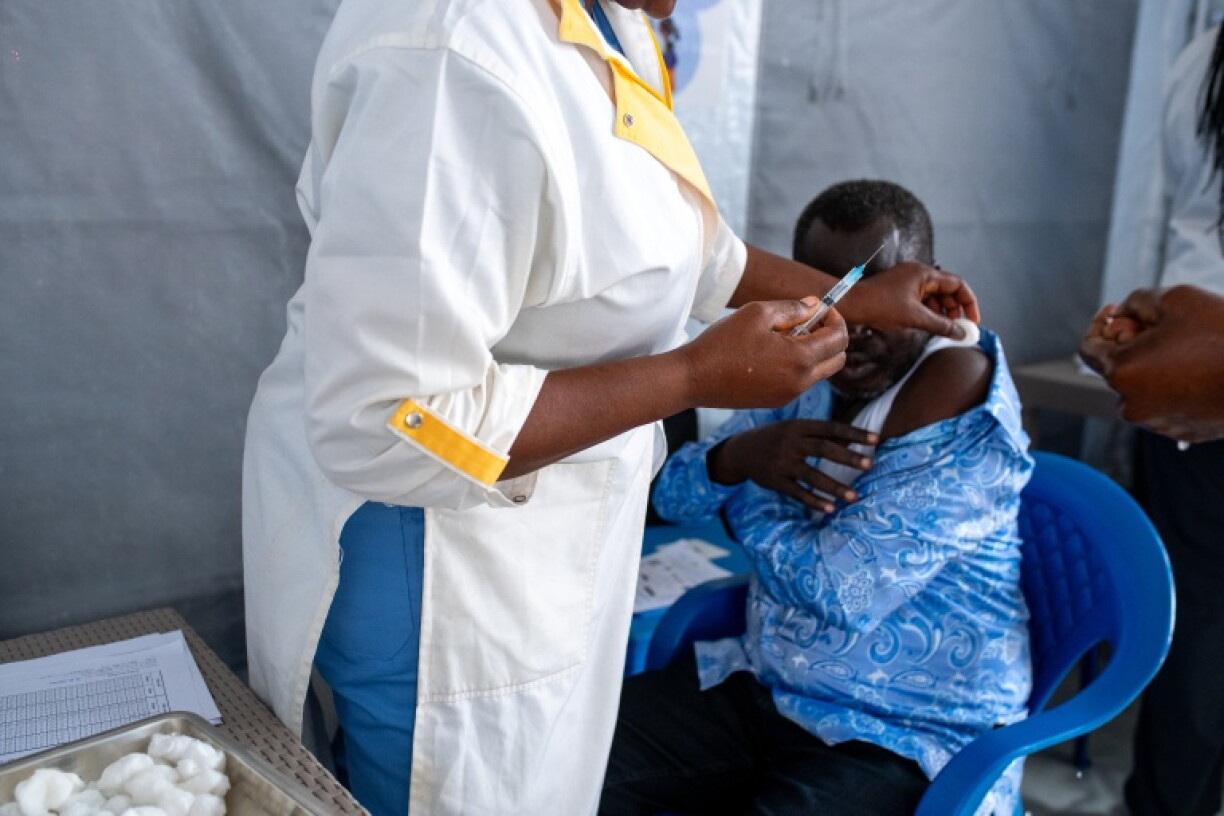
Three major challenges are hampering efforts to quell the deadliest Ebola outbreak in the Democratic Republic of the Congo's history, the head of emergency logistics at the NGO Handicap International told AFP.
While reaching remote areas within the thick tropical rainforest is tough enough, the DRC's chronic insecurity and a distrust of the authorities have complicated the response to an outbreak that has killed more than 5,500 people to date.
Handicap International is a key supplier of medicines, protective equipment and sanitary supplies with three decades of experience in the eastern DRC.
Jerome Bertrand, who heads the France-based group's emergency deployments, has recently returned from the eastern province of Ituri, where the DRC's 17th outbreak of the deadly virus was first declared half a year ago.
Scattered Ebola outbreaks in often impenetrable jungle have since spread to eight of the vast central African country's provinces and "created small epicentres in very remote areas", Bertrand explained.
"We are seeing 500 new cases a week," he added.
The World Health Organization has begun trialling two new vaccines against the less common Bundibugyo species of Ebola behind the latest epidemic.
But getting them to the front line will take weeks.
"If they prove successful, we will have to transport them on a massive scale in refrigerated vehicles without breaking the cold chain, right into areas with absolutely no electricity," said Bertrand.
"A convoy can take up to two to four weeks to travel because of crevasses and bogs in the rainy season," he added -- not to mention the "collapsed bridges" in a region criss-crossed by rivers and streams.
The second challenge is safety in a region long plagued by conflict between the army and a multitude of armed groups and local militias.
Since the outbreak was declared in May, "80 security incidents targeting healthcare staff have been recorded, resulting in deaths", said Bertrand.
Handicap International employs more than 130 people, mainly locals, to help navigate that challenging environment.
For Bertrand, "under no circumstances will we be armed, nor accompanied by Congolese soldiers or any armed group".
But the NGO has "contacts with nearly every armed group", he said, which helps "pass through the many checkpoints".
Not, however, with the Allied Democratic Forces, a notorious militia allied to the Islamic State group which has killed at least 110 civilians in Ituri province since the beginning of November.
On top of that is the further headache posed by the mistrust -- or even resistance -- by some communities towards humanitarian groups and the authorities, given the long absence of the Congolese state from many remote areas in the conflict-riven east.
That has made some locals unwilling to take the advice of aid workers on how to protect against a disease spread by contact with infected bodily fluids, Bertrand warned.
"For some people, it's just like with Covid elsewhere: the same rumours and conspiracy theories, such as 'There was no Ebola before the humanitarian organisations or the government arrived'," he added.
"It's perfectly understandable; we're dealing with customs and what is sacred. Take funerals, for example: we're asking them to radically change the way they say goodbye to their deceased, as they wash and then keep vigil over the dead, sometimes for several days, whilst touching them.
"Yet Ebola is most contagious once the person has died.
"We must educate families on how to hold dignified yet safe funerals."
gir/mba/cw/sbk