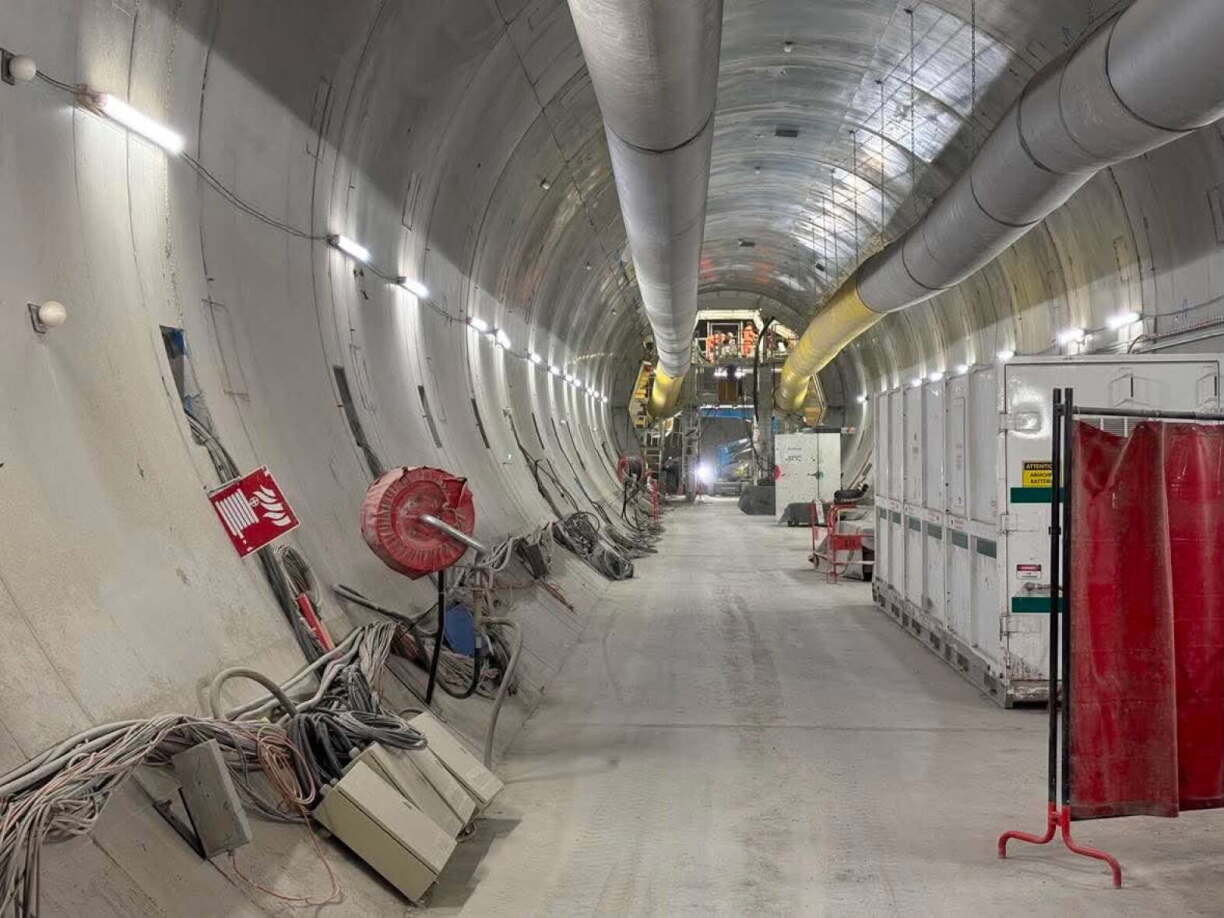
The facility is located in the rural Meuse region, far from populated areas and close to the Haute-Marne border. Its remote location was not the main reason for its selection, but rather its geology.
Around 500 metres beneath the surface lies a thick layer of clay that formed around 160 million years ago. This rock formation has remained remarkably stable for millions of years and is highly impermeable, making it particularly well suited to long-term underground storage.
The underground laboratory, a unique scientific facility designed to support the development of the Cigéo project, was built here.
Despite its 2.5 kilometres of tunnels, the laboratory itself will never house radioactive waste. Instead, it serves as a research centre where scientists can study and measure the properties of the Callovo-Oxfordian clay formation in its natural environment.


The underground laboratory is used to develop and test the engineering techniques required for excavating and supporting the future repository. In preparation for the first construction phase, France's National Radioactive Waste Management Agency (Andra) is constructing and testing structures in the laboratory that closely resemble those planned for the Cigéo facility.
However, it is not expected that any radioactive waste will be stored at Bure before 2050.
Once all the necessary approvals have been received, the Cigéo project will begin the permanent disposal of France's most hazardous radioactive waste at a depth of around 500 metres.
The repository is intended to house waste generated by reprocessing spent fuel from the country's nuclear power plants.
In total, the site is designed to hold 83,000 cubic metres of radioactive waste, which is roughly equivalent to the volume of 33 Olympic-sized swimming pools.
This includes 10,000 cubic metres of high-level waste and 73,000 cubic metres of long-lived intermediate-level waste that can remain radioactive for up to 100,000 years.
The repository is designed to isolate highly radioactive waste in deep clay for tens of thousands of years. The formation's stability and low permeability are key safety features of the project.
Patrice Torres, Industrial Director at France's National Radioactive Waste Management Agency, says that, currently, deep geological disposal is the most reliable long-term solution for managing high-level radioactive waste.
He argues that storing the waste deep underground provides passive safety, sparing future generations the cost of infrastructure and ongoing management.
The planned facility will comprise around 250 kilometres of underground tunnels and galleries. The project is expected to cost more than €33 billion, which will be financed by France's nuclear waste producers, including EDF, Orano, and the French Alternative Energies and Atomic Energy Commission (CEA).
Beyond its technical and scientific aspects, the Cigéo project has become a focal point in the debate about nuclear energy in France.
Since the early 2000s, the town of Bure has faced sustained opposition from local residents, activist groups, and environmental organisations, who see the project as an irreversible commitment with consequences that will affect future generations.
One such critic is the Collective Against the Burial of Radioactive Waste (Cedra), which questions whether safety models can reliably predict the behaviour of a geological repository over such immense timescales.
Opposition to the project extends well beyond the local level. During a demonstration in Bure last September, Green Party lawmaker Sandrine Rousseau criticised the overly optimistic faith placed in humanity's ability to control and manage the long-term consequences of nuclear technology.
She argued that burying radioactive waste underground risks making the problem invisible rather than fully addressing its implications, particularly since some of the materials involved will remain hazardous for up to 100,000 years.
Roger Spautz, Greenpeace Luxembourg's nuclear policy specialist, has also raised concerns about the project's long-term reliability and irreversible nature.
While he does not consider the repository itself to pose a direct threat to Luxembourg, he highlights the scale of the transportation operation required to supply the site.
According to Spautz, between 70,000 and 80,000 shipments would be needed to transport highly radioactive waste from France's La Hague reprocessing facilities to Bure.
In his view, the possibility of an accident during transportation that could release radioactive material can never be entirely eliminated.
Critics are questioning whether local communities have genuinely consented to the project. While some local officials support Cigéo for its potential economic benefits, opponents argue that the region is being asked to bear an unfair share of the burden for the rest of the country.
Meanwhile, supporters point to the project's economic benefits. Cigéo is expected to create over 3,000 direct and indirect jobs in an area that has experienced decades of industrial decline.
However, for many residents, the development remains controversial, with some describing the region as a 'sacrificial territory' chosen to bear the long-term consequences of France's nuclear waste.
Cigéo is part of France’s wider nuclear strategy. The government is promoting a revival of nuclear energy to meet climate objectives, but the long-term management of radioactive waste remains politically and socially sensitive.
Although the project has already passed several administrative milestones, it still depends on key approvals, including a declaration of public utility and a construction permit. Environmental groups have challenged it multiple times, contributing to delays in the overall timetable.
In May, Cigéo entered a major new phase with the launch of a public inquiry. Thousands of pages of documents prepared by France’s National Radioactive Waste Management Agency have been made available in town halls in affected municipalities, and residents there have until 2 July to submit comments or questions.
Neighbouring countries have also been notified. So far, only Luxembourg has formally requested to be kept informed about the process.
At the centre of the controversy is a basic question: what should be done with high-level nuclear waste in the long term? According to France’s National Radioactive Waste Management Agency, more than half of the waste destined for storage in the Meuse region has already been produced, and current surface storage solutions are considered to be no safer than burying the waste 500 metres underground.
Some in the scientific community currently believe that deep geological disposal is the most reliable way to keep radioactive waste away from human activity and environmental hazards.
The clay formation at Bure is believed to significantly limit the spread of radionuclides over long periods, and Andra’s studies suggest that the site has remained stable for over one million years.
However, other experts argue that further research is needed into alternative approaches, such as reducing the radiotoxicity of waste or developing controlled near-surface storage solutions.
Ultimately, the Cigéo project reflects the broader dilemma of the energy transition: how to meet present-day energy needs while taking responsibility for consequences that extend far into the future.
In Bure, beneath layers of clay, decisions are being made that will have consequences lasting well beyond human timescales.





