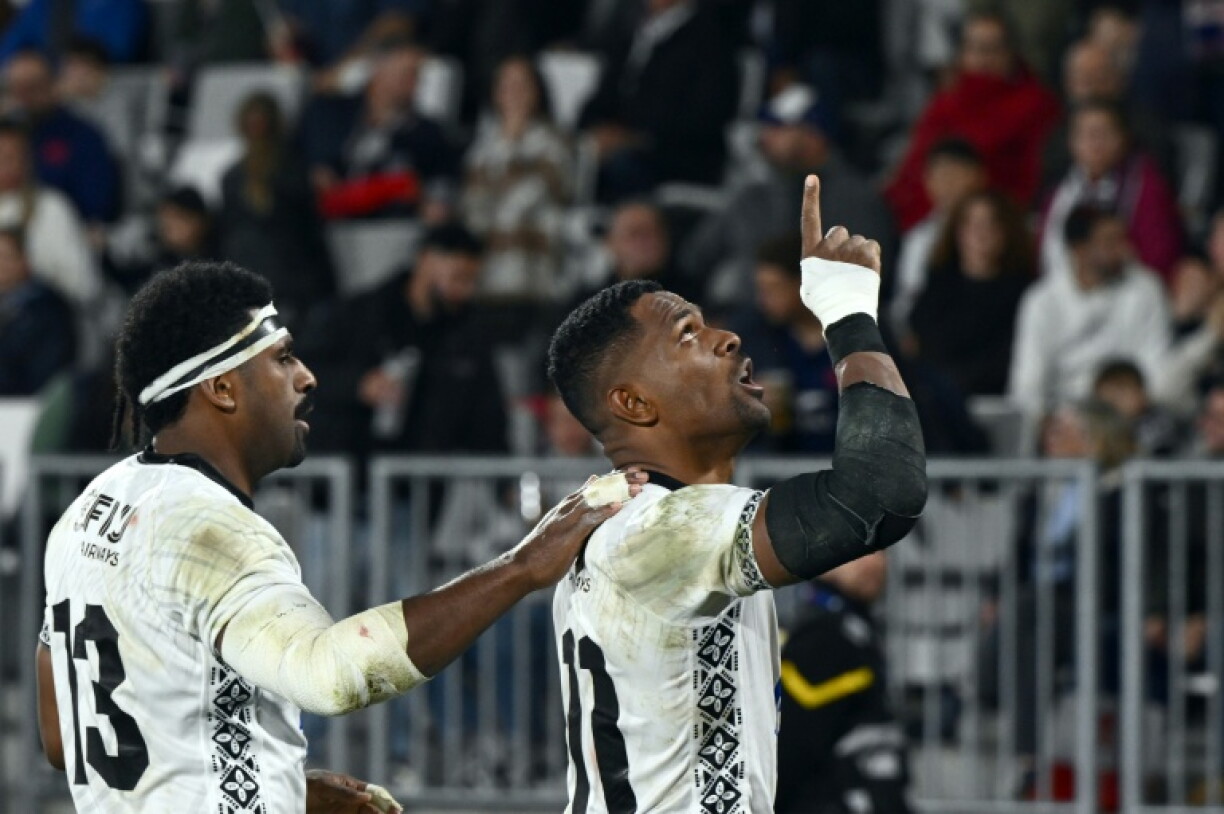
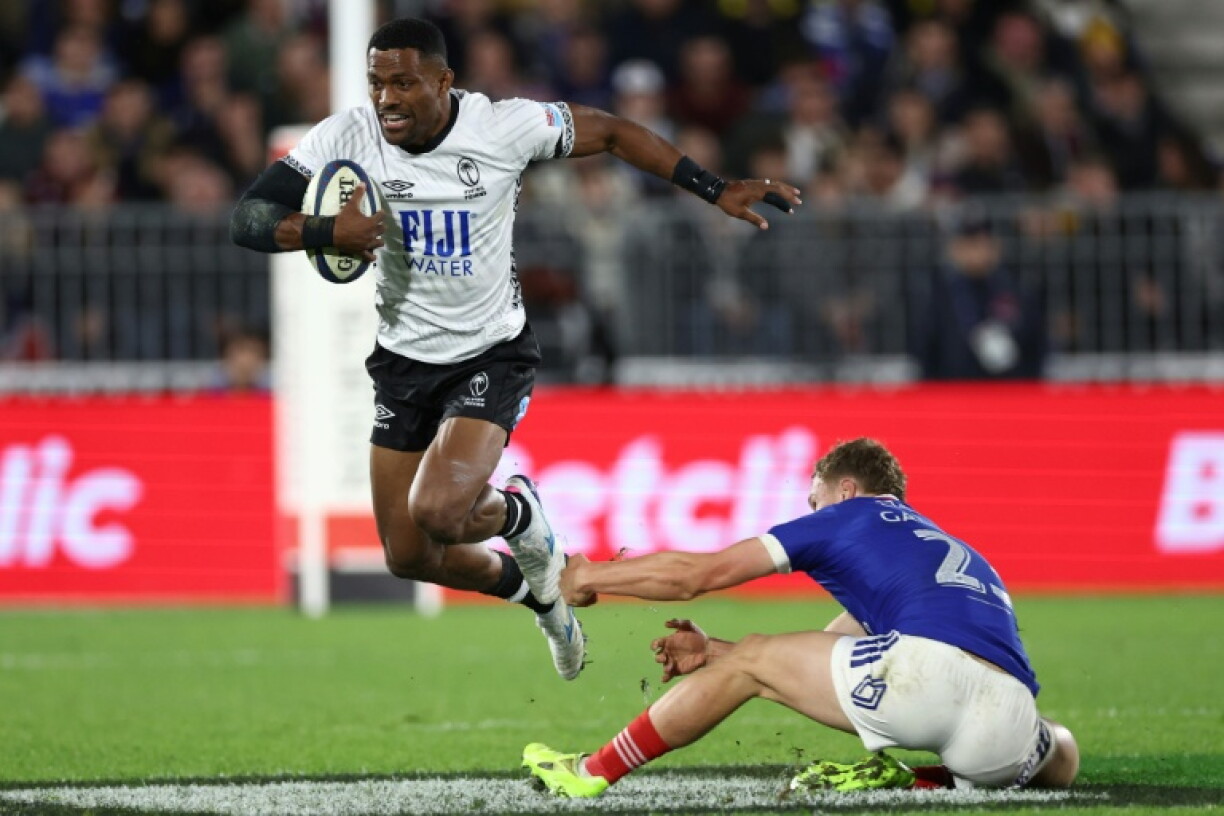
Lethal Fiji winger Jiuta Wainiqolo will test himself against another of world rugby's finest finishers on Saturday when he faces France's Louis Bielle-Biarrey in the Nations Championship.
Wainiqolo was last season's leading try-scorer in the French Top 14 with 18 touchdowns for Lyon, while Bielle-Biarrey, in his distinctive red scrumcap, has notched up 29 tries in 28 Les Bleus appearances.
The Pacific Islander has some way to go to match either Bielle-Biarrey's exploits on the international scene or his club rugby success with two-time Champions Cup winners Bordeaux-Begles.
But instinctive runner Wainiqolo has been French domestic rugby's most dangerous attacker since joining Lyon in 2025.
"He's quicker (than me)," Wainiqolo, 27, joked to AFP by telephone.
"He plays in a good team, that helps him. Everyone is good around him, it makes things easy for him."
Wainiqolo's path to becoming one of the most potent wingers in the game began as he grew up in Navua, 37km down the coast from the Fijian capital Suva on the shores of the Pacific Ocean.
As a child he idolised Fiji greats like Waisale Serevi, Vilimoni Delasau, William Ryder and Semi Radradra, watching DVDs of his heroes before pretending to be them while playing with his friends.
"We always waited at the beach for all of our friends to come," the infectiously positive Wainiqolo said.
"We'd make a team from those players.
"It was so fun just playing at the beach until one of our brothers or sister came with a stick to stop us playing as it was getting dark," he added.
As a teenager, Wainiqolo watched on television as Fiji's men claimed gold at the 2016 Olympics.
Five years later, at the covid-delayed Tokyo Games, Wainiqolo helped the spiritual home of seven-a-side rugby defend their crown, crossing for five tries.
"When I was at the Olympic village on the day of the final, it was early in the morning, I went for a walk near a lake," Wainiqolo said.
"It had a small park, I was just sitting there, just thinking how far I've come, all the hard work to get there.
"I couldn't believe it was coming true for me.
"I was just crying alone in the park, it was so very emotional before the final, I was so happy."
Wainiqolo's performances in Japan helped him earn a contract with Toulon, and he moved to the Cote d'Azur months after the Games.
He scored 37 tries in 87 club appearances during four campaigns at the Stade Mayol, and made the first of his 22 Test appearances before the move to Lyon.
"My first year (in France) was a bit hard because I lost my dad," he said.
"I didn't know it would be the last time I saw him when he dropped me at the airport.
"It was very hard for me because he was a big supporter for me, a big motivation.
"I wanted him to see how far I'd go."
At Test level, Wainiqolo faces stiff competition for a starting berth with Fiji's production line creating a seemingly unlimited number of lethal backs.
By next year's Rugby World Cup, joining the likes of Wainiqolo, Josua Tuisova and Salesi Rayasi could be Australia winger Mark Nawaqanitawase.
The former NRL star has the option of representing Fiji, the Wallabies or even Italy.
"Hopefully Mark will join us," Wainiqolo said.
"I sent him a message and he just replied giving me the 'eyes' emoji.
"I said 'bro come on man'."
This weekend's game in Lyon will be Wainiqolo's first appearance under new Fiji head coach Jake White, who led South Africa to success at the 2007 World Cup.
White began his tenure with a statement 34-28 win over Japan on October 24, although Wainiqolo was unavailable due to his club commitments.
iwd/bc