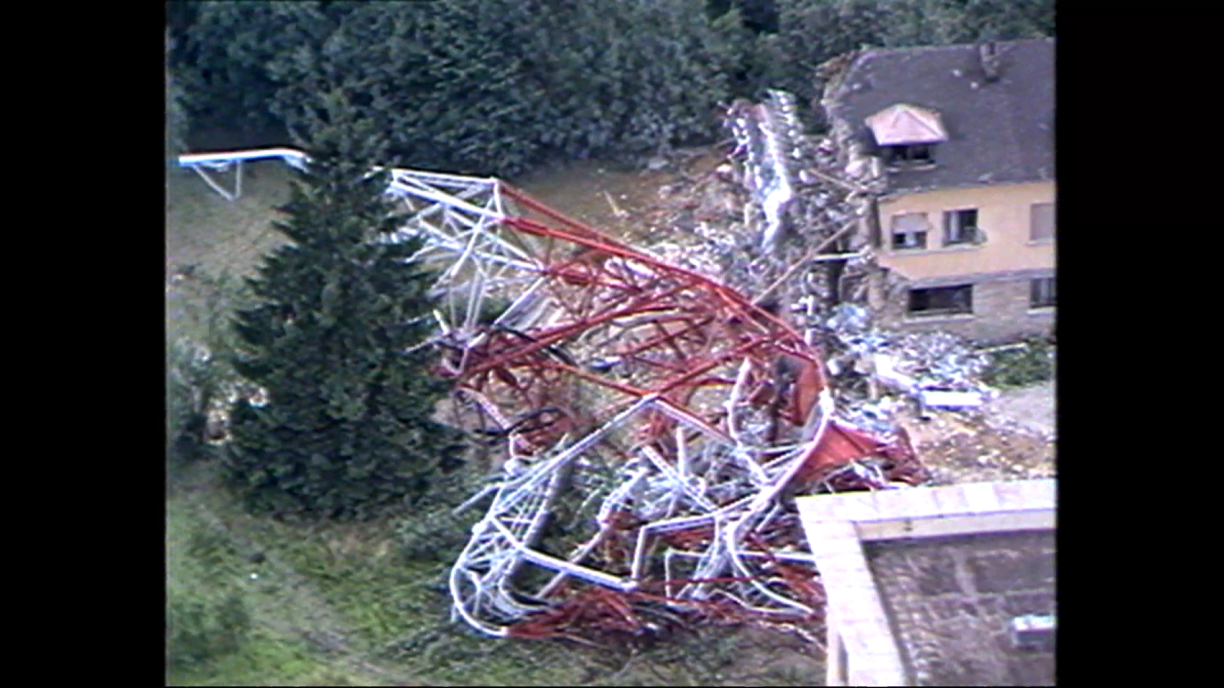
It was a dark day in the history of European television. On Friday, 31 July 1981, shortly before 2pm, a Belgian Air Force fighter jet collided directly with the Télé-Luxembourg transmission mast atop Ginzebierg in Dudelange.
The violent impact caused the near-300-metre tower to collapse, resulting in three deaths and plunging the station's broadcast signal into silence.
The catastrophe claimed the lives of the jet's pilot, as well as RTL technician Paul Wantz and his wife Marianne. As the 22-tonne steel structure fell, it destroyed technical buildings below and crushed the nearby house of Wantz and his wife.
The crash also unleashed a massive plume of smoke, visible for kilometres around. Wreckage from both the aircraft and the transmission tower was scattered across a wide area, with debris even reaching as far as the Arbed industrial complex in Dudelange.
The sudden blackout of television screens was the first clue to millions households that something was wrong. Télé-Luxembourg's signal, which served viewers across Luxembourg, eastern France, and Belgium, was instantly cut off and regular RTL programmes abruptly disappeared, replaced by a test pattern.
A race against time ensued to restore broadcasts. Thanks to swift cooperation from French and Belgian technical networks, and the rapid installation of a temporary antenna, Télé-Luxembourg managed to resume part of its programming as early as the following day.