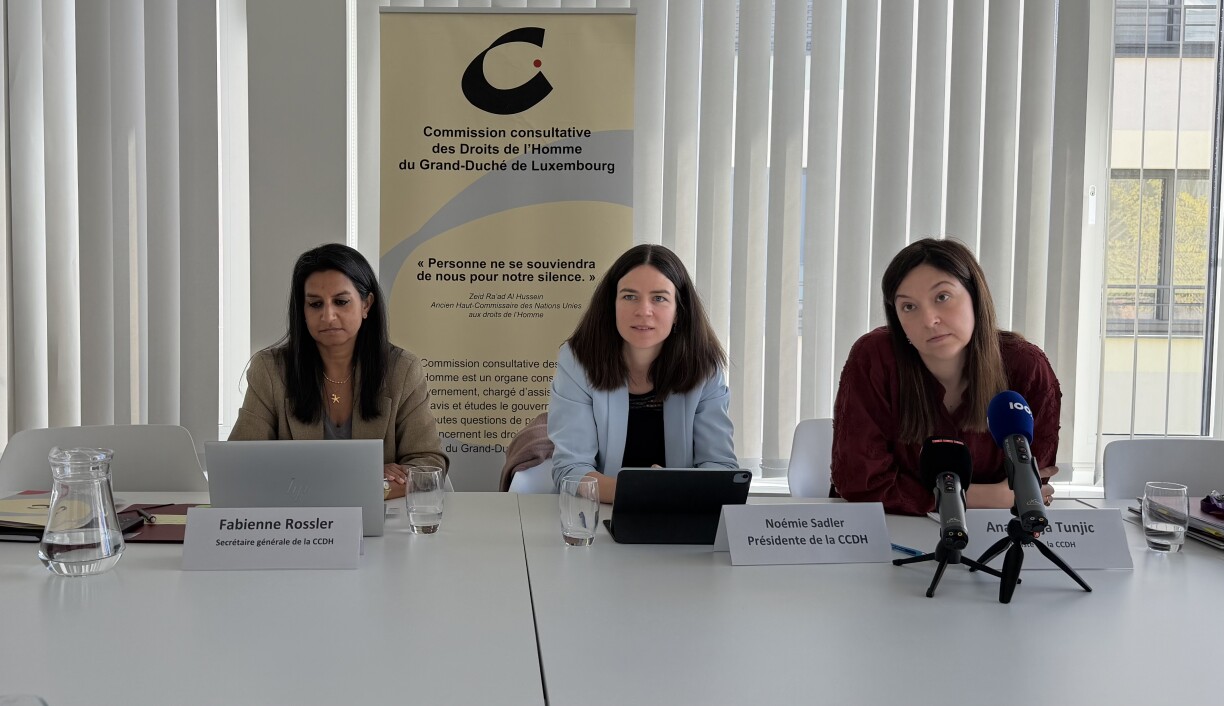
The Consultative Human Rights Commission (CCDH) has once again expressed disappointment with the government's approach to the planned Juvenile Justice Act.
The legislative text has been amended following formal opposition from the Council of State. However, according to the CCDH, the revisions have resulted in a watered-down version of what was already a weak text.
Nevertheless, the Commission welcomes the fact that Luxembourg will finally have an official law on juvenile justice and protection after years of stagnation. The CCDH has long argued that young offenders should not be sentenced and punished as adults. Despite this progress, Commission president Noémie Sadler remains dissatisfied with the work done to establish the Act.
Sadler stated that the amendments clearly ignore all recommendations from the CCDH and other children's rights defenders, such as the Ombudsman for Children's Rights (OKAJU). Instead, she noted, the revisions limit themselves to responding to formal opposition from the Council of State and justice authorities.
According to the CCDH, certain problematic elements have been retained or even made more restrictive – including the age at which a young offender may be prosecuted.
CCDH lawyer Anamarija Tunjic said that setting the age of criminal responsibility at 14 would represent a significant step forward compared to the current standard, and that the Commission welcomed this possibility.
However, she lamented that three years ago, the government lowered the proposed age to 13 without basing the decision on scientific or criminological data. Under the new amendments, Tunjic criticised, the government is retaining that lower age.
The CCDH argues that scientific evidence indicates criminal prosecution only makes sense from the age of 14 onward. The Commission took even greater issue with a previous provision allowing 18- to 21-year-olds to be prosecuted as adolescents, and it welcomed the fact that the amendments completely removed this exception following criticism from the Council of State.
However, the CCDH pointed out that those criticisms could have been addressed by revising the text for clarity, given that the main issue was insufficiently clear wording.
While the CCDH points to several additional examples, the Commission believes the main point is clear: the bill, after amendments, has once again been slightly watered down.
CCDH lawyer Anamarija Tunjic offered a perspective on where this approach may originate, criticising what she described as the "generally negative image" of children and adolescents being propagated in Luxembourg. She noted that young people are often portrayed as dangerous and criminal, requiring a firm crackdown through a range of repressive measures.
The CCDH has faced criticism for similar statements in the past. Detractors typically ask whether protection should not be granted to victims instead of perpetrators.
In response, CCDH President Noémie Sadler stated that one must not look away when young people behave violently. She also rejected the accusation that the Commission is advocating for "coddling" adolescents who commit crimes.
Instead, she stressed that "adapted sentences" must be found, asking what purpose would be served by incarcerating a 13-year-old. She added that numerous international experts agree on the need for a different approach.
According to the CCDH, no minor would be sent to prison in an ideal world. The Commission advocates for prevention and, when a crime does occur, for help and support as the preferable solution. If prison is to be considered at all, it must be a youth prison rather than an adult penitentiary, the CCDH stressed, noting that the new bill does provide for this.
However, Tunjic once again pointed to an exception: during the construction of the penitentiary centre for minors, children could still be sent to the adult prison in Schrassig.
The CCDH is calling for an interim solution to be implemented as soon as possible. The Commission is not putting forward its own proposals on this point, noting that this is the task of politicians – who, the CCDH observes, have so far generally not decided in line with the human rights commission.