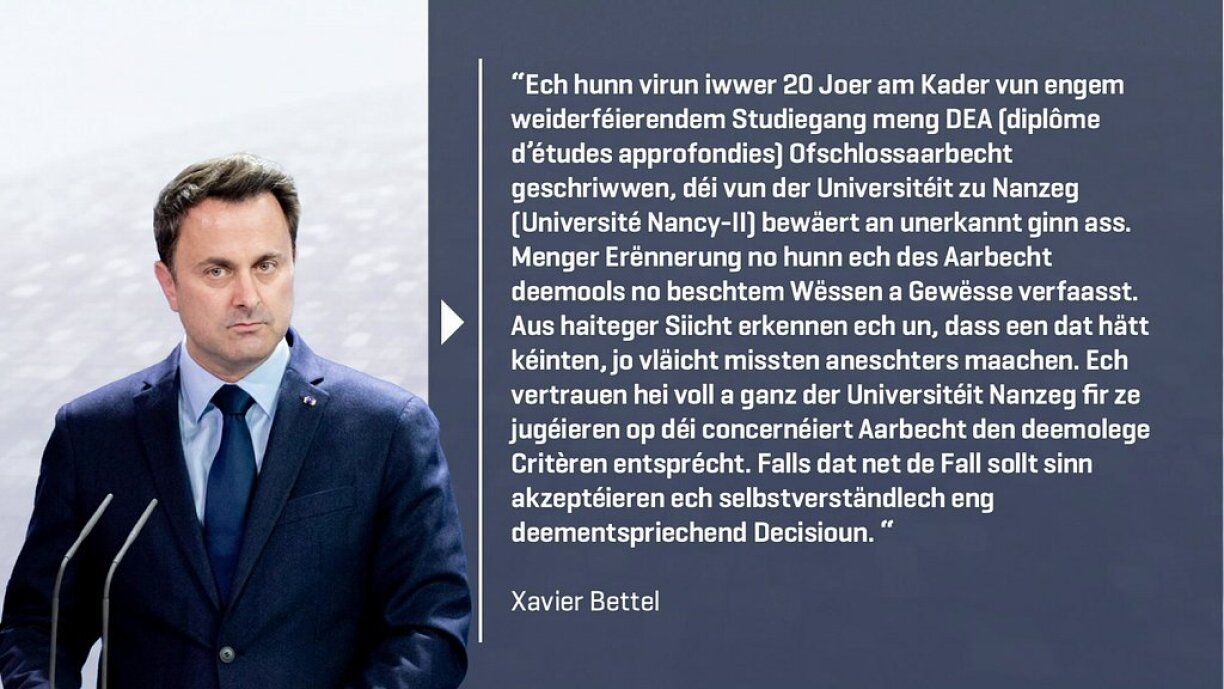
Jeblick said the premier's credibility was at stake, but that he believed the university was primarily at fault in this instance.
Science and scientific work are clearly defined, emphasised Jeblick. He said one important criterion for scientific work is honesty, which includes confirmation that a thought is formulated by an individual, or based on existing writings. If that is the case, he added, that thought should be clearly labelled as such. The law of citation and quotation is not new, but instead a basic principle for academic work.
"It is incomprehensible that he says 'I did this to the best of my knowledge and conscience'," said Jeblick. "I believe him, but if that is the case then he cannot have understood the assignment at the time, in which case it's the professor's job to tell him differently."
Luxembourg PM admits faults in thesis plagiarism row
University of Lorraine opens investigation into suspected plagiarism
In this sense, Jeblick lays the blame at the University of Nancy, stating that the argument that plagiarism computer technology was not available 20 years ago did not hold up under scrutiny. He said the fact no one pointed out the lack of referencing at the time the dissertation was submitted was not possible, and almost Kafka-esque.
The professor in charge at the time has so far played down the reproach in the press. The university has since launched an investigation into the matter, but Bettel's credibility has suffered as a result, said Jeblick. He added that society should, in general, be more aware of the issues surrounding intellectual property, so as to prevent future plagiarism cases and a so-called "copypaste" mentality.





