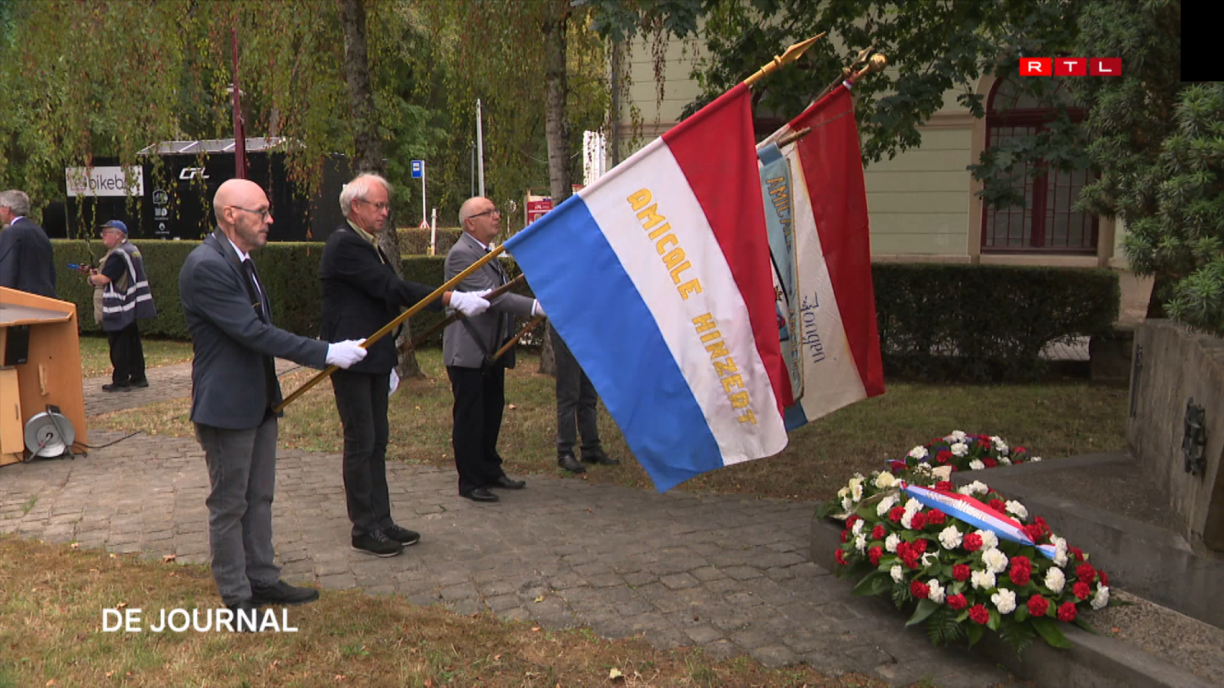
It has been 84 years since the Nazi occupying regime introduced forced conscription in Luxembourg. The country commemorated this dark chapter in its history on Sunday.
Ceremonies at Hollerich railway station and in Limpertsberg remembered the fate of thousands of young Luxembourgers affected by forced conscription during the Second World War.
The commemoration began with the laying of flowers at the Deportation Memorial at Hollerich railway station. During the war, many young Luxembourgers were deported from this station to the German Reich. The first trains carrying forced conscripts departed in October 1942.
On 30 August 1942, Gauleiter Gustav Simon announced in Limpertsberg that military service would become compulsory for Luxembourg men born between 1920 and 1924. The measure was later extended to those born between 1925 and 1927.
Over the following years, around 10,200 young Luxembourg men were forcibly conscripted. The vast majority were made to fight in a uniform they had not chosen, many of them on the Eastern Front.
Many were killed or reported missing, while others ended up in Soviet captivity. Nearly 3,000 of those forcibly conscripted either did not survive the war or never returned home.
Young women were also directly affected by the Nazi regime's measures. A total of 3,614 Luxembourg women were forced to serve in the Reichsarbeitsdienst (Reich Labour Service) and the Kriegshilfsdienst (Wartime Auxiliary Service).
For Josy Lorent, president of the Federation of Forced Conscripts, the scale of what happened remains clear.
"Forced conscription was and remains – and I never tire of repeating it – the Nazis' greatest war crime against Luxembourg's youth", he said.
Forced conscription was met with widespread resistance among Luxembourg's population. Strikes broke out in several parts of the country the day after Simon's announcement.
The Nazi regime responded with brutal repression. Twenty-one strikers were sentenced to death and executed. Those who tried to evade forced conscription, as well as their families, also faced severe punishment.
The consequences were so far-reaching that hardly any Luxembourg family escaped being directly or indirectly affected by forced conscription.
Eighty-four years later, however, the commemoration is not solely about the past. During the ceremony outside the Victor Hugo Hall in Limpertsberg, attention also turned to the present.
Against the backdrop of political developments in Europe and the growing popularity of far-right parties, organisers and political representatives raised the question of how democratic values can be protected for future generations.
President of the Chamber of Deputies Claude Wiseler stressed the importance of individual responsibility.
"It is also about taking action every day", he said. "And not just by clicking on the internet, but by putting all our energy into ensuring that our values are upheld every day, including for future generations."
The commemoration is therefore intended to be more than a remembrance of a historical date. It seeks to keep alive the stories of a generation whose youth was profoundly shaped and taken from them by war and dictatorship.