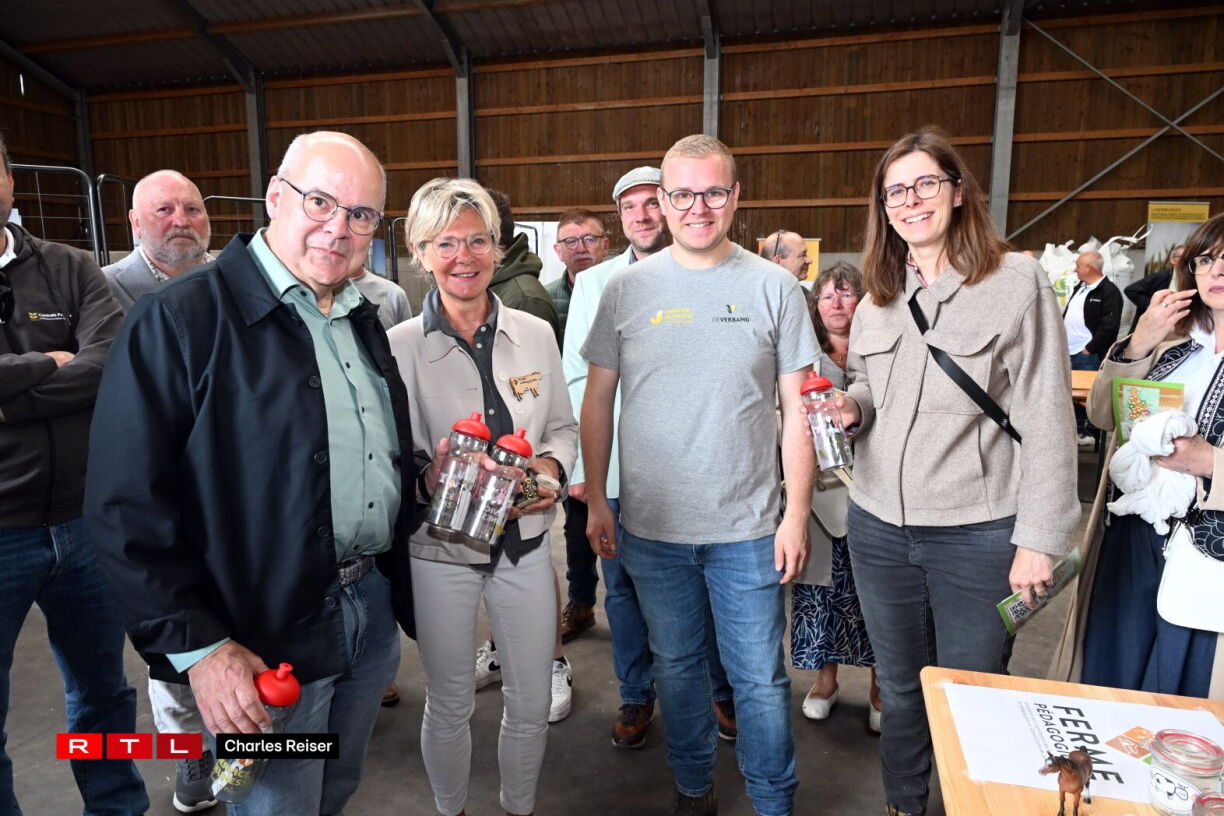
The 40th edition of Farm Day, organised by the youth service of the farmers' association Bauerenzentral, focused on the future of agriculture in Luxembourg and the growing challenge of encouraging young people to take over family farms.
At a time when many consumers no longer have a direct connection to food producers, and the number of farms in Luxembourg continues to decline, the question of whether farming still fits into modern life is becoming increasingly pressing.
For Gilles Eyschen, who invited visitors to his modern farm in Redange-sur-Attert together with his brother Steve, the answer is clearly yes, as long as the family is also willing to support that way of life.
Their farm is a typical family-run business, like many others across the country. In the early 2000s, Gilles and Steve took over the farm from their parents.
Steve Eyschen explained that the farm was originally located in the middle of the village, where there was no longer any room to develop. The brothers therefore began building their current site step by step in 2012, he added.
He explained that they started with 25 dairy cows, partly because milk quotas were still in place. Knowing that these quotas would eventually be abolished, they decided to specialise entirely in milk production, Steve Eyschen said. Today, the site is home to around 160 dairy cows, he noted.
It is a decision Steve Eyschen says he does not regret. He describes farming as a craft, but one that increasingly struggles to attract staff willing to embrace its demands.
He noted that farms face strong competition from the state and municipalities, as many people today prefer jobs with more regular hours, typically from Monday morning to Friday afternoon.
Automation and robots have made work on modern farms easier, but the business model still needs to be viable in order to justify such investments. Beyond that, farming remains a vocation, raising the broader question of whether the profession still fits into contemporary expectations around work-life balance.
In 1990, Luxembourg still had around 4,000 farms. Today, there are just under 2,000, and within 30 years, that number could fall to between 850 and 1,000.
Sam Mille, president of the Bauerenzentral's youth service, said the first question to ask is why young people no longer want to take over their parents' farms.
In many cases, he explained, they see how much their parents work at home and how little may be left over despite all that effort. As a result, many choose a different path, preferring a 40-hour working week.
In society more broadly, work is expected to pay off. In farming, however, much of the income generated is often reinvested directly into the business.
Mille added that a farmer's capital is often visible in one place: the site, the buildings, the machinery, and the infrastructure. He explained that what may look like a great deal of wealth at first glance is often the result of decades of work, not only by the current generation, but also by parents and grandparents.
Labour Minister Marc Spautz pointed out that, beyond the roughly 4,500 direct jobs in agriculture, many other jobs also depend on the sector.
Spautz also appeared to refer indirectly to the recent uncertainty surrounding EKABE, stressing that the processing industry, including dairies, remains closely tied to farming jobs and that efforts were underway to support producers and preserve employment in the sector.
Spautz said Agriculture Minister Martine Hansen was working to ensure that support could still be provided and that farmers would not be left without options. He also referred to jobs linked to sales, as well as the potential for agriculture and alternative energy to help preserve existing jobs and possibly create new ones.
Hansen, for her part, stressed that modern agriculture produces regional products in harmony with nature and allows consumers to know what is on their plates.
She noted that farms in Luxembourg are subject to strict requirements and that, for them to remain economically viable, everyone must play their part. The government, she said, has a role to play by providing financial support to farms, but consumers also have a responsibility to buy local products, even if that sometimes means paying a higher price. In return, she argued, quality is guaranteed.
Hansen urged people to eat and drink local products, saying this supports the farmers who work Luxembourg's land and contributes to food security.





