Police intervened in four cases between September and October after patients in hospitals posed a risk not only to themselves, but also to staff and other patients. According to police bulletins, these incidents typically occurred at night, often in emergency departments, and were mostly linked to alcohol or drug use.
Three of the four cases took place in Esch, another one in Kirchberg.
To understand whether aggression towards hospital staff is becoming more frequent, RTL contacted several hospitals to ask about trends, staff safety measures, and the impact on morale. Staff in emergency departments are there to help people, but many say the psychological toll of dealing with aggressive patients is mounting.
The police confirmed that they do not keep separate statistics for interventions in hospitals, making it difficult to quantify trends or identify which hospitals or departments are most affected. However, they noted that in most cases where police intervene, alcohol or drugs are involved.
Not every incident of aggression is reported or escalates to the point of requiring police intervention. In many cases, staff try to de-escalate situations internally first.
Nevertheless, all three hospitals that responded to our query observed the same trend: patients are less patient, and the threshold for directing frustration at medical staff has dropped noticeably.
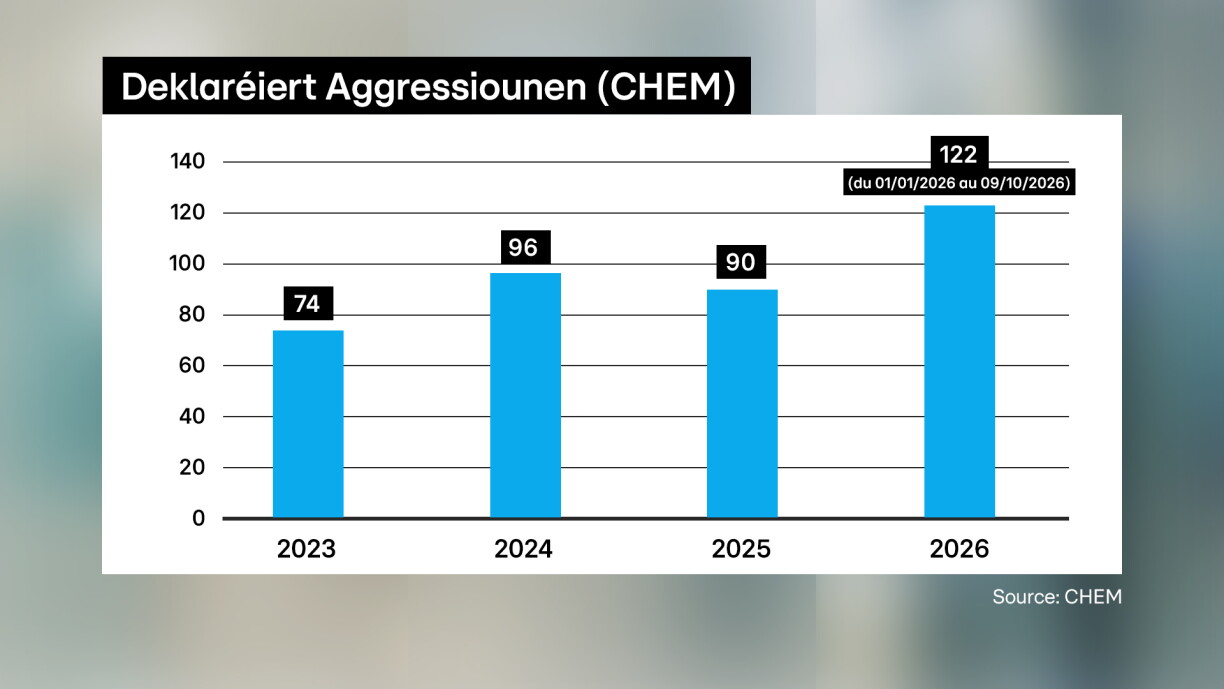
The Emile Mayrisch Hospital Centre (CHEM) provided concrete figures: reported aggression cases have risen sharply, from 90 in 2025 to 122 already recorded between 1 January and 9 October this year. Verbal aggression is described as a "massive phenomenon" with an "explosion of cases in 2026".
The number of verbal incidents jumped from 53 in 2023 to 106 already this year in Esch alone.
Physical aggression is also on the rise. In 2026, CHEM recorded 34 physical blows, 19 cases of shoving, 14 incidents involving biting, spitting, or scratching, and five cases where objects were thrown.
Other serious incidents, including inappropriate touching and strangulation, have also increased since 2023.
It is worth noting, however, that the emergency department at CHEM treats an average of 265 patients daily, amounting to 96,850 cases last year.
At the Robert Schuman Hospitals (HRS), Sandra Lopes, head of the emergency department, confirmed a similar upward trend over the past few years. She noted, however, that internal figures likely underestimate the scale of the problem, as staff do not have the time or habit of reporting every episode while under constant pressure.
The Northern Hospital Centre (CHDN) has not observed an increase in physical violence, but cases of verbal aggression and threats have risen slightly. Again, accurate figures are difficult to provide, as only reported incidents can be counted.
Long waiting times for patients with relatively minor issues have eroded patience and understanding for others in emergency departments.
The CHDN distinguishes between two types of incidents: verbal aggression driven by dissatisfaction, and violence related to medical or psychiatric conditions.
Many people are now more focused on their own situation and less willing to accept that others might be prioritised. Unmet or unrealistic expectations about emergency services can fuel frustration, the hospital noted.
Similar observations come from CHEM and HRS, where staff report that not everyone understands or accepts the triage principle – the system by which those with the most urgent or severe conditions are treated first.
As Romain Schockmel, medical director at CHEM, explained: "Strangely enough, we see more impatience from people with comparatively minor complaints, like a swollen toe or ingrown nail, than from those coming in with something serious, like a heart attack."
Dr Schockmel added that better communication could help prevent such situations: "If a patient waits two hours without information, frustration builds up. We try to counter this by keeping staff and patients informed, that is our main focus."
At HRS, there are even plans to develop an app to keep patients and their families updated on their status in the waiting room.
Another challenge, beyond the general shortage of medical staff, is that emergency departments often serve as a catch-all for patients who could have been treated elsewhere. Katharina G, a nurse at CHEM, stressed the need for greater public awareness about when it is appropriate to use emergency services, noting that many patients would be better served at a medical centre.
Aggression can also be triggered by alcohol or drug misuse, psychiatric illnesses, or conditions like dementia.
"To be honest, intoxicated patients, those with substance dependencies, or people who do not speak the language can become frustrated, sometimes verbally, sometimes physically", said Sandra Lopes of Hôpitaux Robert Schuman. "When police bring in a patient who was causing a disturbance outside, these individuals often require significant psychological support."
Nursing staff are then left to calm these patients, adding to the wait times for others.
"This typically happens at weekends or during the night, especially around festivals or among young people. We also regularly see patients who simply come to us because they do not know where else to go", Lopes added.
A lack of psychiatric facilities outside hospitals is also part of the problem, according to Lopes. "We do have a dedicated security agent in the emergency department, but that is not always enough when managing both substance-dependent and psychiatric patients", she noted.
Lopes argues that more infrastructure is needed outside hospitals, so that intoxicated patients without a fixed address can receive care from trained staff.
One potential solution, she suggests, is to create a "social SAMU" – a social emergency service. Health Minister Martine Deprez has said work is underway on such a project, although a related motion tabled by The Greens was rejected in July with 35 votes against and 25 in favour.
Aggression at work can be demoralising, especially for professionals dedicated to helping others. Staff at all three hospitals say that strong team spirit is the most important tool for coping with the stress of such incidents.
Sharing experiences and supporting each other is key, they told RTL.
Katharina G of CHEM explained: "The good thing is that we are never alone, we have a large team and communication happens quickly. When an aggression is reported, we are contacted by an occupational psychologist, who checks if we need help or want to talk about it."
Dr Schockmel also praised his staff: "Our team has a civil courage that should not be underestimated."
The Hôpitaux Robert Schuman teams also have access to psychological support and discuss incidents together, according to Lopes: "We usually find a solution together."
At CHDN, aggression is a regular topic within the team, and the worst cases involve personal threats, which are a real burden.
For this reason, the hospital provides both de-escalation training and systematic debriefs after incidents, as well as a contact point where employees can request professional support, whether for emotional help or coaching.