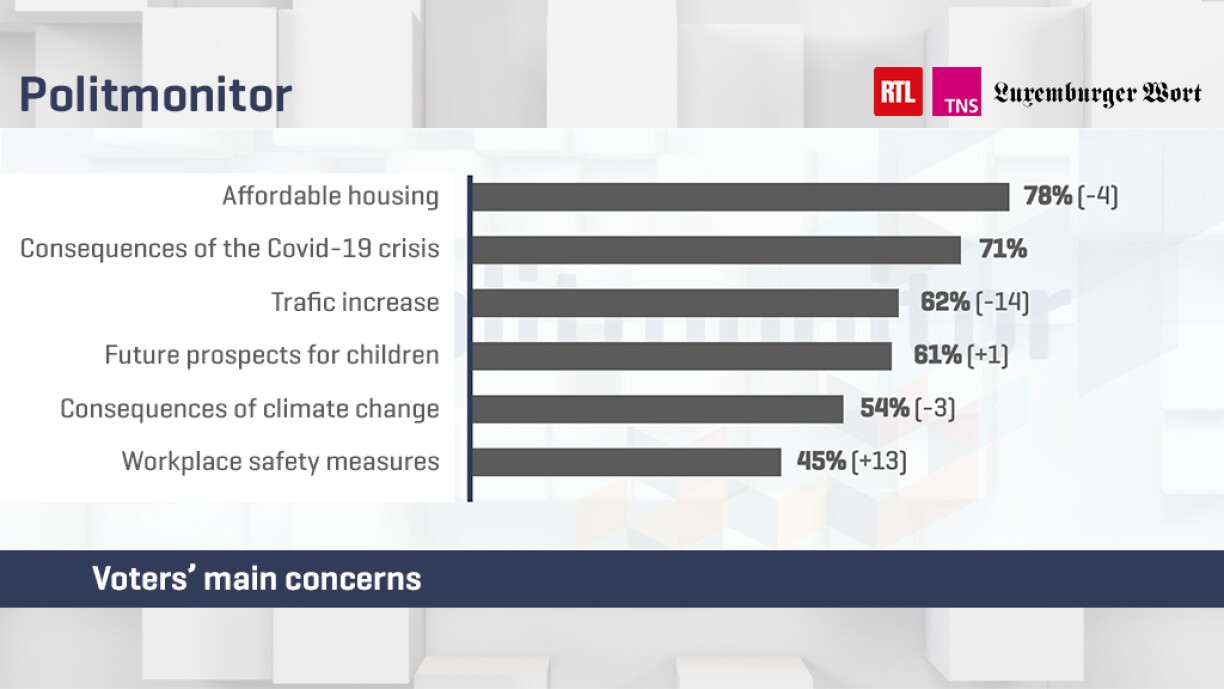
A key takeaway from the survey is that housing remains a major concern for the general population, even during a global pandemic.
Participants also largely rejected the proposition of new tax measures such as inheritance tax for direct relatives - 75% of responses said they were against such a tax. In contrast, more than 60% said they would support a wealth tax. Tommy Klein of TNS Ilres said the wealth tax was the only proposition to gain support in terms of tax reform in the survey, while participants rejected suggestions of a general tax increase, inheritance tax and higher taxes for businesses.
Some contradictory responses appeared on the topic of climate change, with participants expressing a general sense of support towards environmentally friendly policies, but refusing the notion of higher taxes in order to pay for new measures.
Just a third of those surveyed said they would support a €0.05/litre price increase for diesel or petrol. Green Party supporters, unsurprisingly, were the group that were most in favour of such amendments. However, the majority said they would support tougher fines for infractions against the environment.


Coronavirus also played a role in the survey, with 53% of people stating they did not agree with an obligatory vaccine for vulnerable members of society. 57% of people said schools should continue with regular classes in spite of the global health crisis. These opinions were above all held by older participants. A third of those polled said schools should not stay open.
60% of people said they supported the right to work from home, another topic which has greatly been affected by the health crisis.
Despite the stress of the global pandemic, the main concern of all respondents was clear: access to affordable housing. Concerns over the virus and the effects on society and the economy all took a backseat, with 78% of participants agreeing that housing should be a priority for the government.
Traffic, which played a role in residents' main concerns in 2019, is no longer a priority, perhaps as a result of reduced cars on the roads due to the pandemic. However, participants still said they were worried about jobs in Luxembourg, with 45% saying they feared losing their job.
More than half of those surveyed said they felt that Luxembourg was a fair place to live in terms of society.
Other concerns which have fallen by the wayside somewhat are the role of the monarchy in Luxembourg, the country's status as a business hub, and immigration, with just 31% of respondents citing the latter as a concern. 43% said they worried about the future of the Luxembourgish language, and 41% said they had concerns over the economic situation.
Further details on the methods used and the questionnaire can be found at Alia.lu





