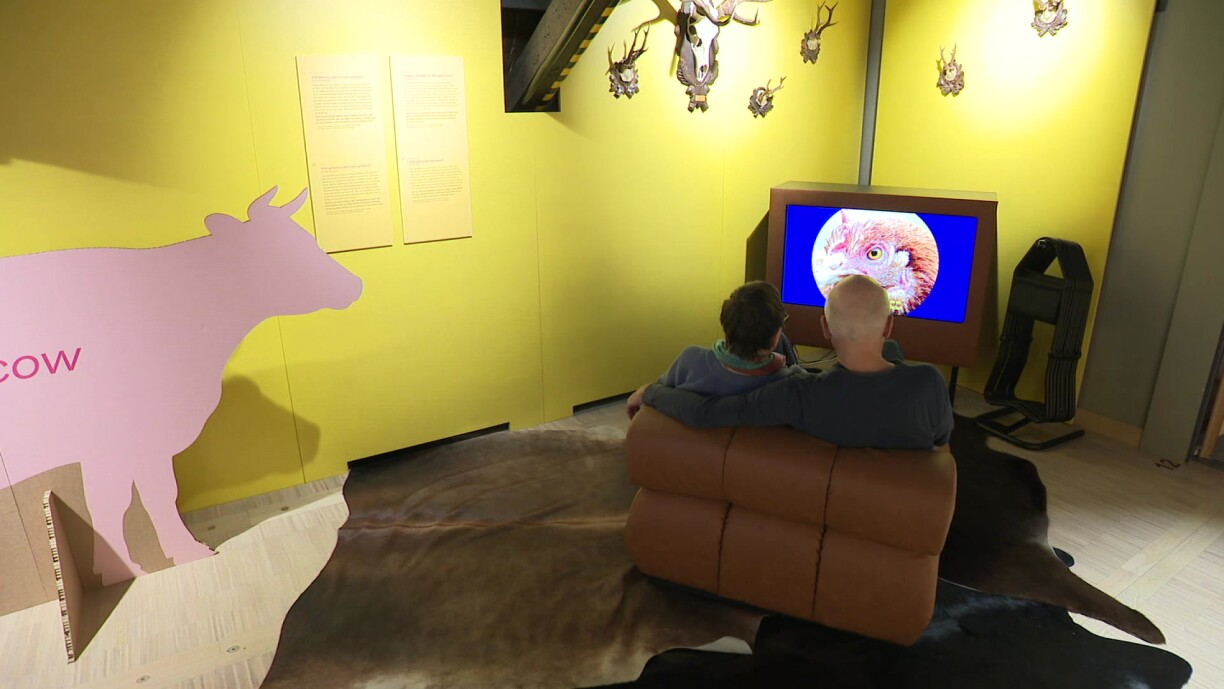
How do we as humans interact with different animals? How has this interaction changed over time? And what role do museums play in this context? A new exhibition titled "animalECH" introduces these themes in an interactive experience at the National Museum of Natural History in Grund.
Our relationship with animals is a topic that can be approached in many ways. The museum has opted to place the focus on the personal relationship between the individual and animals. When entering the exhibition, visitors first walk through a hall of mirrors, in order to confront themselves and their own certainties. This was a very conscious decision, says director Patrick Michaely.
"The exhibition is a corridor, so people enter with certainties about themselves. That is the 'ech' [I] part of the title. But then throughout the exhibition, the experiments, the interactivity, we challenge those certainties and question them. The whole exhibition asks questions and invites discussion."
Visitors are invited to take a fresh look at animals and the topic of animal rights. After the mirrors, they encounter information signs and images retracing the history of animal rights in detail, offering them the perfect foundation for the rest of the exhibits.
"The history of animal rights is long. We start with the ancient Greeks, with Pythagoras, who was a vegetarian. Vegetarians were actually known to be following a 'Pythagorean' diet up until the 19th century. Then you have other well-known figures, such as Descartes, who referred to animals as robots, or automatons, in the 17th century. This goes all the way to modern animal rights, covering every element and stage along the way."
The museum has made use of artificial intelligence to create images depicting the history of animal rights. But this has an explanation – they wanted to use images illustrating different clichés, and that was only possible through the use of AI as there are no real images in existence.
The exhibition is spread across multiple rooms offering an array of interactive activities. Visitors can watch videos, listen to animal sounds, play digital games and solve mysteries, thanks to the diverse ways to experience the animal world and how humans treat and react to them.
Another room covers how the museum itself handles animals. Many museums have followed trends and improved their treatment of animals to render it more respectful than in the past. Michaely explains that more and more people have asked how the taxidermy animals on display died. Nowadays it is more the case that museums use animals that died of natural causes, whereas in the past it was common for animals to be killed specifically to go on display.
The "animalECH" exhibition shows how humans' treatment of animals has changed over the years, moving in an increasingly animal-friendly direction. It is open until 23 August 2026.





