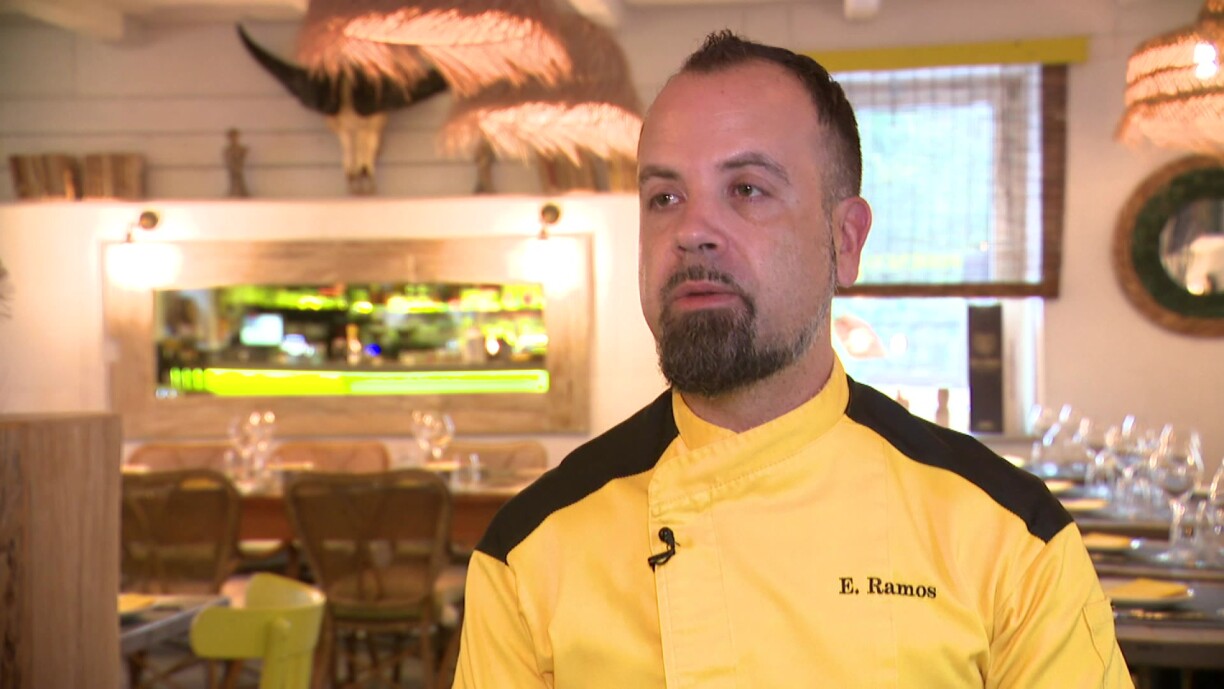
Leaving one’s country to open a restaurant elsewhere is never a trivial decision, especially in a country as multicultural as Luxembourg, where customer expectations are high and culinary references diverse. Yet for Daniele, Eduardo, and the trio Andreas, Spiros, and Demetris, the choice felt obvious: here, it is possible to offer a demanding, sincere cuisine that remains deeply rooted in its identity.
For them, Luxembourg presents itself as a land of opportunity. Andreas, from the restaurant Nostos in Bonnevoie, saw clear potential: "There’s good potential in the city for Greek cuisine,” he explains, convinced that Luxembourg’s public is ready to discover more than softened versions of foreign dishes. Eduardo, who runs the restaurant Podenco in Bertrange, highlights the working conditions: "Here, I feel valued. Professionally and financially, it’s better than in Spain."
But attracting customers does not mean compromising. They all share the same guiding principle: staying true to their culinary traditions, even if it means challenging certain preconceptions. Daniele, chef of the restaurant Kore in Steinfort, who lived with his partner Chiara in several countries, points out that so-called "simple" cuisine is often the hardest to master: "If you only have three ingredients and one isn't good, it’s a disaster. Where do you find good tomatoes in Luxembourg? It’s not easy.” For him, as for the others, product quality is non-negotiable.
Andreas shares the same view and refuses superficial adaptations: "Everyone needs to see real Greek cuisine, not a version adapted for people who live further north than our home country." Eduardo, meanwhile, proudly embraces his family heritage: "My grandmother would start cooking at 10 in the morning, and we’d eat at 2 or 3 pm. It simmered for five hours. That’s what I bring here."
Across from them are Luxembourg’s customers, curious and open, but sometimes influenced by clichés. “Sometimes you have to educate them a little," Eduardo smiles. "In paella, there’s no lemon and no chorizo." That teaching happens through the plate itself. Spiros insists on authentic ingredients: tarama made from fish roe, Greek yoghurt for tzatziki, and Kalamata olives. No compromises, even far from Greece.
For Daniele, this fidelity sometimes takes a more creative form. Italian cuisine meets Japanese techniques, always with respect for the ingredients. "It’s a balanced mix," he says, describing the meeting of sea bass tartare with Amalfi lemon and Japanese noodles, one of the signature dishes on his menu.
Beyond the kitchen, integration also happens in everyday life. Eduardo speaks about languages and his children’s education. Andreas mentions how easy it is to meet people. Spiros still remembers his first "moien" exchanged in the streets of the capital.
Ultimately, they all pursue the same goal: offering an honest experience. "I’m not trying to be the best, I’m trying to be content with what I do," Eduardo sums up. And while Andreas says he wants customers to feel as if they have stepped into Greece when they enter his restaurant, Spiros goes even further: "Here, they eat better than in Greece. Because we’re not a tourist restaurant."





