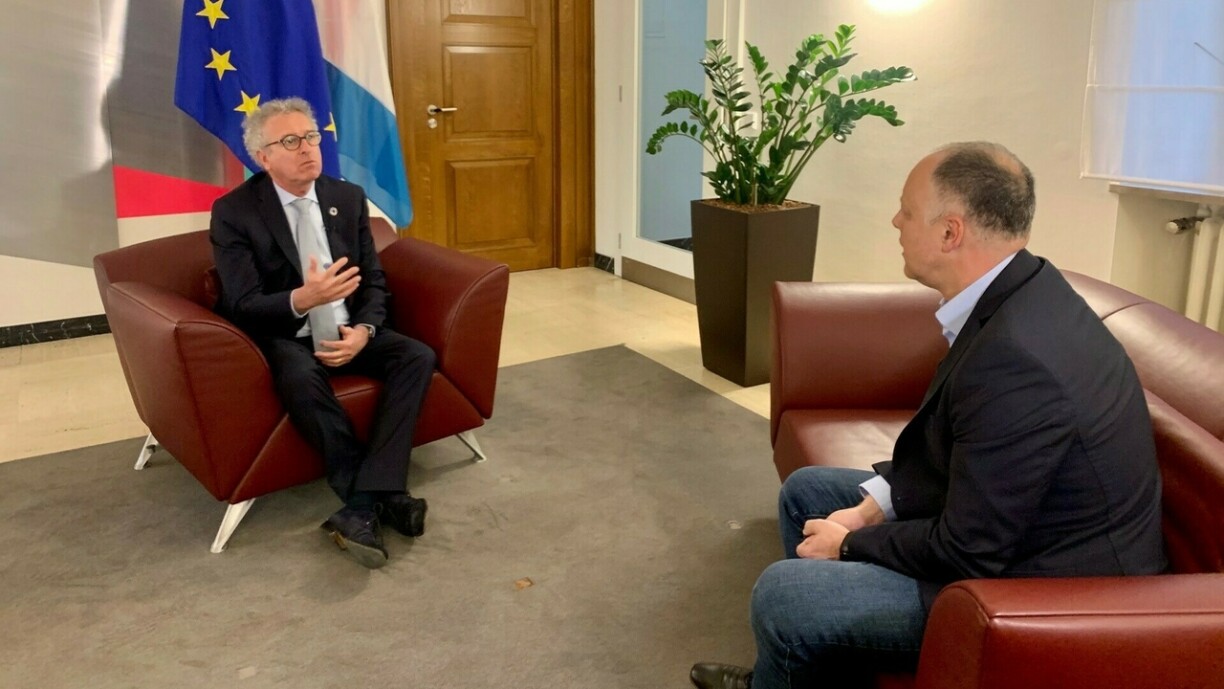
Luxembourg's Minister of Finance Pierre Gramegna told RTL that it was yet too early the gauge the true extent of the economic impact of the coronavirus crisis as the government is yet to devise a concrete exit strategy. He confirmed that the initial state budget is recalculated due to the unexpected coronaviurs-related expenses.
According to the minister, the International Monetary Fund (IMF) forecast a decrease of Luxembourg's GDP. The latter is expected to decreased by 4 to 5%. It was initially presumed to grow by 2.3%. If this grim economic forecast comes true, it would be synonymous with the worst national economic result in a a very long time, the minister warned.
Gramegna negotiated in the negotiations of a European coronavirus rescue plan until Thursday evening. This plan, which received the green light on Thursday, foresees a financial aid amounting to €500 billion. The staggering amount will be used to cover loans, guarantees, and short-time working schemes. Despite the grim outlook, the minister highlighted that the international sense of solidarity continued to reign strong in the European Union.


The breakthrough in negotiations came after the Netherlands softened its position on the crucial question of making needy countries commit to economic reform and outside oversight in return for assistance.
The Hague had blocked the talks two days earlier by insisting that Italy, or any other country in need, deliver on governance targets -- which Rome saw as a shocking demand during a health crisis.
"Today we answered our citizens call for a Europe that protects," Eurogroup chief Mario Centeno said after the talks.
"This response contains bold and ambitious proposals that didn't seem possible just weeks ago," added Centeno, who is also Portuguese finance minister.
As a compromise, the final statement clearly states that the rescue would be specifically earmarked for costs related to the COVID-19 crisis, which has killed more than 65,000 people in Europe.
The ministers, however, set to one side a proposal from Italy, Spain, and France for a joint borrowing instrument, sometimes dubbed a "coronabond", that would have raised money towards a recovery after the outbreak.
Germany, the EU's most powerful member, has refused the pooled debt proposal and ministers agreed only to "explore" the idea under the direction of EU leaders, who are set to meet later in the month.
The package agreed is worth about 500 billion euros ($546 billion), short of what many observers believe is necessary to restart the European economy when the health crisis recedes.
Data indicate that the economy across the continent is already in a historic meltdown, with everyday life paralysed to fight the spread of the virus.
Despite 19 EU countries sharing a common currency, member states have reacted unilaterally to save their economies, giving richer countries such as Germany a big advantage over those with less spending power.
The main component of the rescue plan involves the European Stability Mechanism, the EU's bailout fund which would make roughly 240 billion euros available to guarantee spending by indebted countries under pressure.
Italy and Spain had the backing of the majority of member states to keep the conditions for tapping the ESM to an absolute minimum, but the Netherlands fought hard for something tougher.
Putting conditions on support is seen as a humiliation in Rome and Madrid, evoking bad memories of the eurozone debt crisis when auditors from Brussels dictated policy to bailed out Greece, Portugal and Ireland.
Dutch Finance Minister Wopke Hoekstra insisted if a country asked for any non-virus related support from the ESM -- it would still come with conditions.
"That's fair and reasonable," he tweeted.
However, the mutualisation of debts was a bridge too far for Berlin and The Hague, which refuse to take on joint loans with highly indebted states such as Italy, France or Spain which they consider too lax in their public spending.
French Finance Minister Bruno Le Maire said the debate was still open and that everyone agreed that new sources of funding were necessary to restart the economy.
"Common debt... is not said, but it is implied," he said.
But, repeating her well-known position, German Chancellor Angela Merkel had earlier on Thursday firmly rejected the notion of pooled debt in Europe.
"I don't believe we should have joint liability (shared debt) in the (EU) in its current form, and that's why we reject that," she said.
In addition to the eurozone rescue fund, the EU ministers agreed 200 billion euros in guarantees from the European Investment Bank (EIB) and a European Commission project for national short-time working schemes.





