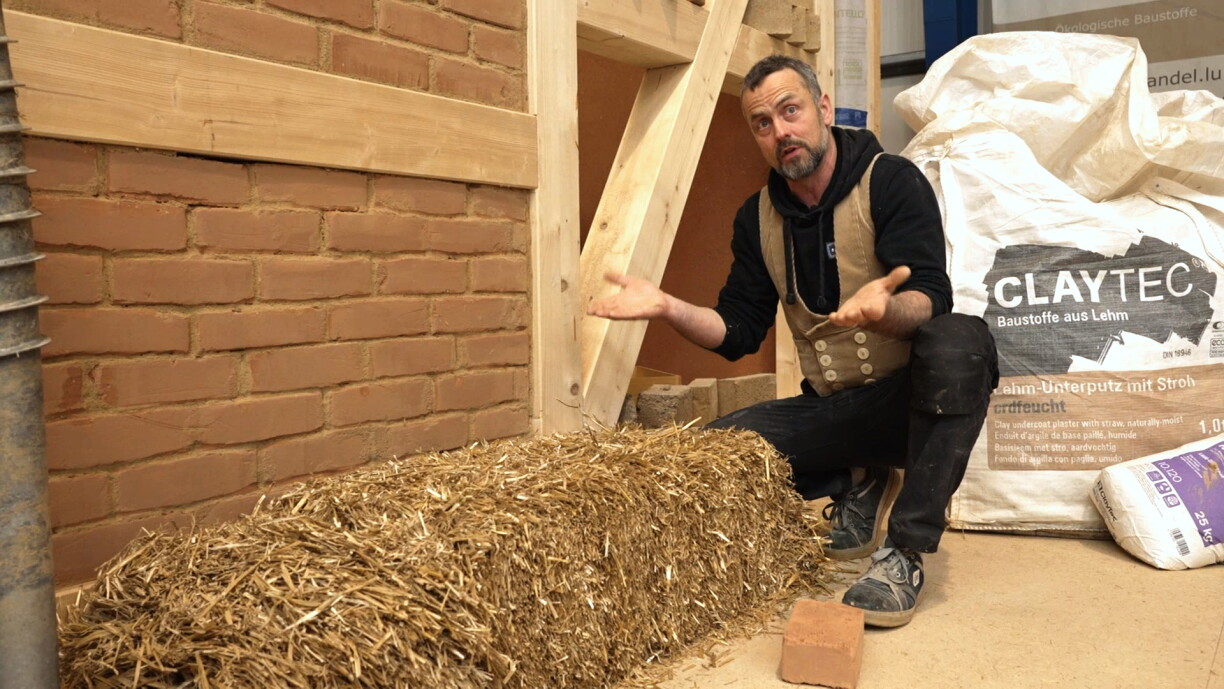
When Marc Neu describes building his home, he does not beat around the bush: "A straw bale like this, about 1.1 metres long, costs five or six euros. I managed to insulate my entire house, from the floor slab up to the roof, for just €6,000. No insulation material can beat that price,” he asserts with conviction.
Unlike most homeowners, Neu did almost everything himself, choosing to shun conventional building materials such as breeze blocks, plasterboard, or polystyrene. Instead, he fell in love with straw bale construction – a technique he now champions with infectious enthusiasm. "I am in love with building with straw," he says, grinning.
Neu's project, by his own account, is "completely crazy" – but it is starting to catch on. At a large workshop hall belonging to the National Centre for Continuing Vocational Training (CNFPC) in Colmar-Berg, Neu is leading a hands-on training course.
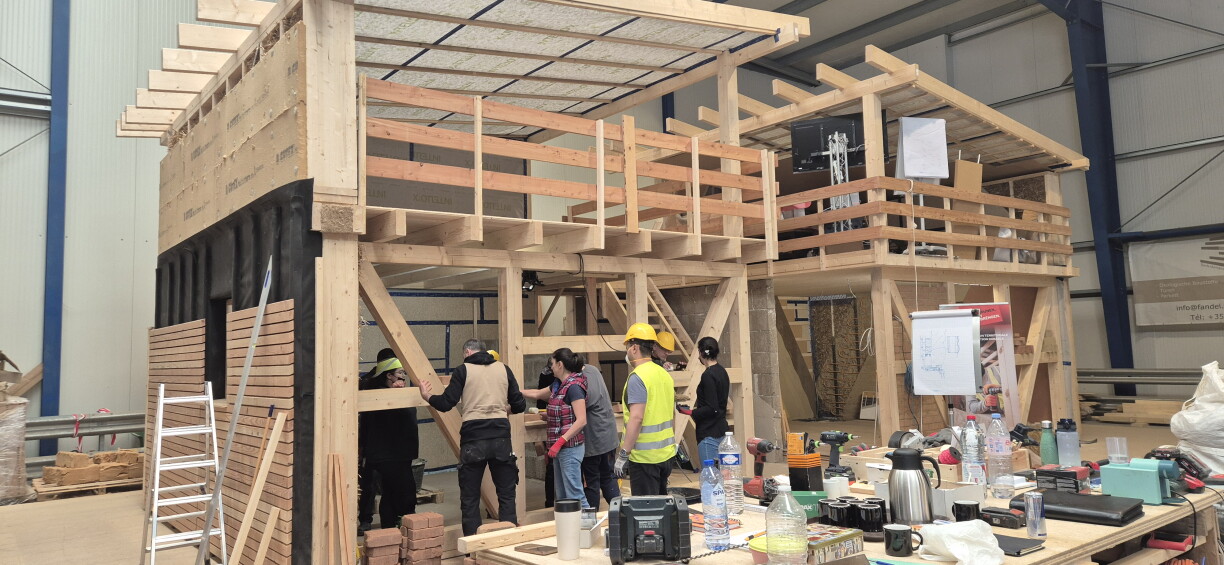
Here, eight participants are constructing a life-sized, fully sustainable house, which will be assembled and then dismantled over the course of the three-week programme. The group consists entirely of jobseekers: building draughtsmen, masons, engineers, and students alike, according to Neu.
Neu's aim is to broaden their horizons and introduce them to the principles of sustainable construction, which he believes represents the "Rolls-Royce of houses". Getting hands-on is essential: on this particular day, the group is using a machine to spray liquid clay onto straw-bale walls.
Neu passionately explains the appeal of clay: "It is a fascinating material. If you are working with clay and your friend comes over for a beer, you can put down your tools and simply moisten the clay again the next day. With concrete, however, you would have to throw all your tools away because the material would have completely set."
Building with wood, straw, and clay, Neu says, offers not only strong energy performance, but also unbeatable protection of natural resources. "It is a healthy construction from start to finish. If I have to take a house like this apart, ninety percent of it is untreated wood, untreated straw, and clay. There is almost nothing to take to landfill," he points out.
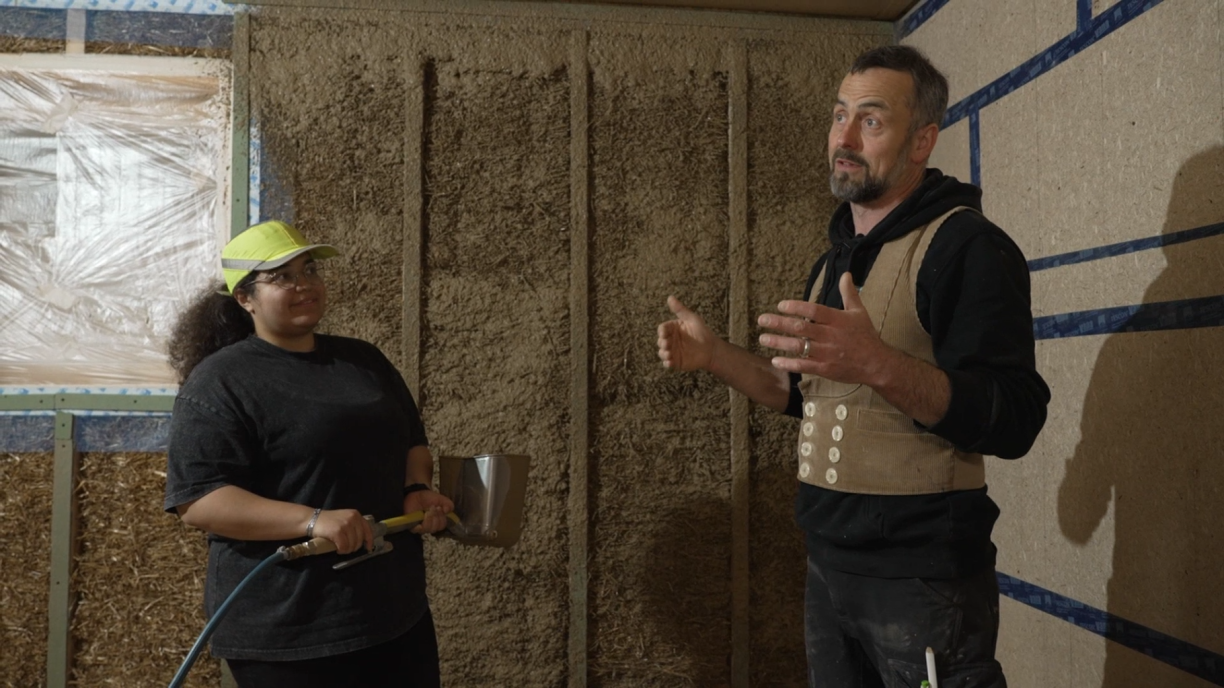
The enthusiasm is shared by those learning from him.
Houssem Eddine Drici, a jobseeker from Algeria with a master's in energy efficiency from the University of Luxembourg, explains: "This training is part of my support from ADEM (Luxembourg's employment development agency). This project shows that it is possible to build highly energy-efficient houses. In Algeria, we often build with stone and earth, and we have seen that you can naturally regulate temperature in all seasons without the need for heating or ventilation."
Neu readily addresses the classic doubts people have about straw homes: fire, moisture, and rodents. "People think straw burns, rots, and attracts mice," he says.
"Yes, straw burns – just like wood, paper, or even polystyrene. But try setting a tree trunk alight with a lighter: it does not work, because it is too dense, there is not enough oxygen. It is the same principle with tightly packed straw bales," he says.
He adds that as long as the straw bales are of good quality and the construction is done properly, mould should not occur. He points to many half-timbered houses, apartment blocks, and churches built with straw and wood that have stood for centuries.
As for rodents, Neu is not concerned. "With the density, the wooden frame, and the coatings, and with modern agricultural machinery, there should not be any grain left in the straw. I always say mice are more likely to look for cornflakes in your kitchen than grains in a straw bale."
Heat in summer is another challenge for wooden houses, he admits.
"It is a real challenge. You need to design the house and its façade carefully based on its orientation. For example, we use clay bricks, which add mass and help regulate temperature and humidity," Neu says.
Neu also explains that under his own house, there is a ventilated gap of 80cm beneath the wood-and-straw floor, which protects against rising damp, radon, and termites – just one of the solutions he has put in place.
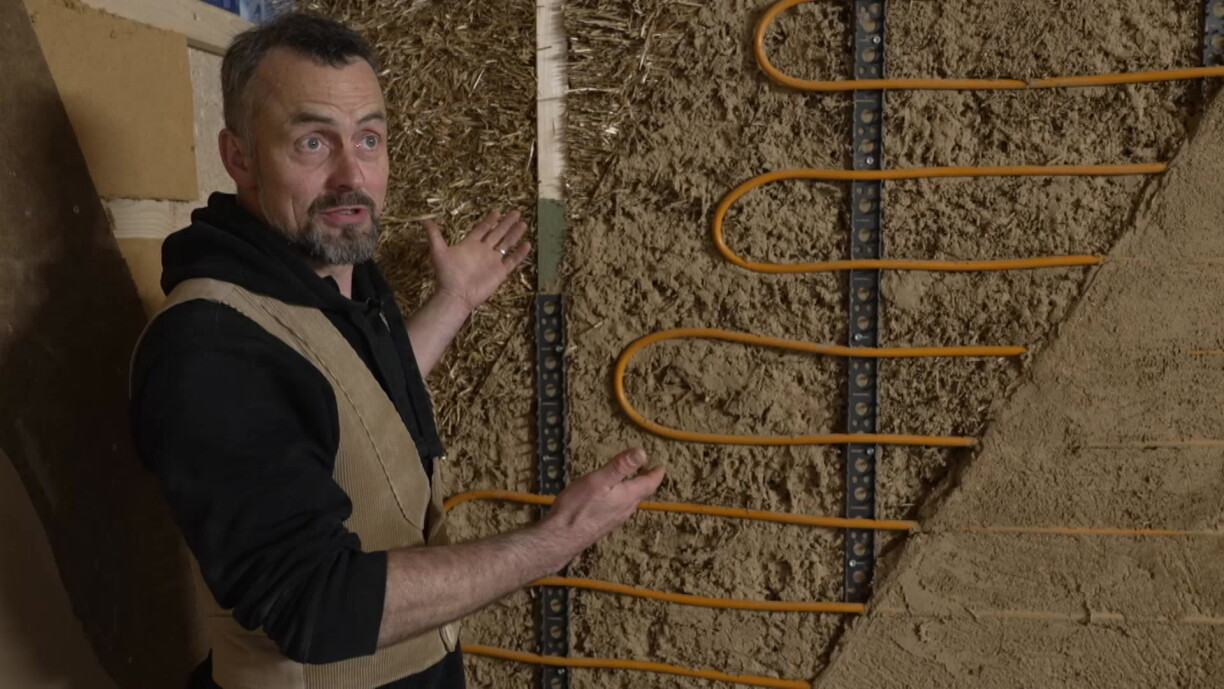
At 4.30pm, Neu's training session finishes, and he takes us to visit his pride and joy: his own straw house. Over the past three years, he has built the 200-square-metre structure almost single-handedly, working through both summers and winters.
He moved in only a few days ago, and while some finishing touches remain – wood cladding for the façade, plastering walls, window frames – Neu is proud. He admits the process has required sacrifices, especially for his family and friends, and left him feeling drained, but the result, he says, is worth it.
"I am proud. It has given me experience, and as a sustainable construction trainer, I have proved I know a thing or two about what I teach."
Inside his home, wood is everywhere, often left untreated or only lightly oiled. The staircase reveals a wooden slab made from beams connected without glue, only massive wooden dowels.
Neu even plans to fit a "truth window" in one wall to display the straw insulation inside.
Since moving in, Neu and his family have settled in well. "We feel good here. Before, we lived in one of the oldest houses in Useldange, made of stone, and we were always cold. Here, a masonry stove is enough to heat the whole house."
But what about costs? The million-euro question, says Neu, is how much a sustainable house actually costs.
Neu explained: "It is more expensive than a conventional house, which makes sense due to economies of scale – we do not build enough with wood and straw to compete with traditional companies, and labour costs are high in Luxembourg. Handling a straw bale costs more than fitting a polystyrene board, unless you do it yourself or with friends."
This, however, is a key advantage: straw bale building lends itself well to self-build projects. "Plastering a straw wall with clay is not rocket science – it is easy," Neu insists.
Having completed about ninety percent of the work himself, Neu estimates the final budget for his 200-square-metre house at between €450,000 and €500,000 – around €2,000 to €2,500 per square metre, well below the Luxembourg average of €2,500 to €4,000 (excluding the cost of land).

In Luxembourg, obtaining an energy performance certificate (EPC) is mandatory for all building sales, rentals, renovations, extensions, or new constructions – a requirement Neu welcomes, but one he says can sometimes lead to greenwashing.
With twenty years of experience as an energy consultant, he has seen many new builds and renovations focus on energy performance, which he applauds, but he warns there are several ways to achieve this.
"You can build with concrete and polystyrene or with natural materials like I do," he said. The problem with conventional homes, Neu continues, is that people only consider the building's energy performance after it is complete, forgetting everything that happens before and after: resource extraction, transport, chemical pollution, end-of-life, and recycling.
"We should do as indigenous peoples do – borrow from nature during our lives and return it when we die. But with concrete, polystyrene, synthetic paints, polyurethane foams, and all this other rubbish that produces wonderful energy certificates, we are far from that. We are destroying our planet while thinking we are saving it with A+ rated homes," Neu concluded.





