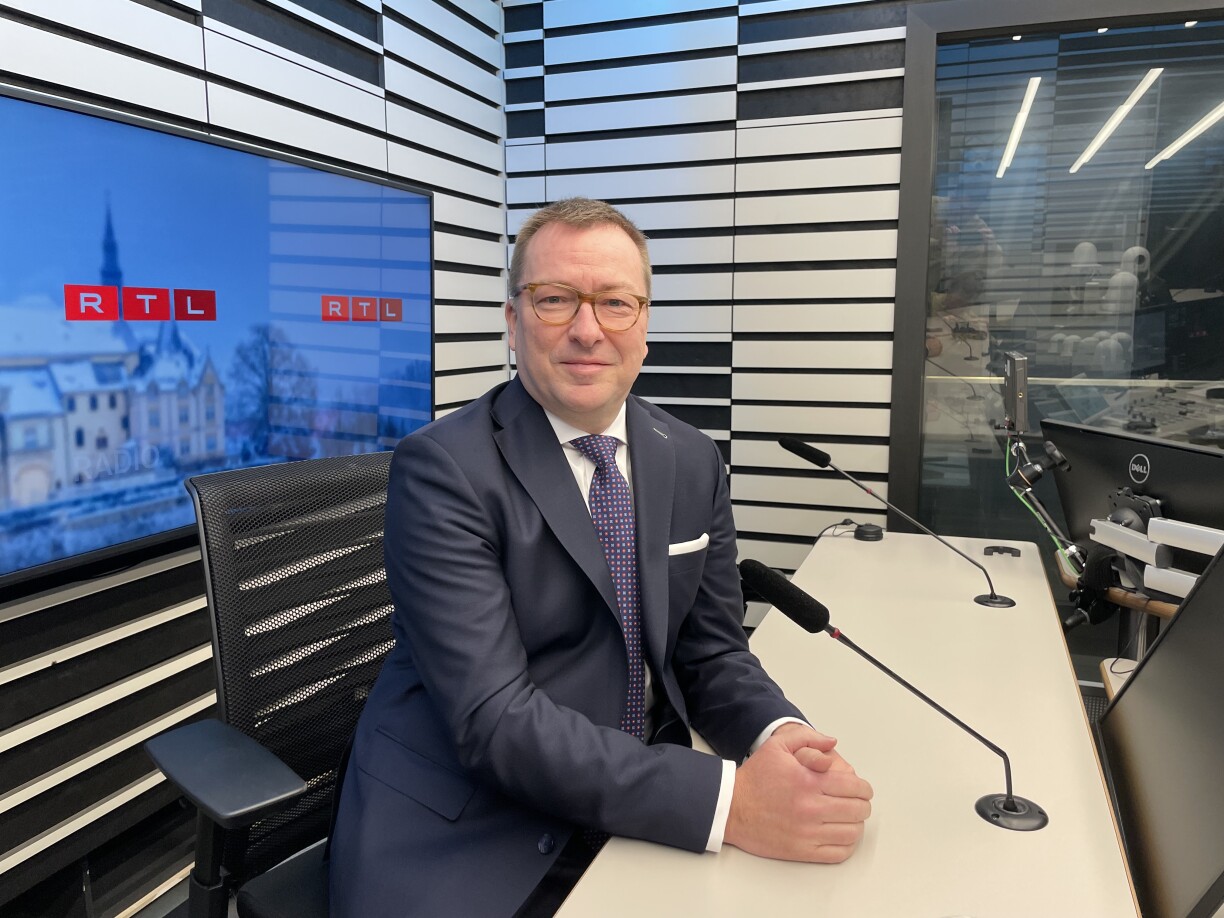
Sworn in on 20 January, Marc Hansen succeeds long-serving colleague Fernand Etgen of the Democratic Party (DP) at the Chamber of Deputies. It is not his first stint as an MP: he briefly sat in parliament between December 2013 and March 2014 before joining the government, where he went on to hold several portfolios, including Housing, Digitalisation, and the Civil Service.
After the 2023 general election, however, Hansen failed to secure a parliamentary seat and did not return to government. Since then, he had largely disappeared from the political spotlight.
Asked what he had done during those two years, amid jokes that he had simply played golf and mown the lawn, Hansen insisted his retreat from politics was intentional.
He said that once a mandate ends, he does not believe in continuing to interfere in public debate from the sidelines. Without an active mandate, he felt it was not appropriate to weigh in publicly or offer unsolicited advice. Instead, he kept in touch privately with political colleagues across party lines but focused mainly on his family, Hansen said.
During that period, Hansen received the transitional allowance granted to former ministers for up to two years. For the first three months, former ministers receive their full salary, minus representation expenses, thereafter, the monthly payment stands at around €8,560.
Hansen said the allowance is automatic, whether or not a former minister takes up other paid work. But he also argued that ethical considerations played a role in his decision not to move straight into a new job. He explained that Luxembourg's government code of conduct requires former ministers to notify a deontology committee before taking on roles that may be related to their previous portfolios. In some cases, the committee can impose restrictions or even block certain appointments, he said.
Hansen added that he wanted to avoid any risk of a perceived conflict of interest. As a former digitalisation minister, for instance, he suggested that joining a tech company shortly after leaving office could have sparked public controversy.
Was his return to parliament timed to coincide neatly with Fernand Etgen's retirement and the end of his transitional allowance? Hansen rejected suggestions of behind-the-scenes coordination. He said that while Etgen's future had been mentioned at one point after the elections, he did not speculate on hypothetical scenarios. Once the decision was formally communicated, he made up his own mind.
He also dismissed any idea that Etgen was pressured into stepping down. No one, he said, discussed such matters with him.
Now president of the parliamentary Defence Committee, Hansen faces a far more serious set of challenges. With Russia's invasion of Ukraine ongoing and uncertainty surrounding the US commitment to NATO under Donald Trump, Europe is rethinking its security posture. Luxembourg has earmarked more than €1 billion for defence in this year's budget.
Hansen called the situation "dramatic". For much of his generation, he said, Europe lived without war on its doorstep. That is no longer the case. He argued that it is necessary to invest more in defence as a preventive measure, quoting the old maxim: "If you want peace, prepare for war."
He stressed that he does not welcome the need for increased military spending, but believes there is no alternative. Europe, he said, must close capability gaps and can no longer assume that allies will automatically provide protection.
At the same time, he insisted that defence investments must be handled with caution and not normalised. Hansen emphasised that even innovative financing tools such as defence bonds should not obscure the harsh reality behind them. Diplomacy, he said, must always remain the preferred path, but preparedness is essential.
Luxembourg is also seeking to strengthen its armed forces, including for a planned joint battalion with Belgium. Recent legislative proposals aim to improve pay conditions for soldiers. The starting salary for voluntary recruits would rise by more than €500 in the first year, bringing it to just over €2,700 per month.
Hansen acknowledged that higher pay alone will not solve recruitment challenges. He explained that a broader package of measures is needed, including investment in infrastructure, equipment, and new specialist profiles, particularly as Luxembourg increases spending on air defence in line with NATO commitments.
Before returning to parliament, Hansen served as Minister for the Civil Service. Asked about his successor Serge Wilmes' decision to negotiate the public sector wage agreement exclusively with the trade union General Confederation of the Civil Service (CGFP), and not with the Independent Luxembourg Trade Union Confederation (OGBL) and the Luxembourg Confederation of Christian Trade Unions (LCGB), Hansen said this is entirely consistent with past practice.
He noted that ahead of the 2023 elections, most parties pledged to negotiate salary agreements solely with the CGFP, the representative body for civil servants. He emphasised that his predecessor Dan Kersch did so, and that he himself followed the same approach.
Collective agreements for state workers, he added, are negotiated separately and do involve the OGBL and LCGB. For Hansen, therefore, Wilmes' stance comes as no surprise.





