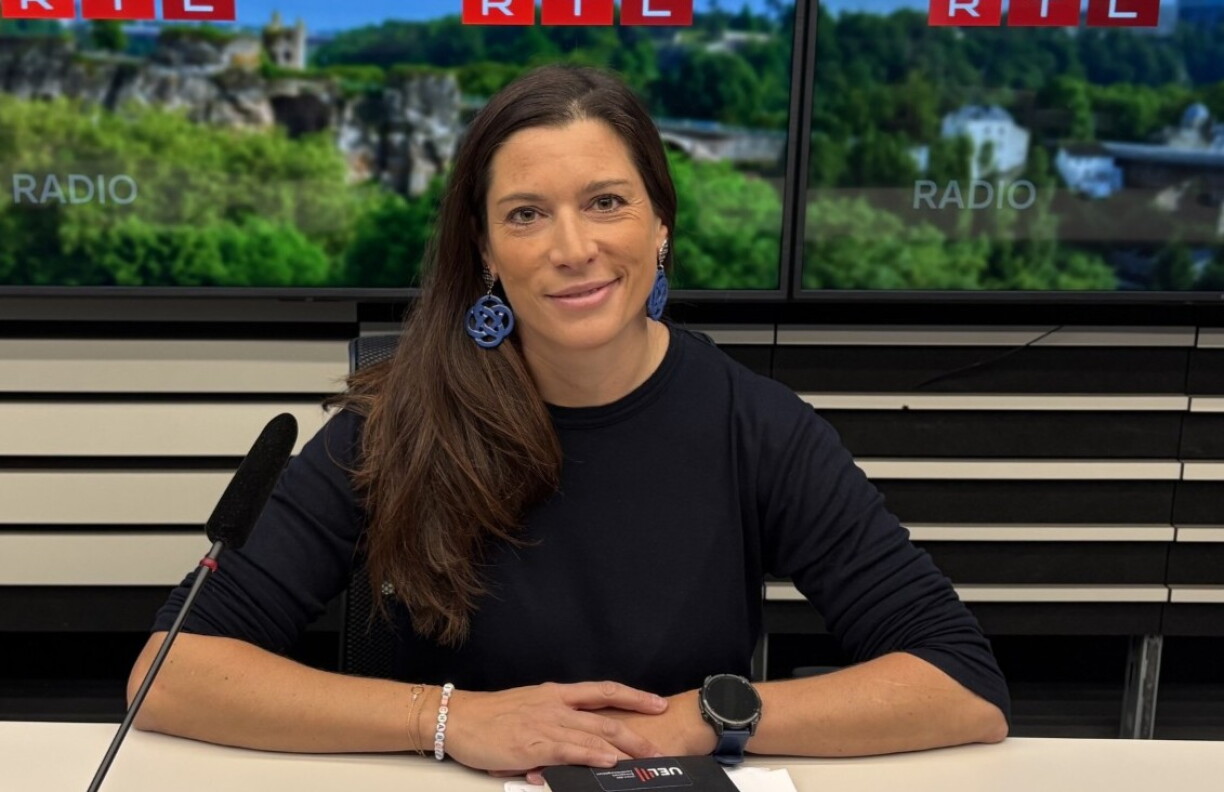
Charlotte Junck, who recently took over as UEL director, says the federation's key mission remains unchanged: representing the interests of Luxembourg's businesses. She signals, however, that employers are adopting a more conciliatory tone in social dialogue, hinting at a potential shift from the previous leadership's approach.
Her comments come a little over halfway through the CSV-DP government's term and after a period marked by significant tension between unions and employers, particularly over collective agreements and pensions. She recently succeeded Marc Wagener as UEL director, while Marc Lauer replaced Michel Reckinger as president. Junck declined to assess her predecessor's work, but described social dialogue as "a bit like being in a couple", with periods of greater or lesser harmony.
She said there are topics where consensus is more easily achieved, and others where disagreement is the norm. Some situations foster compromise, while others are more strained. Referring to the Tripartite agreement reached last week, Junck argued that even with "absolutely legitimate" diverging interests, it is still possible to find common ground.
Junck said government intervention to dampen inflation generated less friction in social dialogue than other contentious issues. However, she called Luxembourg's wage indexation mechanism "delicate", a double penalty for businesses, which first have to absorb cost increases and then raise salaries. Despite these challenges, she said, Luxembourg enjoys more social peace than many other countries, and people should be "glad" to live in a country where purchasing power is actively protected.
One particularly sensitive area is the organisation of working time. Both the government and business associations are seeking greater flexibility. Marc Spautz, who recently succeeded Georges Mischo as Minister of Labour, has put forward new proposals, with the aim that collective agreements should provide for more flexible working arrangements.
"It is no secret that we would have preferred this to be enshrined in law", Junck said. She also questioned how small businesses would be treated under the new system. While the UEL and the unions are currently examining the proposals, Junck indicated that employers will be seeking "openness" at the next meeting of the Permanent Employment Committee.
At the start of the interview, Junck introduced herself as 41 years old and originally from Dudelange. She also spent three years living in Madrid while her father, Roland Junck, worked for ArcelorMittal.
She studied law and criminology in Paris and Strasbourg, and after working as a lawyer, established the legal department at Päiperléck aides et soins à domicile. Junck emphasised that she is "absolutely not" affiliated with any political party.