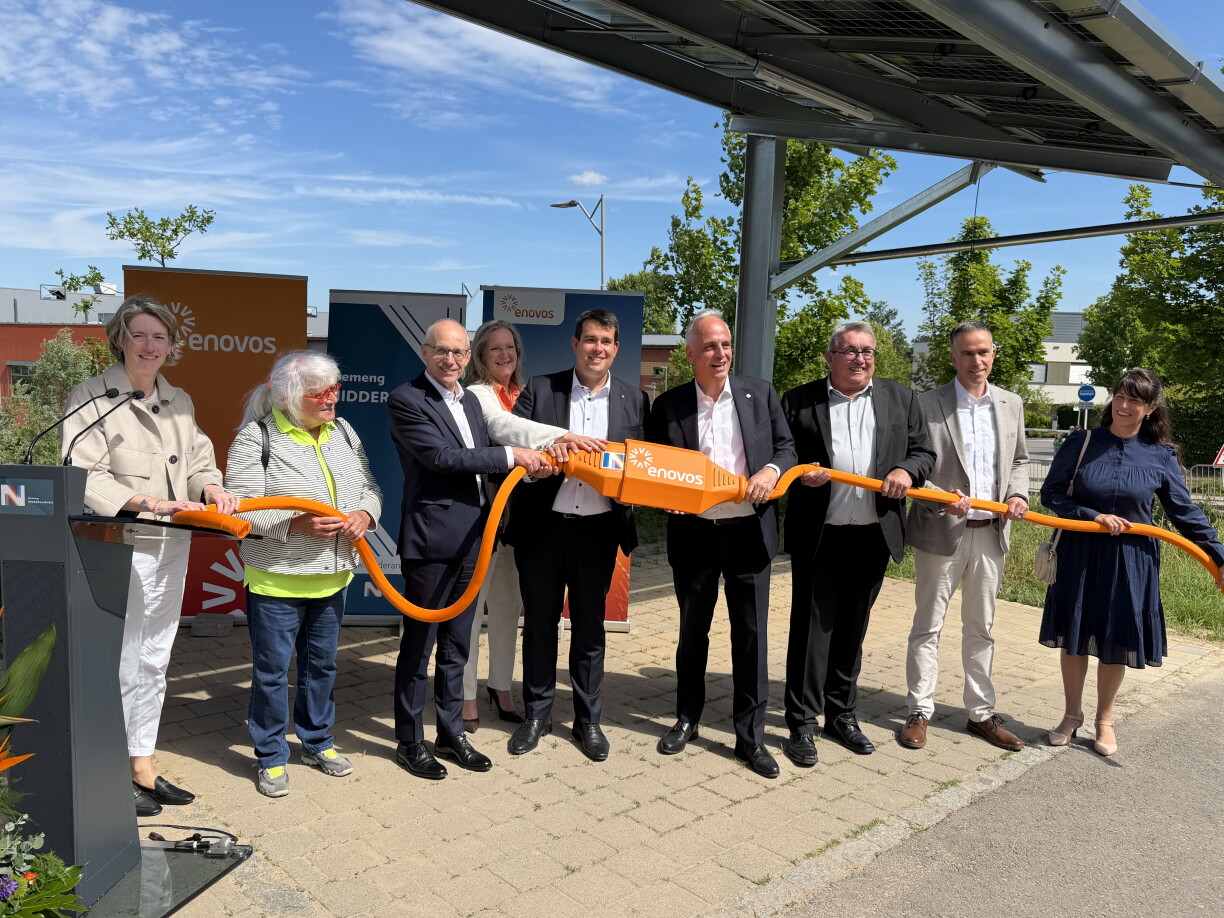
The energy transition was recently one of the major topics discussed during the tripartite talks. However, if ambitious climate targets are to be achieved, concrete projects are also needed at local level.
PM Luc Frieden visited Niederanven on Monday to see one such project. The municipality presented its new solar carport at the Maison Relais, while also outlining its new energy transition strategy.
The municipality of Niederanven has set itself ambitious goals. By 2030, the private housing sector is expected to become climate-neutral, followed by the municipal administration and all communal buildings by 2040, and the entire municipal territory by 2050.
Mayor Fréd Ternes explained that the municipality's approach is based on four pillars.
He explained that the first and main pillar is photovoltaics, while the second is wind energy, as the municipality also needs an alternative renewable energy source to solar power. Ternes added that the third pillar is an energy community, which the municipality wants to launch by the end of this year.
He noted that it will be a regional community open to everyone, allowing producers who have their own photovoltaic panels to earn more for the electricity they generate but do not use themselves, while consumers can access cheaper electricity. According to Ternes, this would make everyone a winner.
He said this is also linked to wider energy infrastructure, concluding that the fourth pillar is a comprehensive decarbonisation strategy.
Current figures show that the municipality has long invested in solar energy. Solar installations in Niederanven now produce around 9.8 million kilowatt-hours of electricity per year.
A concrete part of this strategy is the new solar carport, which covers the entire car park in front of the after-school care centre ("Maison Relais"). While cars parked beneath the panels are protected from sun and bad weather, renewable energy is produced at the same time.
The project was carried out in close cooperation with Enovos, Luxembourg's main energy supplier, which supported the municipality in planning and implementing the solar carport.
According to Enovos director Eric von Scholz, the installation produces roughly enough electricity for 150 households and saves around the same amount of CO2 as 20 cars emit in a year.
He said the scale of the project was interesting because, once several such installations are in place, they become worthwhile and the electricity can also be used locally. The system can also be used to charge a number of cars, von Scholz added.
Alongside expanding energy production, the municipality also wants to reduce consumption. Planned measures include energy-efficient renovations, support for heat pumps, smarter management of energy use, and the expansion of electric mobility.
At the same time, energy communities are to be created so that locally produced electricity can be shared and used directly within the region.
For PM Luc Frieden, initiatives of this kind are an important part of the national energy transition.
Frieden said the state is also supporting households and businesses in this process. During the tripartite talks, the government again decided to increase the Klimabonus Wunnen scheme, making it easier for people to carry out energy renovations on their homes, he said.
Frieden stressed that what is needed above all is a concept, political will, and communication to explain to citizens what is possible and what support is available from the state. Together, he said, these goals can be achieved.
In its energy transition strategy, the municipality of Niederanven is deliberately focusing on citizen participation. Regular citizens' meetings, a climate forum, and a dedicated energy transition committee are intended to ensure that residents are actively involved in the process.
With almost 10 million kilowatt-hours of solar electricity produced per year, Niederanven is already among Luxembourg's frontrunners in the field of photovoltaics.





