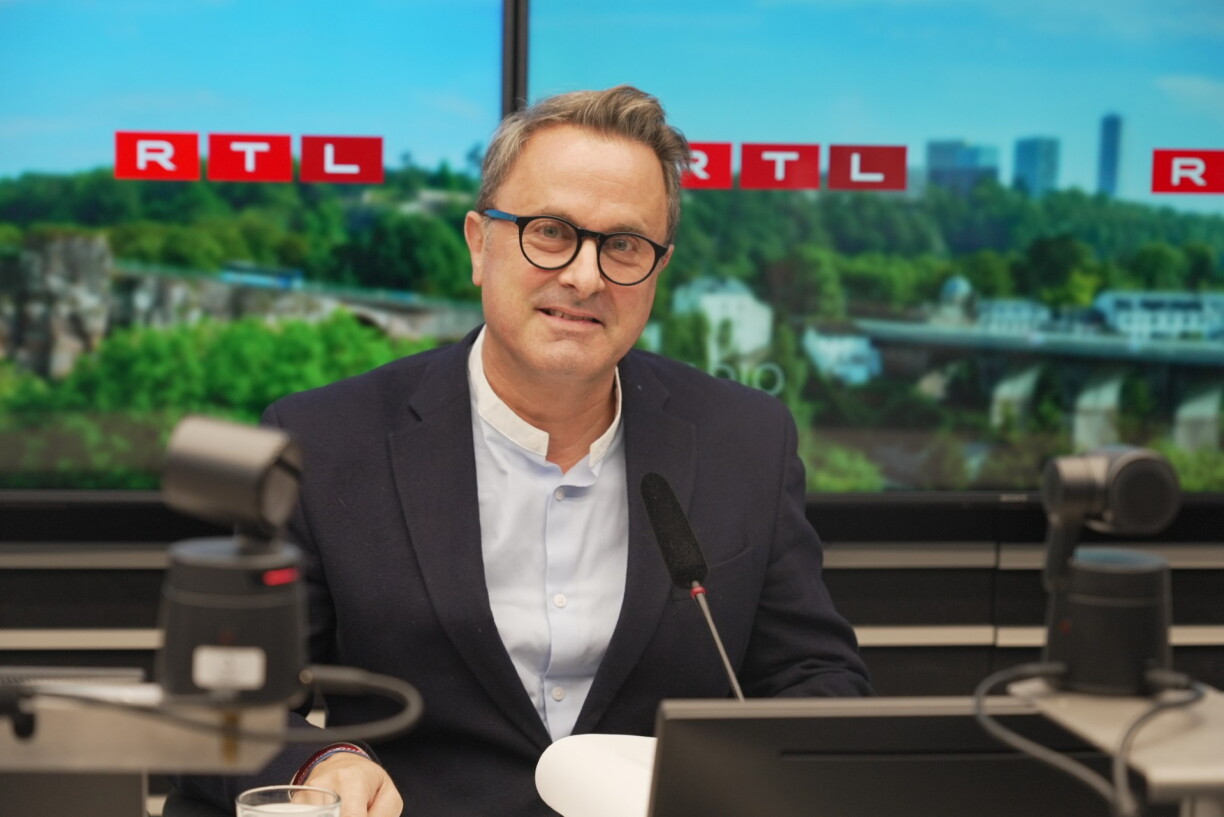
On Saturday, Foreign Minister Xavier Bettel sat down for an interview with our colleagues from RTL Radio.
Regarding the Israel-Palestine conflict, Minister Bettel described it as "one of the most complicated issues" he faces. He stressed that without peace in Palestine, the broader situation cannot improve.
The minister expressed caution regarding the political landscape in Israel. While he acknowledged that a potential new government could present an opportunity for policy shifts, he noted he does not automatically expect a major change in the conflict with the Palestinians.
Bettel said he would welcome the exclusion of far-right ministers Itamar Ben-Gvir and Bezalel Smotrich from a future government, calling their absence a "big win." However, he warned that any new coalition could be "very fragile", as the participating parties do not necessarily agree on all issues.
Ultimately, Bettel argued, the decisive factor is not just who is in power, but whether there will be a tangible change in policy toward the Palestinians.
Describing the situation in Gaza as a "scandal", the Deputy Prime Minister criticised the inaction of both Europe and the United States.
Bettel stopped short of using the term "genocide", arguing that it is a "legal definition" that must be determined by international courts. However, he stressed that this distinction does not change his view that Israel’s actions in the Palestinian territories must be halted.
While Bettel characterised the recent US midterm elections as a major success for the Democratic Party, he cautioned that the US’s future policy direction still warrants careful observation.
The minister pointed out that US President Donald Trump retains significant executive power, even without a congressional majority. Bettel expressed hope that the US will return to a greater emphasis on international cooperation, stressing that "one should never lose hope." Regarding the Democrats, he noted that the party must now overcome its internal divisions to offer a united political alternative.
Addressing the military campaign against Iran, Minister Bettel criticised the unilateral strikes carried out by the US and Israel, emphasising that international law must apply equally to all states.
Beyond the energy crisis triggered by potential blockades in the Strait of Hormuz, Bettel expressed deep concern over the risk of a global food crisis. He noted that while the US and Israel made the unilateral decision to attack Iran, the entire world is left to suffer the consequences.
Turning to the conflict in Ukraine, the minister insisted that any peace agreement must not be concluded at Ukraine’s expense. He drew on his own experiences talking to Russian President Vladimir Putin and Ukrainian President Volodymyr Zelensky during his tenure as prime minister.
Bettel also pushed back against the tendency to criticise smaller nations when they take independent diplomatic initiatives.
Warning that Europe's security situation is deteriorating, Bettel highlighted cyberattacks, disinformation, and drone technology as ever-growing challenges. To counter these threats, he argued that Europe must strengthen its own defence and technological capabilities while reducing its dependence on other global powers.
In his view, Europe has left behind its previous era of peace. The continent must now take on greater responsibility, foster deeper integration, and prioritise diplomatic solutions.
On a domestic level, the minister argued that planned investments in the defence industry should not all be directed abroad. If one billion euros per year is to be invested in the sector, Luxembourg must see economic benefits, he said. To achieve this, he is advocating for security and tech companies to establish operations in Luxembourg and create local jobs.
Regarding China, Bettel advocated for dialogue paired with clear rules. He warned that Europe must not allow itself to be economically dominated by Chinese industry, though he acknowledged that decoupling entirely from China is unrealistic, particularly for critical technologies like computer chips and solar panels.
Bettel also outlined a pragmatic approach to the United States. Although he described himself as "no fan" of Donald Trump, he noted that Trump was democratically elected and emphasised that maintaining dialogue with the US remains essential.
Nevertheless, he stressed that Luxembourg cannot simply accept every demand. "I do not kneel; I am not a vassal", Bettel said, concluding the interview by stating his preference for direct, closed-door discussions over public confrontations.