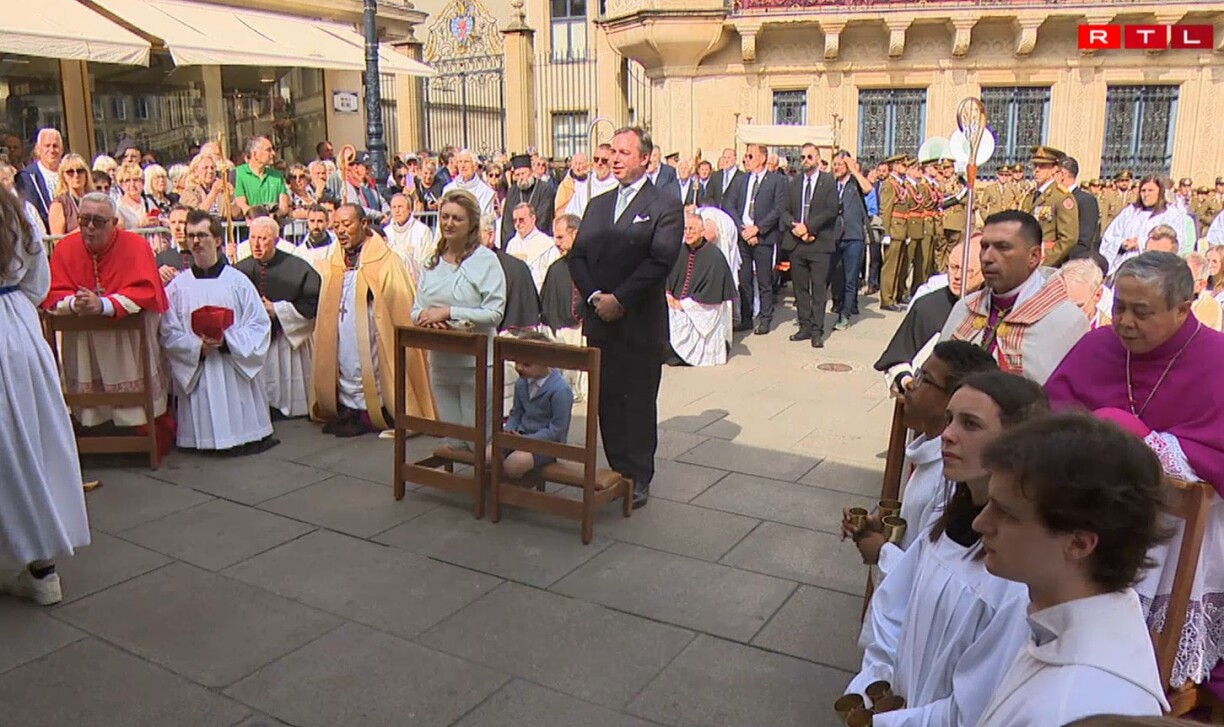
After two weeks of pilgrimages and prayer, the Octave of Our Lady came to an end on Sunday with the traditional closing procession through the capital.
The sound of church bells, musicians preparing to perform, and thousands of worshippers gathered around the cathedral once again marked the official conclusion of one of Luxembourg's most important religious celebrations.
The closing procession is a long-standing tradition in Luxembourg. For some, it is something they have known since childhood and continue to take part in as adults. Others come simply to watch. Many young people were also present this year, including altar servers from Echternach.
Ahead of the procession, a special atmosphere could be felt as participants prepared, put on their robes, and exchanged a few final words before setting off.
Thomas Delcominette, who has been an altar server in Echternach for 15 years, said he had been interested in the tradition since childhood. He explained that the many processions, as well as the sight of cardinals, bishops, and all the other participants, made the occasion particularly impressive.
For Delcominette, this also helps encourage others to take part, as everyone contributes something of themselves to the event.
The Octave has existed for more than 400 years and is now part of Luxembourg's intangible cultural heritage. For many worshippers, it is a combination of faith, tradition, and community.
Renée Schmit, president of the Octave Commission, explained that 40 groups took part in this year's closing procession. These included several foreign communities, among them Croatian, Italian, Portuguese, and English-speaking groups.
She also highlighted the presence of a Maronite priest, who joined the procession with members of his community, including Lebanese refugees. The sermon in the cathedral was delivered by Ägidius Zsifkovics, the Bishop of Eisenstadt in Austria.
The tradition of the Octave dates back to 1624, when the Jesuits settled in Luxembourg and promoted devotion to the Virgin Mary. During a period marked by plague epidemics, a wooden statue of Our Lady was erected and quickly began attracting large numbers of pilgrims.
Today, thousands of worshippers from Luxembourg and the Greater Region continue to make their way to the capital over the course of two weeks to honour Our Lady, Comforter of the Afflicted, in the cathedral.







