Eighty-four years ago, Luxembourg resistance fighter Raymond Petit died in tragic circumstances.
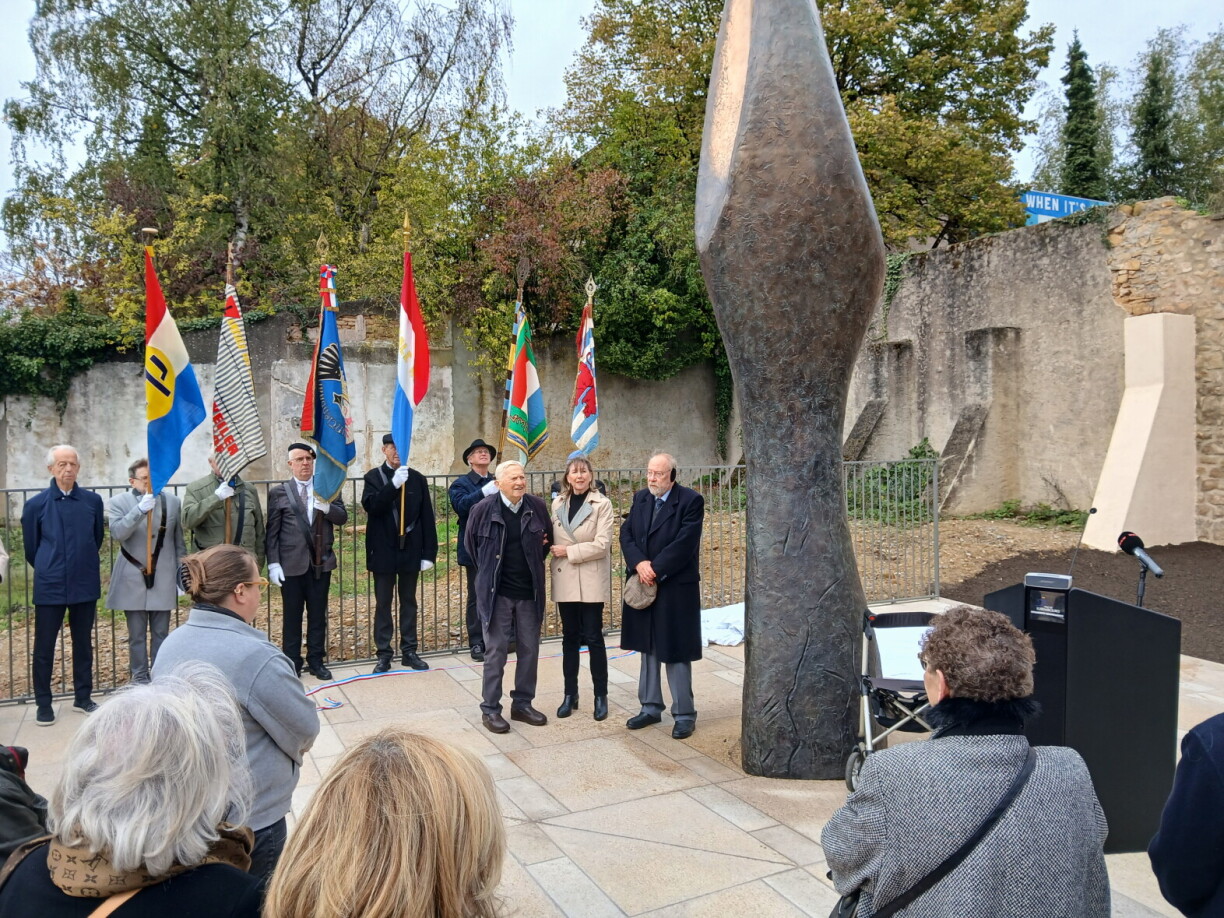
In a move to honour his memory, and that of the wider resistance movement during World War II, the City of Luxembourg has inaugurated a memorial site featuring a new sculpture. The unveiling ceremony was attended by city representatives and relatives of Petit, in the same area where he once lived.
Luxembourg was invaded by the German Wehrmacht on 10 May 1940. In response, the Luxembourg Patriotic League (LPL) was founded on 4 September 1940 in Echternach. Among its founding members were Raymond Petit and Henri Roth, brother of the author Lex Roth.
The LPL undertook actions such as distributing leaflets against the German occupation, opposing the census, and helping those seeking to join Allied forces. On 21 April 1942, aged just 22, Raymond Petit died in Berdorf. Trapped in a house surrounded by the Gestapo, he chose to shoot himself rather than risk being captured, tortured, and forced to betray his fellow resistance members.
As Lex Roth later commented, Petit's act represented the ultimate sacrifice: One really cannot do more than that, for one’s country and for our freedom. Lex Roth remarked that even if, 85 years later, their children and grandchildren can no longer fully imagine what happened, it cannot be held against them.
He added that his own generation also knows little of the First World War, other than what can be read in history books. This, he argued, is why it is so important to continue remembering people like Raymond Petit and the stories of their courage.
The memorial has been installed on the Route d’Arlon, near Place de l'Étoile, at the precise spot where Raymond Petit's family home once stood.
The City of Luxembourg bought the property as part of plans to extend the tram line, with Petit's nephew, who bears the same name, having previously owned the house. Mayor Lydie Polfer explained that while there was outside interest in the building, Raymond Petit’s nephew was only willing to sell on one condition.
Polfer recounts that, for him, it was absolutely essential that, through this purchase and the redevelopment here, there would always be a lasting commemoration of his uncle and, by extension, all those men and women of the resistance who helped ensure that Luxembourg remains independent and free.


Raymond Petit, the nephew, is himself a sculptor, so he was the natural choice to become the designer of the monument in honour of his uncle. Entitled “Le Flambeau” (The Torch), the sculpture features a torch as a symbol of freedom. Petit began with a small-scale model.
Describing the process, he explained that the model was then enlarged by a specialist company using laser technology. At that stage, it was just the form, without any structure, which was subsequently added. Afterwards, the foundry created negatives in several pieces, cast them, before the patina was applied and any finishing touches were made.
The sculpture will eventually be relocated. As part of the broader redevelopment of Place de l'Étoile, a new square will be created and named after Raymond Petit. Until then, the torch remains in its current position, the former house number 14 on Rue d’Arlon.
A plaque from the Luxembourg Patriotic League (LPL) at the site also reminds passers-by that this was once the location of Petit's childhood home and commemorates the sacrifice he made as a member of the resistance.