
Among those affected was Stelio Kokkinos, who had spent a week on vacation in Dubai and suddenly faced a difficult situation.
Stelio Kokkinos was in Dubai when the attacks on Iran began. His flight to Luxembourg was planned for 2 March, just two days after the start of the attacks.
"My flight from Dubai was cancelled twice. That’s when I realised that the situation could last longer”, Kokkinos recounted.
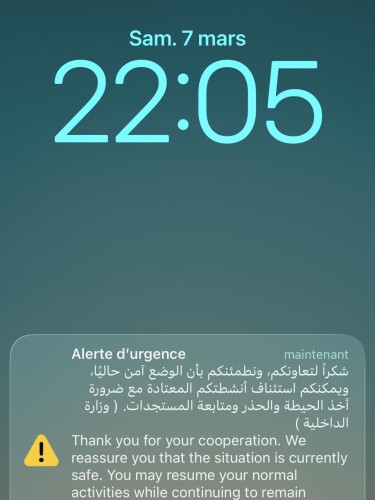
The days leading up to the evacuation were shadowed by uncertainty and worry.
Kokkinos remembered hearing “sounds of rocket interceptions in the sky" and regularly receiving "alarm messages", which urged them to seek shelter and stay away from the windows.
He had to go down to the basement of his hotel a few times.
At first, he didn’t know whether rockets had hit the ground and, if so, how close they were to him.
“That scared me the most”, he admitted.
At the same time, he emphasises that the authorities in the Emirates had managed the situation well. The communication had been clear and helped prevent the spread of panic.
Already the day after the attacks began, he was contacted by the Luxembourg Ministry of Foreign Affairs.
Kokkinos said that he was asked whether he was "okay or in danger", and "gave him advice. " It was immensely reassuring to know that they were already thinking of us”, he recounted.
In the following days, he was offered repatriation via Oman with Luxair. However, since he didn’t feel safe travelling through another country in the Middle East, he didn’t take that option. When the Ministry later offered him an evacuation directly from Dubai by the military, he agreed with great relief.
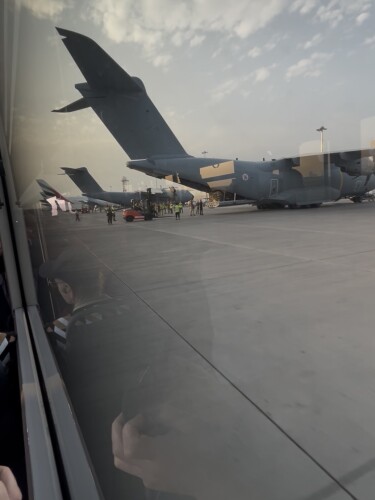
Stelio Kokkinos was repatriated on an A400M plane. In Dubai, there were two aircraft – one from the Luxembourg-Belgian unit and another from the Belgian army. He admitted that “flying is not really my thing”, so seeing the military plane left him a bit uneasy.
But the flight itself was “extraordinary”, he said. “I’ve never felt so safe.”
The soldiers were highly professional, friendly, and helpful. They carefully explained the course of the flight, the safety instructions, and how it differed from a regular commercial flight. Before takeoff, water and earplugs were handed out, since the noise was louder than on a typical plane.
What impressed him most?
He recalled the “professionalism, the communication, and the good spirits. I almost forgot that I was on a military plane.”
At takeoff, however, he felt a bit of fear and a queasy feeling.
“I knew that rockets had probably been intercepted. On top of that, there had been an explosion at Dubai airport the day before.”
He only began to feel calmer about 15 minutes after takeoff, once the plane had left Emirati airspace.

The repatriation was organised jointly by the Belgian and Luxembourg armies. After a seven-hour stop in Hurghada, Egypt – where representatives from the Luxembourg Ministry of Foreign Affairs and the Belgian embassy were present throughout – the passengers continued to receive assistance.
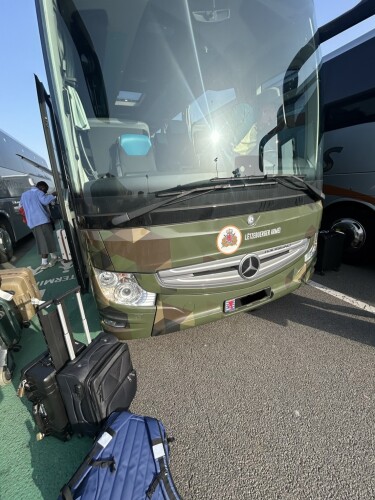
They provided food, drinks, and blankets, set up a modem to ensure internet access, and even had a small infirmary ready for anyone needing medical attention. From Hurghada, the passengers continued their journey on a commercial flight to Brussels. At Zaventem Airport, a Luxembourg army bus was waiting to take them to Findel, where they arrived around 2pm.
Kokkinos reflected on the experience, noting how fortunate he felt to live in Luxembourg and how safe he considers his country: he said he “realised how lucky I am… and how safe I feel.”
It was an experience he knew one would quickly forget in everyday life. Compared with other countries, Luxembourg had acted “very efficiently and quickly.”
He expressed his gratitude, saying he wanted to "thank the authorities and everyone involved from the bottom of my heart”, adding that it was the least he could do.





