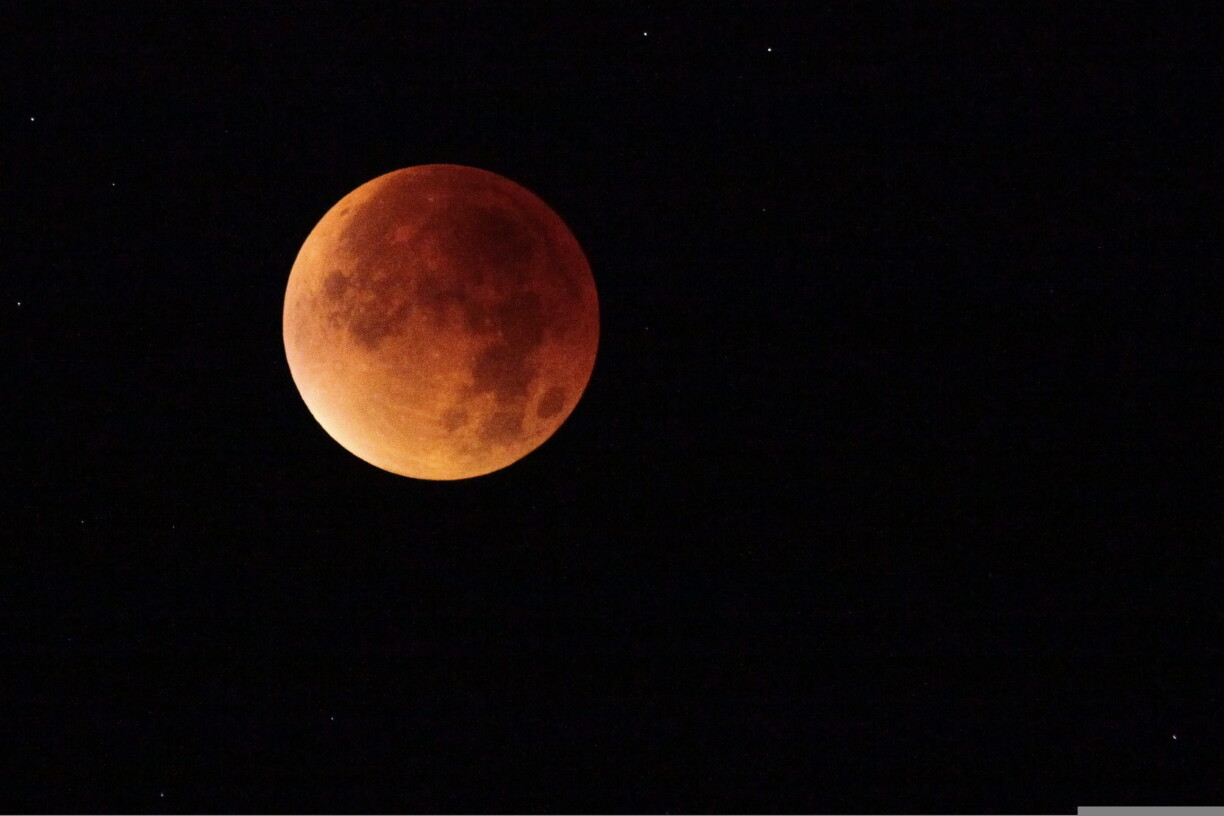
A lunar eclipse occurs when Earth passes between the Sun and the full Moon, blocking the sunlight that normally illuminates the lunar surface and casting a long shadow into space. Unlike a solar eclipse, however, it can be observed safely without filters and is visible from any location where the Moon remains above the horizon.
Because the Moon’s orbit is tilted by about five degrees relative to Earth’s orbit around the Sun, most full Moons pass above or below our planet’s shadow, and an eclipse occurs only when the alignment is sufficiently precise. The same geometry explains why this event follows so closely after the partial solar eclipse seen from Luxembourg on 12 August: both belong to the same eclipse season, during which a solar eclipse at new Moon can be followed about two weeks later by a lunar eclipse at full Moon.
The eclipse begins at 3.23am, as the Moon moves into the penumbra, the faint outer part of Earth’s shadow where sunlight is only partly blocked, although the initial dimming may be difficult to notice. The change becomes much clearer at 4.33am, when the Moon reaches the umbra, the darker central shadow where Earth completely hides the Sun from the lunar surface. Over the following hour and a half, this shadow will spread across the lunar disc, revealing Earth’s rounded outline directly from the ground.
By about 6.12am, roughly 93 per cent of the Moon’s diameter will lie inside the umbra, leaving only a narrow bright section outside Earth’s dark central shadow. This will be a very deep partial eclipse rather than a total one, since nowhere on Earth will the Moon become completely immersed in the umbra.
The shadowed portion may take on copper, orange or reddish tones because some sunlight still passes through Earth’s atmosphere and is bent towards the Moon. Blue wavelengths are scattered more readily, allowing red and orange light to reach the lunar surface, while dust, clouds and other atmospheric particles determine the Moon’s final colour and brightness.
For observers in Luxembourg, the eclipse will be a race between Earth’s shadow, the brightening dawn and the western horizon. At maximum eclipse, civil twilight will have just begun, and the Moon will stand only about five degrees above the west-south-west horizon. Sunrise will follow at around 6.45am, only a few minutes before the Moon sets near 6.52am with the eclipse still in progress.
With the Moon so low, a completely unobstructed horizon will matter more than finding the darkest possible site. A high viewpoint or open field with a clear view towards the west-south-west will offer the best chance, since trees, buildings and Luxembourg’s hills may hide the Moon well before the calculated moonset.
Anyone wishing to follow the visible partial phase should be ready by about 4.20am, shortly before the Moon begins entering the umbra at 4.33am. The most striking transformation should occur between roughly 5.15 and 6.15am, although even thin cloud or haze near the horizon could obscure the final stages.
No glasses or special filters are required, as a lunar eclipse is completely safe to observe with the naked eye, binoculars or a telescope. For most people, binoculars may be the simplest option, providing a closer view of Earth’s curved shadow while remaining easy to use as the Moon approaches the horizon.
For photographers, the low altitude creates an opportunity to include a familiar Luxembourg landscape, castle or church tower in the composition. A telephoto lens will reveal the shadow in greater detail, whereas a wider view can capture the more distinctive story of an eclipsed Moon sinking into dawn.
Observing the eclipse will require an early alarm, an open horizon and some luck with the weather, but the reward will be unusual: an almost entirely shadowed Moon descending into Luxembourg’s dawn and setting before the eclipse is over.
Date: Friday, 28 August 2026
Penumbral phase: Begins at 3.23am
Visible partial phase: Begins at 4.33am
Maximum eclipse: Around 6:12 am, with roughly 93 per cent of the Moon’s diameter inside the umbra
Safety: Completely safe to observe without glasses or filters





