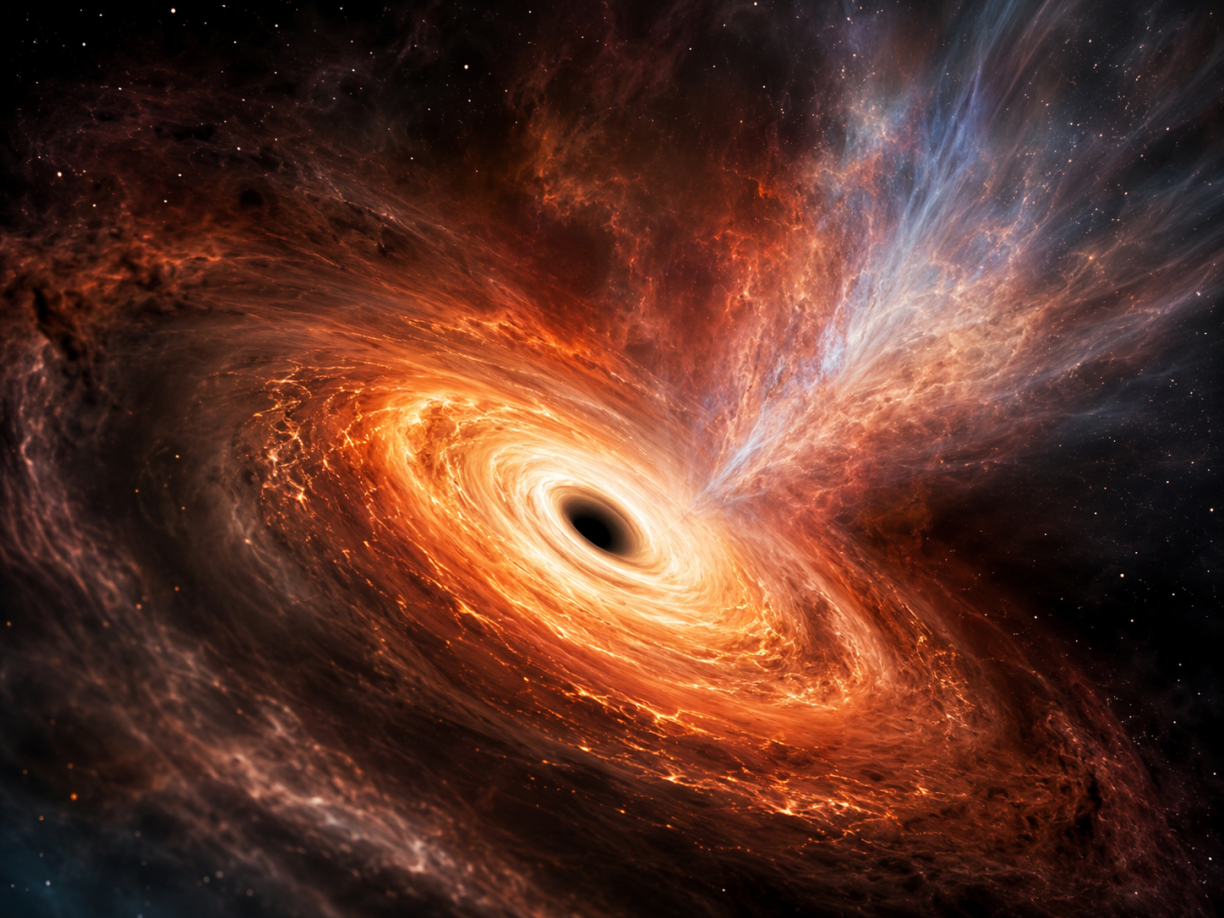
Most massive galaxies host a supermassive black hole at their core, and our own Milky Way is no exception. The object in question is called Sagittarius A*. It sits about 26,000 light-years away, in the direction of the constellation Sagittarius, and has the mass of about four million Suns.
For decades, scientists suspected that Sagittarius A* was pushing material back into space; they just couldn’t detect it. This may sound counterintuitive for an object famous for its inescapable gravity, but not everything that approaches a black hole is swallowed. Some material can be redirected outward, feeding powerful jets or wider cosmic winds.
Of course, this isn't the kind of breeze we’re used to; there is no air in the vacuum of space. The term “wind” describes a stream of hot gas and charged particles flowing out from the region around the black hole. Astronomers have long witnessed this phenomenon in other galaxies, but the wind from Sagittarius A* has proven notoriously elusive.
After decades of searching, astronomers may finally have solved the mystery of its missing wind.
To make the discovery, researchers combined data from two heavyweights in astronomy: ALMA, a powerful radio telescope array in Chile, and NASA’s Chandra X-ray Observatory. While ALMA mapped the cold gas around the black hole, Chandra captured the hot gas glowing in X-rays.
Together, they provided evidence of a stream of superheated gas rushing away from our supermassive black hole. As this wind expands, it appears to have carved a large cavity in the surrounding interstellar material, leaving behind a cosmic track that astronomers could finally trace.
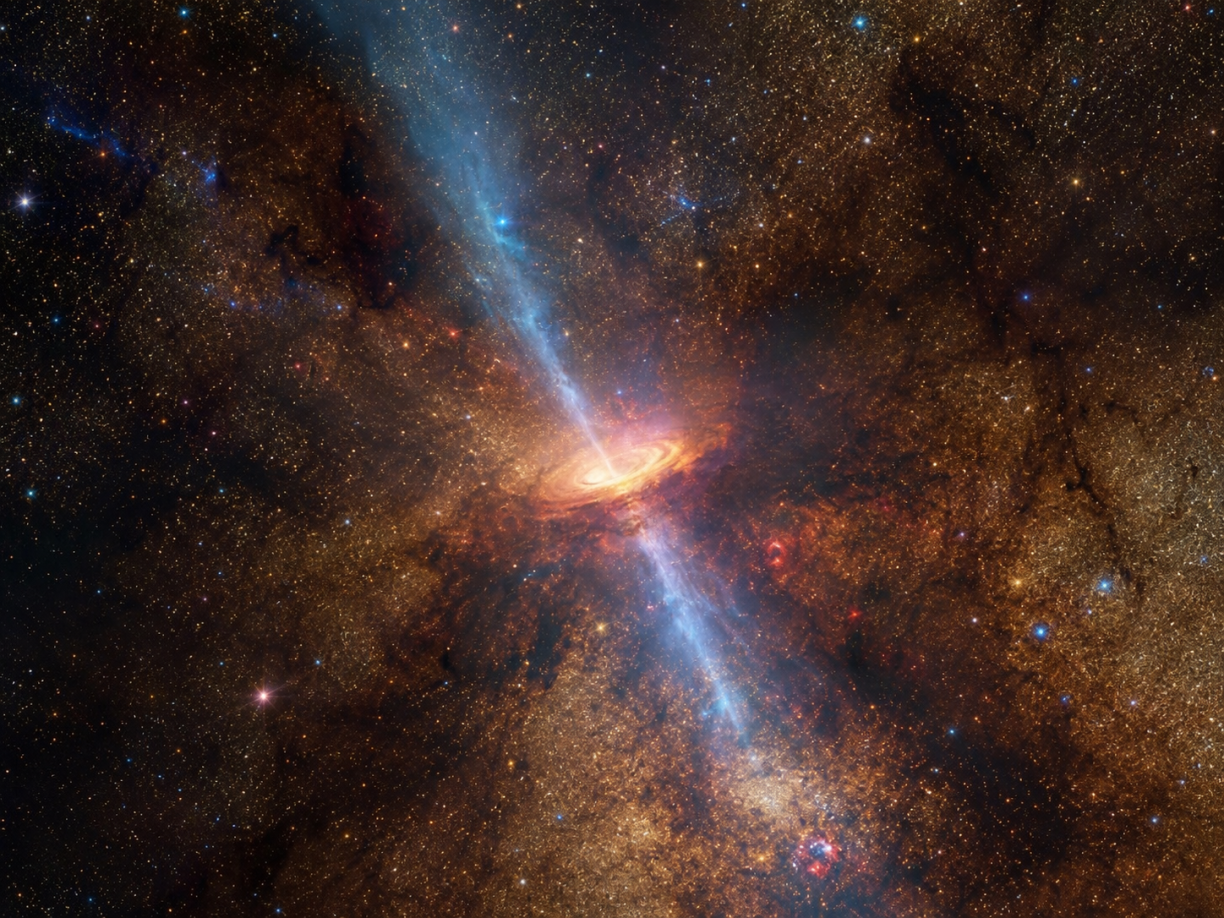
Black holes are often depicted as destructive objects sweeping in everything on their way. Sagittarius A*, however, is remarkably quiet: it isn’t feeding on massive amounts of matter, and it isn't shooting out the massive plasma jets we see in distant galaxies.
That is exactly what makes this discovery so compelling. The wind detected from Sagittarius A* might be mild compared to the torrential outflows of its more chaotic cousins, but when it comes from a supermassive black hole, even a gentle breeze can have extensive consequences.
Over cosmic timescales, these subtle currents shape the gas at the galactic centre, effectively regulating the birth of new stars. In other words, black holes sculpt their surroundings and the future of the galaxy.
When we look at the Milky Way from Earth, it looks like a serene spiral of stars and dust. In reality, the core of our galaxy is a crowded, high-energy region of space where stars orbit at unimaginable speeds and gas clouds twist violently around a central anchor.
Detecting this wind helps astronomers understand how Sagittarius A* interacts with its neighbourhood, connecting our local black hole to a broader universal pattern.
While brilliant, active black holes are easier to spot across the cosmos, they likely represent just a brief, dramatic phase. Quieter black holes like ours may actually represent the norm.
For now, Sagittarius A* remains a difficult object to study. It is hidden behind dense clouds of gas and dust, and much of its activity is far too faint to detect without specialised instruments.
But this discovery adds an important piece to the picture. Even in its quiet state, our galaxy’s central black hole is constantly pushing back, shaping the environment, and quietly dictating the terms of the galaxy we call home.





