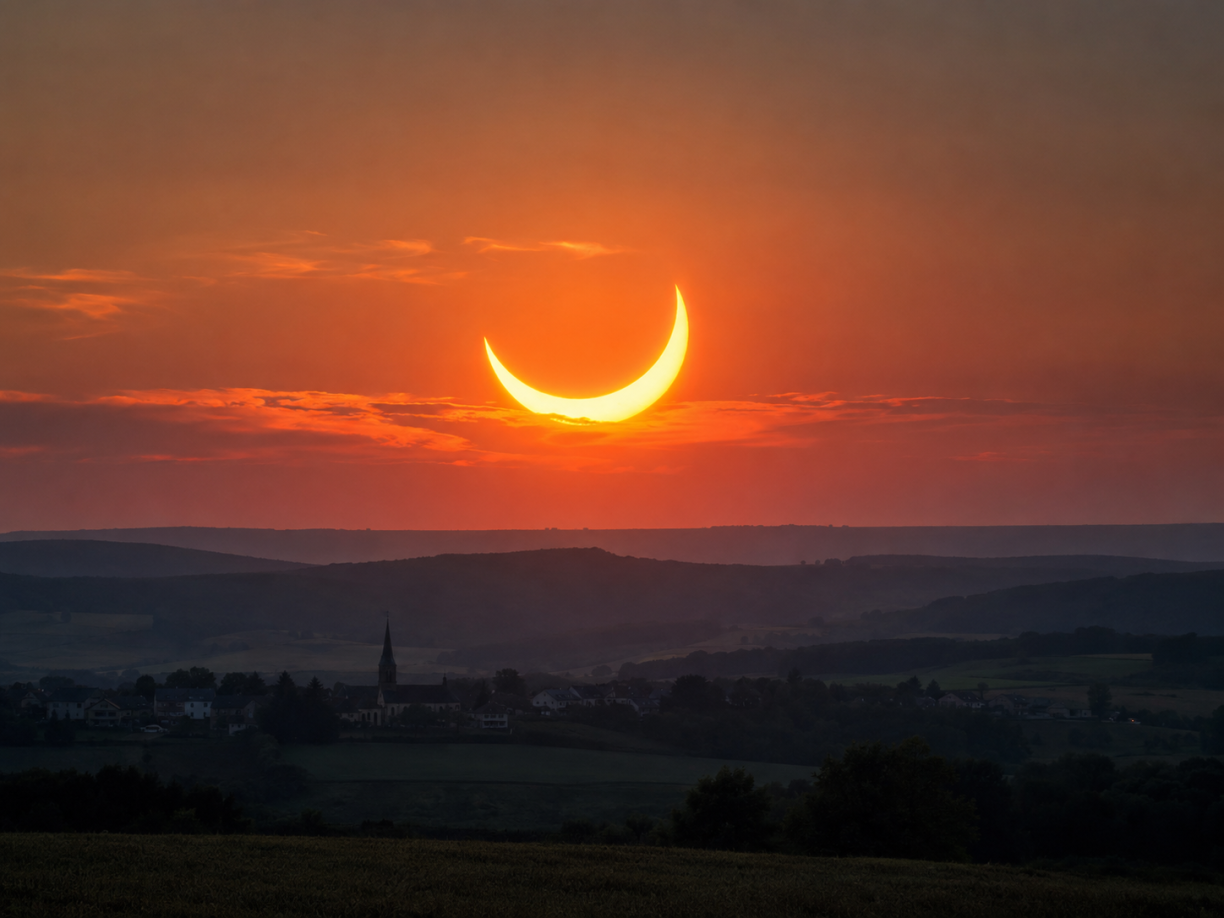
Understanding how an eclipse happens is one part of preparing for the event. Knowing how to watch it safely is just as important, if not more so. The visible part of the Sun may be smaller and less intense as the Moon moves across it, but the light that remains is still powerful enough to damage our eyes permanently!
The Sun is around 1.4 million kilometres wide and lies almost 150 million kilometres from Earth; even at that enormous distance, it provides the light and heat that make life possible on our planet. Its visible surface is heated to around 5,500 degrees Celsius, while the nuclear fusion in its core releases the energy that eventually reaches us as sunlight.
An eclipse changes how much of the solar surface we can see, but it does not make the uncovered part any less bright or less dangerous. At the peak in Luxembourg, around 8.15pm, only a narrow part of the Sun will remain visible. But keep in mind that the crescent is still part of the same intensely bright surface we see every day.
This is why even a brief, unprotected look can cause solar retinopathy, an injury to the light-sensitive tissue at the back of the eye. The most deceptive aspect is that damage may not hurt while it occurs because the retina has no pain receptors. Symptoms can appear later and may include blurred vision, distorted shapes or a dark spot near the centre of sight. Although some people recover, the damage can be permanent.
For direct observation, the simplest solution is a pair of proper eclipse glasses or a handheld solar viewer. These should comply with the ISO 12312-2 international safety standard and come from a reliable manufacturer or supplier. A printed ISO mark alone is not proof that a product is genuine, so glasses bought from unknown online sellers should be treated with caution.
Before using solar glasses or viewers, hold them up to a lamp and inspect them for scratches, punctures, tears or areas where light passes through unexpectedly. If they are damaged, discard them.
Also, put the glasses on before looking towards the Sun, then turn away before removing them. Make sure to supervise children at all times and instruct them properly before the event. Remember, the Sun is beautiful but not forgiving!
Ordinary sunglasses are not enough, regardless of how dark they are. Smoked glass, exposed photographic film, CDs and homemade filters are also unsafe. From Luxembourg, there will be no total phase and therefore no moment when the eclipse can be viewed directly without protection. The glasses must stay on whenever you look at the Sun.
If you’re planning to view the eclipse through binoculars, a telescope, or a camera lens, you need even more caution as optical instruments concentrate sunlight, making it even more dangerous. Looking through an unfiltered lens can cause instantaneous eye damage! Always fasten a purpose-built solar filter over the front of every objective lens before light enters the optics.
If you are not already familiar with solar equipment, the eclipse is not the day to improvise. Use an instrument only under the guidance of an experienced observer or just choose a simpler method.
One of the safest alternatives is pinhole projection. With your back to the Sun, allow its light to pass through a small hole in a piece of card and fall onto a second white surface. The projected image of the Sun will slowly become a crescent as the eclipse progresses.
A kitchen colander can create dozens of small solar images at once, while gaps between leaves often produce the same effect on the ground. The important point is to look at the projection, not through the hole.
Experts from Nightwise and the Luxembourg Science Center will guide you through safe observation at the Solar Eclipse Day 2026 event at Däichhal in Ettelbruck. The free public event, organised by Nightwise and UniPop, will run from 5pm until 1am.
Visitors will receive purpose-built eclipse glasses conforming to ISO 12312-2 standards and will be able to use supervised viewing points, solar telescopes and indirect observation methods, alongside scientific activities for the whole family.
The locally visible phase will be observed safely on site, while the peak and the total eclipse from inside the path of totality will be followed by live broadcast on screens. After sunset, the programme will continue with Perseid watching and telescope observations under a moonless sky. All information about the event is available here:
A solar eclipse should inspire curiosity, not fear. With the right protection, the Sun becomes an extraordinary object to observe and understand. On 12 August, the safest view will also be the best one: a chance to notice the changing shape, explore our star in different kinds of light and share the experience without taking unnecessary risks.
Date: Wednesday, 12 August 2026
Time: starts around 7.20pm, with the peak around 8.15pm
Protection: purpose-built eclipse glasses or handheld viewers complying with ISO 12312-2
Never use: ordinary sunglasses, homemade filters or unfiltered optical equipment
Public event: Solar Eclipse Day 2026, Däichhal, Ettelbruck
Never look directly at the Sun without suitable solar protection





