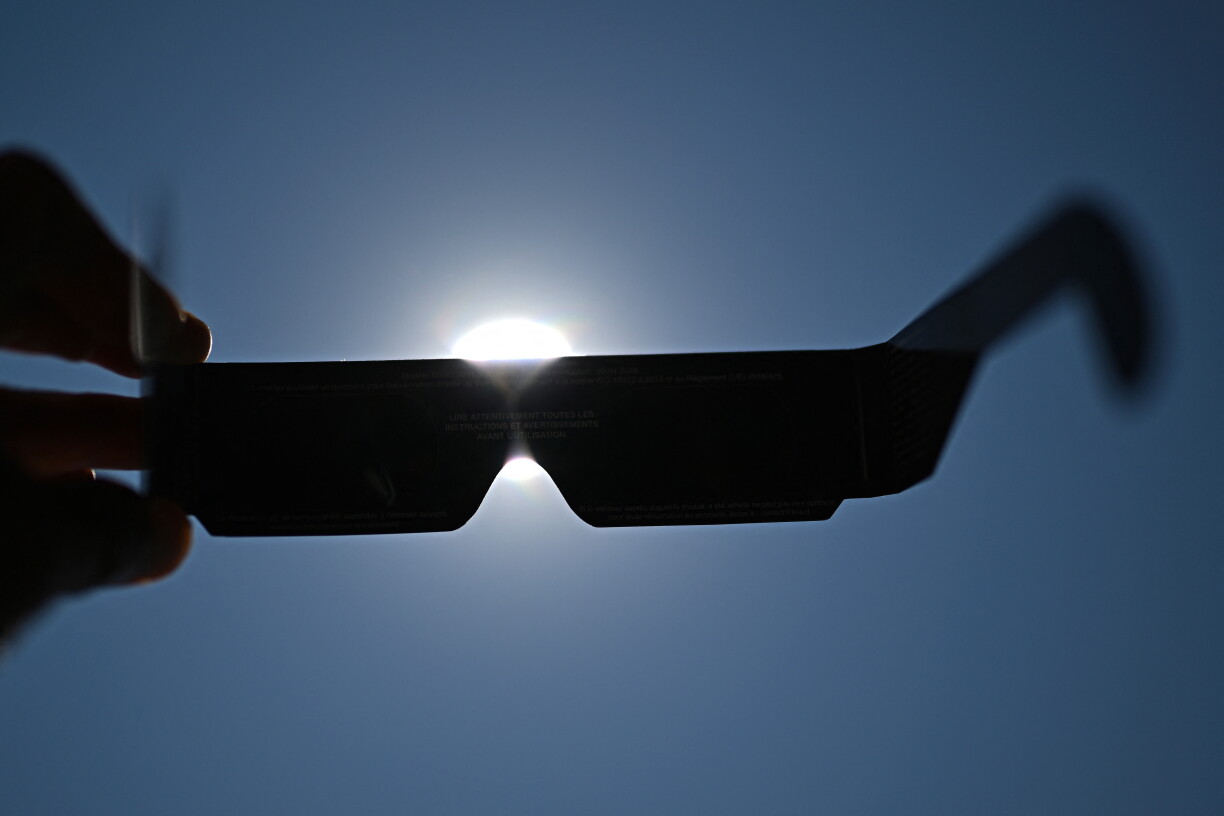
Next Wednesday, an unusual celestial event will take place as a partial solar eclipse graces the skies early in the evening. This phenomenon occurs when the Moon passes directly between the Earth and the Sun, partially obstructing our view of the Sun. Despite the Moon's smaller size, it casts a limited shadow on Earth, revealing the intricate balance of celestial orbits.
This precise alignment is due to the coincidental fact that the Moon, though 400 times smaller than the Sun, is also 400 times closer to Earth. This proportion allows the Moon to occasionally obscure the Sun completely during a solar eclipse. However, Luxembourg will not experience total darkness on 12 August. Instead, as the region lies outside the path of totality, the Sun will remain visible, with only 90% being obscured at the peak of the eclipse. This partial eclipse is a significant event, as the last total eclipse visible here occurred in 1999, and the next total eclipse will be visible in Spain this year.
It is crucial not to look directly at the Sun without proper eye protection, as doing so can cause severe retinal damage. During a solar eclipse, the temptation to look at the Sun is even greater, necessitating the use of special eclipse glasses with protective filters that meet specific ISO standards. These glasses can be obtained from opticians, the Science Centre, or possibly at the Solar Eclipse Event in Ettelbruck. Standard sunglasses are not safe for viewing the eclipse. Alternatively, a camera obscura can be used to watch the partial solar eclipse safely. Instructions to build one are available on science.lu.
The solar eclipse is not the only event to watch for that night. Later, when darkness falls and if the sky is clear, numerous meteors, known as Perseids, will be visible, potentially up to 60 per hour. This occurs as Earth passes through a dust cloud left by the comet Swift-Tuttle. These dust particles, or meteoroids, enter Earth's upper atmosphere at high speeds and burn up, creating the streaks of light known as shooting stars. The Perseids are so named because their apparent point of origin, or radiant, is in the vicinity of the Perseus constellation.
For sky enthusiasts, the partial solar eclipse can be observed across Luxembourg on Wednesday, 12 August 2026, starting at 7.20pm, with the peak at around 8.15pm, assuming clear skies. The Perseids will be visible later that evening once it is completely dark. It is best to find a location with an unobstructed view of the sky, away from street or building lights, for optimal viewing of both events.





