What do Greta Thunberg and Elon Musk have in common?
They both have an autism spectrum diagnosis. Everyone is familiar with characters on TV like Monk, Rain Man, or Sheldon Cooper.
But they represent a very specific form of autism, formerly known as Asperger's, and therefore convey a distorted image of autism.
They could give you the impression that all autistic people are successful and/or exceptionally clever. While this is indeed the case for a minority, most of them face many problems in their daily lives.
In this episode of Ziel mir keng!, we'll explain what autism is and why more and more people are being diagnosed with autism these days. For this video, we worked with researcher Dr Andreia Costa from the University of Luxembourg. She studies how autistic people use 'masking' methods to adapt to society. But these often have a negative effect on their mental health. She also researches how this masking contributes to the late diagnosis of autistic women.
Do you often feel burnt out after being around a lot of people? Do you have trouble maintaining eye contact with the person you're speaking to? Are you extremely tidy?
These could be signs of autism, but not necessarily. Perhaps you're just introverted, or you have an attachment disorder or obsessive-compulsive disorder or you suffer from depression.
We now know that every brain works differently, but there are neurological norms or averages. People whose brains function in a way that aligns with these norms are considered 'neurotypical'. If they deviate significantly from the norm, it’s referred to as 'neurodivergence'.
Examples of neurodivergence include ADHD, dyslexia or, indeed, autism.
But what does that mean, exactly?
Autism is not a curable disease. It is a neurodevelopmental condition. Those affected exhibit:
In addition to these two main criteria:
In the past, a distinction was made between five forms of autism:
These categories are no longer used, as they were imprecise and partially overlapped. Today, we understand it as a single autism spectrum.
Those affected are neurodivergent to varying degrees and on different levels. That's why no two people on the autism spectrum are the same.
People on the autism spectrum are also, to a greater or lesser extent, reliant on outside help. Support Level 1 applies to those who are largely self-sufficient, whereas Level 3 refers to individuals who rely entirely on others for care.
An autism diagnosis is complex and the waiting lists are often long. From initial suspicion to a final diagnosis, it can easily take several months or even years. The individuals concerned have to answer questionnaires and take tests. For example, one test requires you to quickly recognise emotions from faces or eyes. Psychologists or behavioural therapists also interview family, friends and others in the individual's life.Among other things, they investigate whether these traits have been present since early childhood. A psychiatrist then makes the final diagnosis.
A diagnosis like this is particularly important for those who struggle due to their autism. Either:
Many people on the spectrum don't even know they have autism because they've learned to cope. They manage somehow, or their social circle accepts them as they are. Others may struggle, but the possibility of an autism spectrum disorder being the cause of these difficulties hasn't yet been considered.
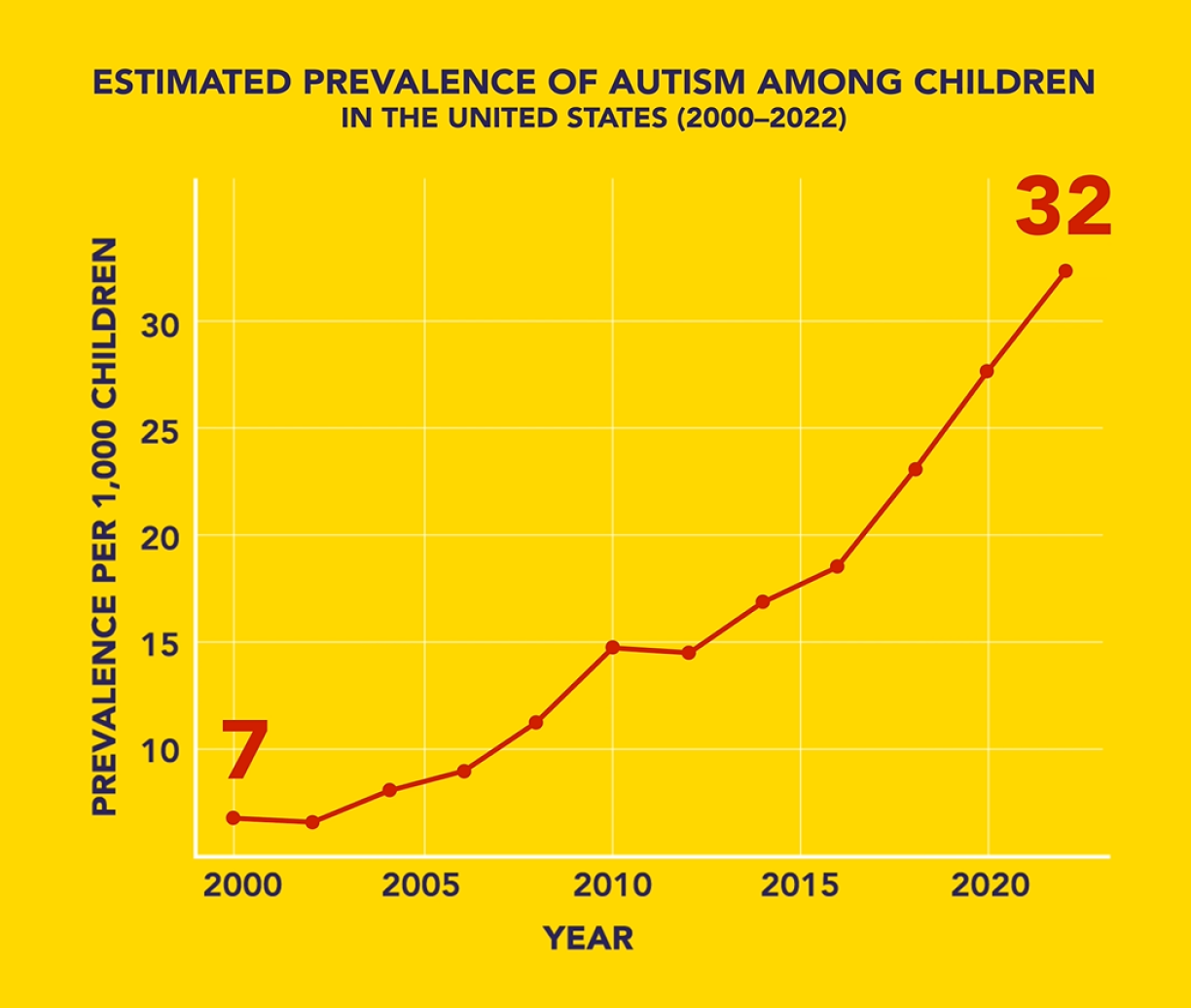
Data from the USA clearly confirms this!
In the year 2000, seven in 1,000 eight-year-old children were diagnosed with an autism spectrum disorder. By 2022, that number had already risen to 32.
Statistics from Europe, South Korea, and Japan show a similar trend. These days, more and more people are being diagnosed with an autism spectrum disorder.
But why is this happening?
The main reason is probably that fewer and fewer people are falling through the cracks.
And there are several reasons for this:
While in the past, the number of unreported cases was higher, today more and more people are being correctly diagnosed.
Incidentally, it's safe to assume that autism is still under-diagnosed because it takes so long to get a diagnosis, and because it is not yet universally known what autism is.
For a long time, it was thought that autism almost exclusively affected boys and men. But that's not true. Recent studies show that many more girls and women have autism than previously thought, and that they were under-diagnosed.
And yet, even today, boys and men are diagnosed two to four times more often than girls and women.
But besides better diagnostics, are there perhaps other factors at play?
It's currently assumed that in about 80% of cases, genetic factors are responsible for autism. The remaining 20% are linked to environmental factors, such as exposure to pesticides or fine particulate matter.
But could these factors explain the rise in diagnoses? The hypothesis about fine particulate matter, for example, doesn't really add up: its concentration in the air has been steadily decreasing since the 1990s, while the number of children with autism has been rising. So that can't really be it.
Another hypothesis is the higher age of the father, or of the parents in general, at birth, but more research is needed on this.
Another frequently mentioned but false hypothesis for the cause of autism is vaccinations.
This all started with the well-known case of Andrew Wakefield. In 1998, he claimed in the renowned scientific journal The Lancet that the vaccine against measles, mumps, and rubella (MMR) caused autism. Subsequently, many scientists tried to reproduce his results, but no one succeeded. What did emerge later was that Wakefield had been paid to prove this – no less than £400,000 by parents of autistic children, in order to demonstrate the link between the vaccine and autism so that the parents could then sue the pharmaceutical companies. The study was retracted, and many studies since have shown that this causal link cannot be confirmed. Other theories, like traces of mercury in older vaccines or the combination of multiple vaccines, have also been scientifically disproved as causes of autism.
Moreover, Donald Trump recently claimed that taking Tylenol, in other words paracetamol, during pregnancy, causes autism. This link has also been refuted in recent large-scale studies.
It’s true that these days, more and more people are being diagnosed with an autism spectrum disorder. The exact reasons are not yet clear, but better diagnostics, greater understanding, and reduced stigma certainly play an important role.
By being open and understanding towards autistic people, we can all help make their lives easier.
Ziel mir keng! is broadcast on Sunday evenings after the programme Wëssensmagazin Pisa on RTL Tëlee and is a collaboration between RTL and the Luxembourg National Research Fund. You can also watch the episodes on RTL Play.
Authors: Jean-Paul Bertemes, Michèle Weber (FNR)
Advice and peer review: Andreia Costa (University of Luxembourg)
Editing: Tom Weber
Presentation: Jean-Paul Bertemes, Michèle Weber (FNR)
Video and illustrations: SKIN
Translation: Nadia Taouil (www.t9n.lu)





