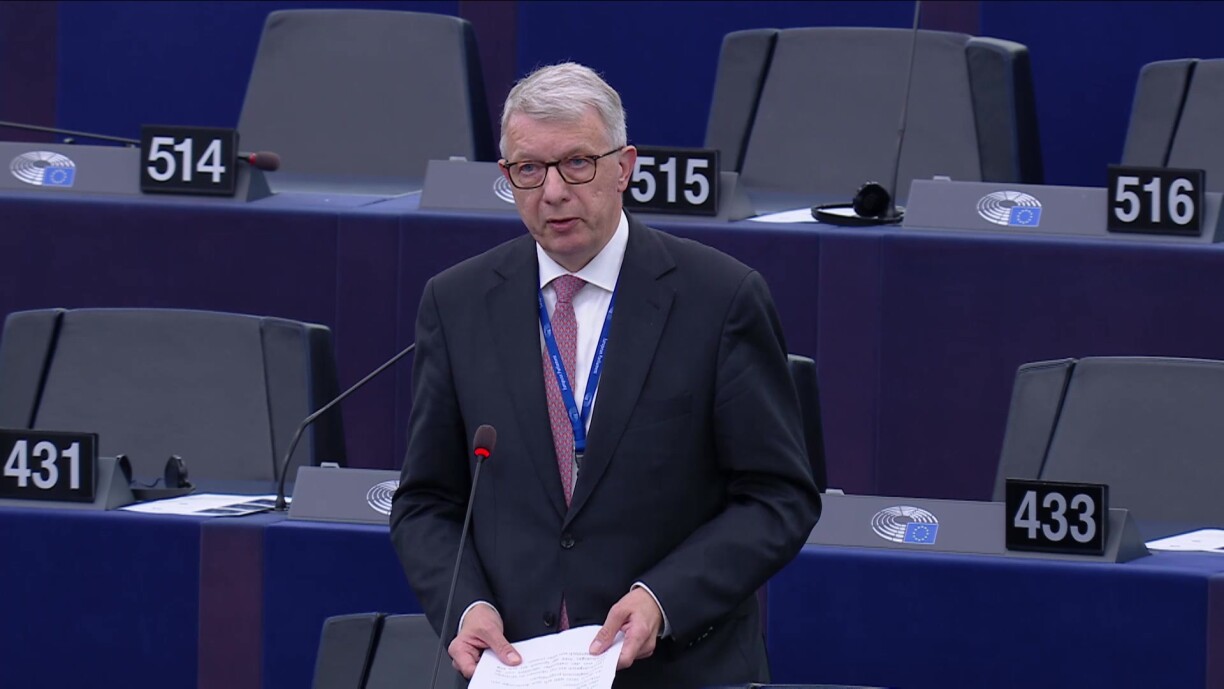
Luxembourg MEP Fernand Kartheiser has come under criticism following his involvement in organising a videoconference between members of the European Parliament and Russian officials, with critics accusing the Kremlin of using the event for propaganda purposes.
Kartheiser, a politician from the Alternative Democratic Reform Party (ADR), organised the videoconference on his own private initiative at the end of 2025. He collaborated with Russian MPs, including far-right Duma member Leonid Sluzki, as well as MEPs from Germany's far-right Alternative for Germany (AfD) and the Sahra Wagenknecht Alliance (BSW).
Sluzki, who also participated in an earlier exchange following Kartheiser's visit to Moscow in May 2025, is regarded as a hardliner within the Russian parliament, particularly for his stance on the war in Ukraine.
Speaking about the initiative, Kartheiser said the goal was to create a basis of trust that would allow progress in areas where dialogue has so far been impossible. He stressed the importance of maintaining official communication channels, noting that several EU member states, including Hungary and Slovakia, continue to maintain relations with Russia. He also pointed out that Luxembourg's ambassador continues to engage with the Russian foreign ministry.
"Not much is happening on the level of the European Parliament," Kartheiser said, explaining that his aim was to continue the dialogue between the European Parliament and the Duma, which officially ended some time ago. "I took this initiative to maintain a bridge between these two parliaments," he added.
In response to criticism that many participants came from the political fringes, Kartheiser noted that all 720 MEPs had been invited to take part. He also expressed bewilderment at suggestions, particularly in German media, that the conference had been held in secret.
Critics have accused the Kremlin of exploiting the exchange for propaganda purposes by portraying it as formal negotiations with European lawmakers. Kartheiser dismissed such concerns, arguing that "you can't protect yourself against that." For him, he said, the important thing was the ability to discuss openly. How each side chooses to present the outcome is a matter for them, he argued, adding that participants are free to form their own judgment.
Kartheiser said his side strives to be "very factual" in its press releases. While he acknowledged that Russian statements on the event were oriented "slightly differently," he took no issue with this, concluding simply that it was "fair enough."
The MEP said he had received criticism from people "who say that you're not allowed to talk to the Russians." He countered that both the United States and Ukraine are engaged in dialogue with Russia, and that it is primarily European countries and institutions that are not.
According to Kartheiser, there was no fixed agenda for the exchange. While the war in Ukraine was "of course" discussed, he maintained that a wide range of subjects could be raised, even if not all questions received answers.





