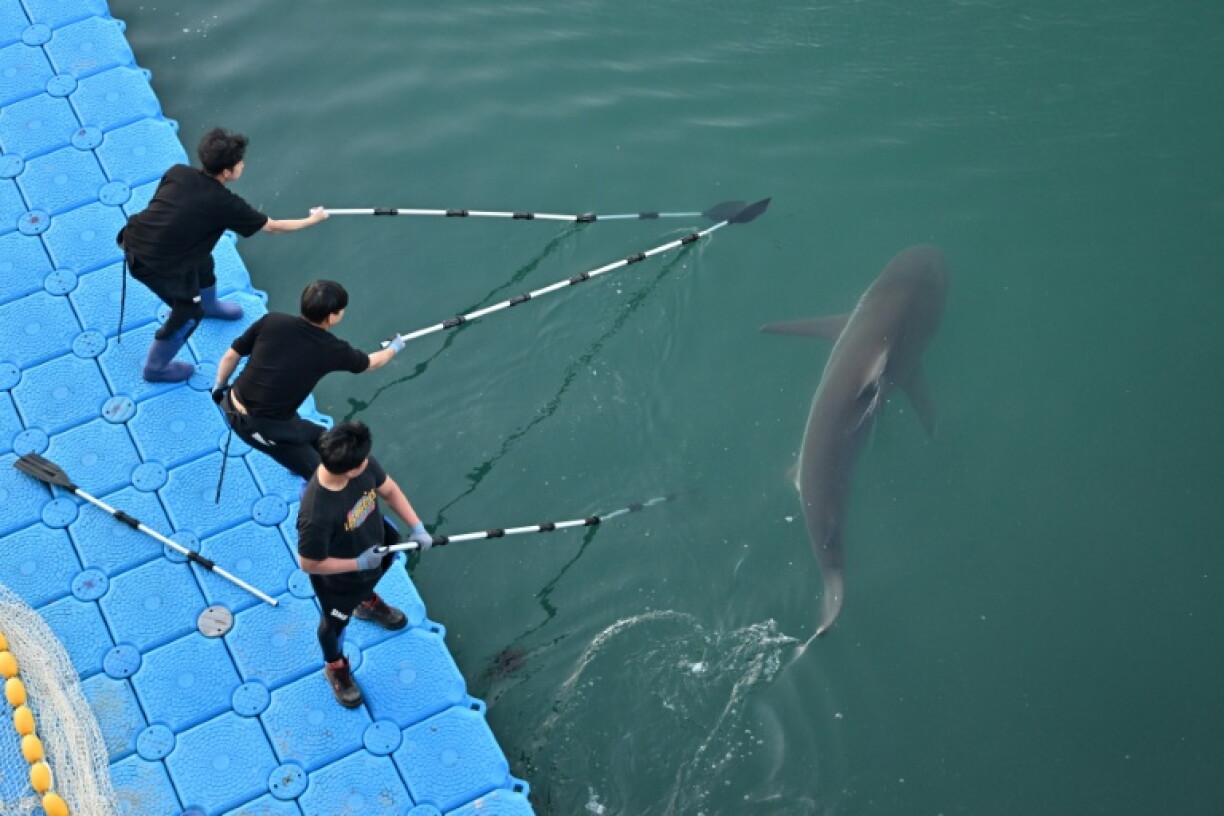
A shark that has become a viral sensation in South Korea was coaxed out of a canal in which it was stuck, authorities said on Wednesday, as falling temperatures raised concerns for its survival.
The shark -- nicknamed "Bukhangi" by fans -- was spotted in an artificial waterway in the southeastern port city of Busan last month, with climate activists linking its appearance to climate change.
"The shark was guided to the southern entrance of the North Port Waterfront Park, where a net barrier was installed to prevent it from re-entering," the oceans ministry said in a statement.
"The shark is now swimming outside the artificial channel, where the water is deeper ... making it less vulnerable to temperature changes as the weather cools and less likely to become trapped."
The canal where it had been stranded was about three metres (9.8 feet) deep.
The three-metre "dusky" shark, a species typically found in tropical climates, amassed a huge following, drawing more than 1.6 million people to the Busan canal for a glimpse and bringing an unexpected boon to the local economy.
Authorities had twice tried unsuccessfully to steer Bukhangi back to sea, using water jets and then nets, before launching a third attempt on Wednesday morning as the water grew colder.
Officials initially opted to wait for the shark to leave on its own, but growing concerns for its well-being prompted a third attempt, a spokesperson said.
The operation was livestreamed by the city as curious onlookers gathered along the canal for a glimpse of the shark.
Busan authorities fixed nets to floating pontoons that were moved gradually as the shark headed towards the open sea.
The nets were intended to block its return to the waterway once it passed, they said.
An ocean ministry official told AFP that experts had raised concerns about the shark's health because it "had not been seen eating and appeared to have difficulty maintaining its balance while swimming".
"These were not normal signs, and the experts believed its condition appeared to be deteriorating," the official said.

The shark has been celebrated for its unexpected boost to the local economy, with Busan Mayor Chun Jae-soo thanking it for generating publicity he said would otherwise have cost "trillions".
However, environmental groups say the shark's appearance should be seen as a warning of the climate crisis, rather than a spectacle or an economic boost.
They link its arrival to warming seas, saying that rising temperatures are pushing warm-water fish northwards, with subtropical sharks in pursuit.
Sharks venturing into South Korean waters is "not common at all", Kim Jin-koo, a professor of global fisheries at Pukyong National University, told AFP last month.
"As water temperatures around South Korea have risen, it appears to have moved closer to the country's coast," Kim said.
cdl/cwl/lga