In the first two parts of this series, we saw how the US constructed the old Middle Eastern order and how Iran built a rival Axis of Resistance.
We ended with Saudi Arabia becoming increasingly nervous. Iranian influence was approaching from the north through Iraq, Syria, and Lebanon, and from the south through Yemen, while the US appeared increasingly reluctant to carry the region's security burden after costly wars in Afghanistan and Iraq.
Saudi Arabia needed an answer. Its search began with Pakistan in 2015.
When the Houthis seized Sana'a and pushed southwards, Riyadh sought help from one of its oldest military partners: Pakistan.
But Pakistan said no to intervention in Yemen.
In April 2015, parliament unanimously called for neutrality while promising to defend Saudi Arabia if the Kingdom itself was threatened. Joining the war risked dragging Pakistan into the Saudi-Iranian rivalry.
More significantly, in a country where foreign and security policy had traditionally been dominated by the military, an elected parliament had rejected a war requested by one of Pakistan's closest allies.
Saudi Arabia had discovered that friendship did not necessarily translate into soldiers.
It therefore had to try something bigger.
In December 2015, Saudi Arabia announced the creation of an Islamic military coalition against terrorism. Pakistan's parliament had blocked participation in Yemen, but Pakistan later returned to the centre of Saudi Arabia's new security project when former army chief General Raheel Sharif became the coalition's first military commander in 2017.
If the US was becoming less willing to police the region, perhaps Saudi Arabia could construct its own security architecture along religious lines.
But sharing a religion is one thing. Sharing enemies is another.
Qatar demonstrated that problem.
Qatar had joined the Saudi-led campaign in Yemen, but Doha and Riyadh disagreed over the Muslim Brotherhood, Al Jazeera, Türkiye's presence in Qatar and, crucially, Iran.
For Qatar, Iran was also geography. The two faced each other across the Gulf and shared the enormous North Field/South Pars gas reservoir. Confrontation with Tehran therefore carried risks.
In 2017, Saudi Arabia, UAE, Bahrain and Egypt blockaded Qatar, demanding, among other things, that it reduce relations with Iran. Qatar refused and was removed from the Yemen coalition, leaving Saudi Arabia increasingly dependent on UAE.
That relationship would develop problems of its own.
Saudi Arabia and UAE had entered Yemen fighting the same opponent, but gradually discovered they were fighting for different Yemens.
Saudi Arabia backed Yemen's internationally recognised government and territorial unity. UAE increasingly supported southern forces seeking an independent South Yemen. Their coalition also faced stiff resistance, while Riyadh and Abu Dhabi increasingly disagreed over Yemen's political future.
UAE gradually reduced its direct military involvement, leaving Saudi Arabia to carry more of the burden in Yemen.
By this time, Pakistan had refused to join, Qatar had fallen out with Riyadh and now even UAE wanted a different Yemen.
It was time for Saudi Arabia to try a different hand.
Saudi Arabia now began looking for ways to talk to Tehran, particularly to ease Iranian pressure on its southern flank. Pakistan reappeared, but this time as a mediator rather than as a soldier.
In 2019, Prime Minister Imran Khan travelled between Tehran and Riyadh, but with no significant breakthrough. Further talks followed through Iraq and Oman.
Then China entered.
Beijing hosted and brokered an agreement in March 2023 under which Saudi Arabia and Iran restored diplomatic relations.
But diplomacy could not eliminate Saudi Arabia's security problem. Iran influenced Hezbollah, Iraqi armed groups and the Houthis, but did not necessarily command them. China could bring two governments together, not necessarily the regional networks underneath them.
Saudi Arabia still needed deterrence.
Meanwhile, the calculus in Pakistan and Türkiye was changing dramatically.
Pakistan had said no in 2015. Over the following decade, its calculation changed.
Repeated balance-of-payments crises made Saudi financial support increasingly important, with Riyadh providing billions through central-bank deposits, deferred oil payments and repeated rollovers.
But money was only one part of the story. Pakistan's confrontation with India was the bigger one.
The 2019 Balakot crisis brought Indian strikes and aerial combat. In 2025, they clashed again, this time much more intensely, using missiles, drones and aircraft while keeping the confrontation below the nuclear threshold.
Pakistan now had its own reasons to seek stronger regional partners against an increasingly assertive India.
Pakistan had also changed politically. Parliament, which had said no in 2015, had become weaker. The Army, historically closest to Saudi Arabia, had become stronger.
Saudi Arabia needed Pakistani military power. Pakistan needed Saudi economic support and strategic partners against India.
Both partners now needed something from the other, unlike in 2015 when Pakistan had little incentive to join Saudi Arabia in Yemen.
Saudi Arabia and Türkiye were hardly natural allies. They had competed over Qatar, the Muslim Brotherhood and regional leadership, against the backdrop of historical Arab-Turkish rivalry. Relations deteriorated further after Jamal Khashoggi's murder inside the Saudi consulate in Istanbul.
But Syria was changing their calculations.
Türkiye had turned against Assad and increasingly feared a Kurdish-controlled belt along its southern frontier linked to groups it associated with the PKK.
Saudi Arabia wanted Assad weakened for a different reason: Syria connected Iran through Iraq to Hezbollah in Lebanon. Assad's fall could break Iran's northern corridor.
Türkiye looked at Syria and saw Assad and the Kurdish question. Saudi Arabia looked at Syria and saw Iran.
Different problems were producing overlapping interests.
The three countries had arrived at the same destination from different histories, different threats and different interests.
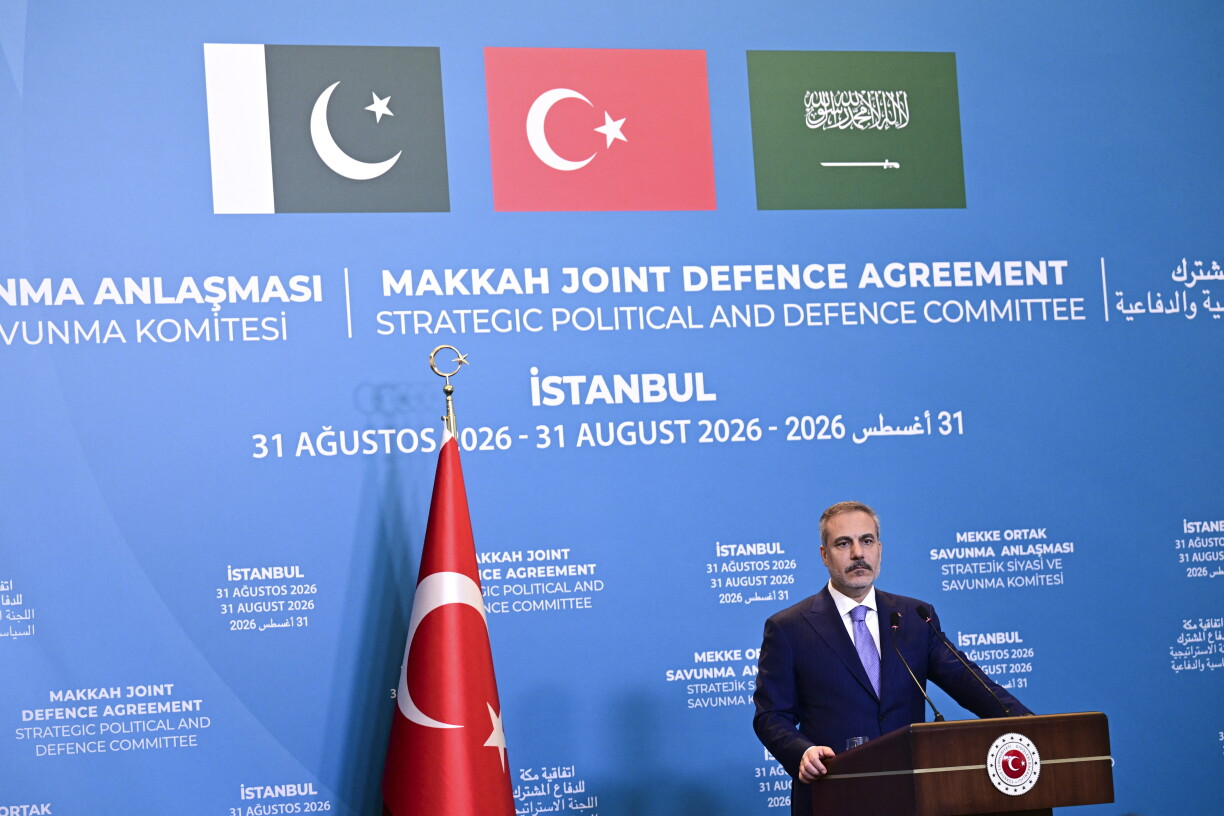
On 7 August 2026, Saudi Arabia, Pakistan and Türkiye signed the Makkah Joint Defence Agreement. An armed attack on one would now be considered an attack on all.
Each could see something different in the same pact.
Saudi Arabia could see stronger collective deterrence against threats from Iran's 'Axis of Resistance'. Pakistan could see two powerful regional partners as its confrontation with India intensified. Türkiye could see a defence framework capable of strengthening its wider strategic position, including in Syria.
But perhaps the most important thing about the Makkah Pact was not who was sitting at the table.
It was who was not.
India. Israel. UAE.
A convergence of interests had brought Saudi Arabia, Pakistan and Türkiye together. But another potential convergence of interests was emerging among the countries left outside.
About the Author: Waqas M Awan is a Luxembourg-based corporate professional and the author of Power of Sage: An Anti-thesis to Machiavellian Prince. He writes on economics, geopolitics, and power systems at his Substack publication Perspectives (waqasperspective). He has held senior finance roles at Amazon, Kraft Heinz, and KPMG.