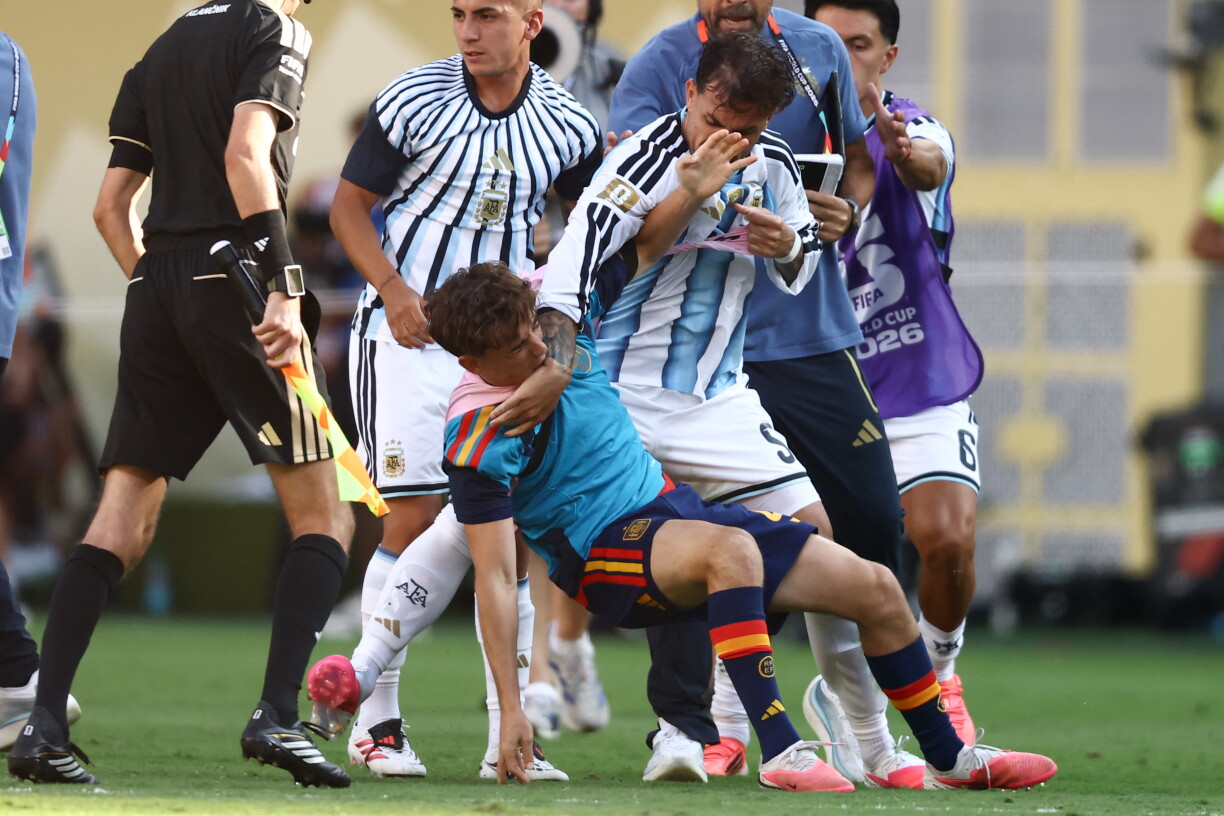
The President of the Luxembourg Football Federation (FLF) recently gave an interview to RTL in which he stated that Argentina winning the World Cup would have been a "catastrophe", that Argentina focused on disruption instead of playing football, that they were unprofessional and provocative, and that they played too rough of a match.
While it is understandable that he may have a personal preference for a team in the final match, his statements are problematic for several reasons.
First of all, let me congratulate my Spanish brethren for a well-played game and a deserved victory. There is no doubt in my mind that Spain played what many would call a "better" match than Argentina, showing true skill in the game.
I will not defend the incidents at the end of the match, though I will say that such events are not rare in competitive football; one need just recall the 2006 final match between France and Italy, where Zinedine Zidane headbutted Marco Materazzi before the penalties and received a red card. I doubt any French citizen is ashamed of that incident.
Or even better, also in 2006, the so-called Battle of Nuremberg, played between Portugal and the Netherlands, featured both player-to-player violence and set a record for cards shown during the 90 minutes of play. I can understand that the FLF and Luxembourg in general may be unaccustomed to such events, but they do happen from time to time.
That being said, I'd like to argue that, ultimately, football is about winning, not about playing a beautiful game. One style of play may be easier or harder on the spectators' eyes than another, but all styles and tactics are fair means to secure a win. Even fouling, when done smartly and properly penalised by the referee, is a valid strategy.
The President complains about Argentina's aggressive style of play in this World Cup, but it seems he forgets about the Netherlands (again, see the Battle of Nuremberg), a side famous for its rough game for many decades.
This strategy brought them to three World Cup finals, which they ultimately lost. Other European teams have also complained about alleged roughness from South American teams; to this I can only answer that roughness exists in European football too: again, think of the Netherlands, Sergio Ramos, and Spain's old nickname "La Furia" (The Fury, referring to how rough they were).
We also heard complaints from the French and the Germans about Paraguay's style of play, but what can be said about it, when they only conceded one goal (by penalty) to France, while Sweden conceded three goals in the previous stage?
It seems unreasonable to ask a team to play an entertaining game if it means they'll concede plenty of goals. It makes much more sense to play defensively, even if it isn't great for TV, and try to force extra time and penalties (a strategy which worked perfectly for Paraguay against Germany) than to try to play the same style as the opponent and go home with a terrible result.
This is ultimately what Argentina did, and it held up pretty well until extra time. One has to bear in mind that Argentina had one fewer day of rest after their semifinal, which was particularly intense; that they had been through extra time in two matches before, which represents an additional physical effort; and that the average age of their team is about four years higher than Spain's.
All this made playing the same style as Spain rather difficult, and it's something that football fans and viewers, both frequent and occasional, should bear in mind and try to understand. Actually, considering what was just mentioned, Argentina's defensive effort and their goalkeepers' performance should be praised.
They managed to keep a younger, better rested team at bay for most of the match, conceding a goal only in extra time. There is a lot of skill in keeping a clean sheet when the opposing team dominates the match, plays on your half, and shoots at the goal twenty times, as the President of the FLF mentioned.
After what was mentioned above, the most relevant point to convey is that one can play a beautiful match and dominate the game, but if one fails to score and win, that means nothing. If the match had gone to penalties and Argentina had won, that would not have been a "catastrophe", that would have just been football as we know it all around the world.
The match is won by kicking the ball in the goal, not by having nice statistics during the game. Sure, being good and dominating is important, but it's not all there is to it.
To conclude, I'd like to invite the President of the FLF and all the readers to watch more than just European football, which may dominate and be entertaining today, but has not always dominated and will not always dominate the sport.