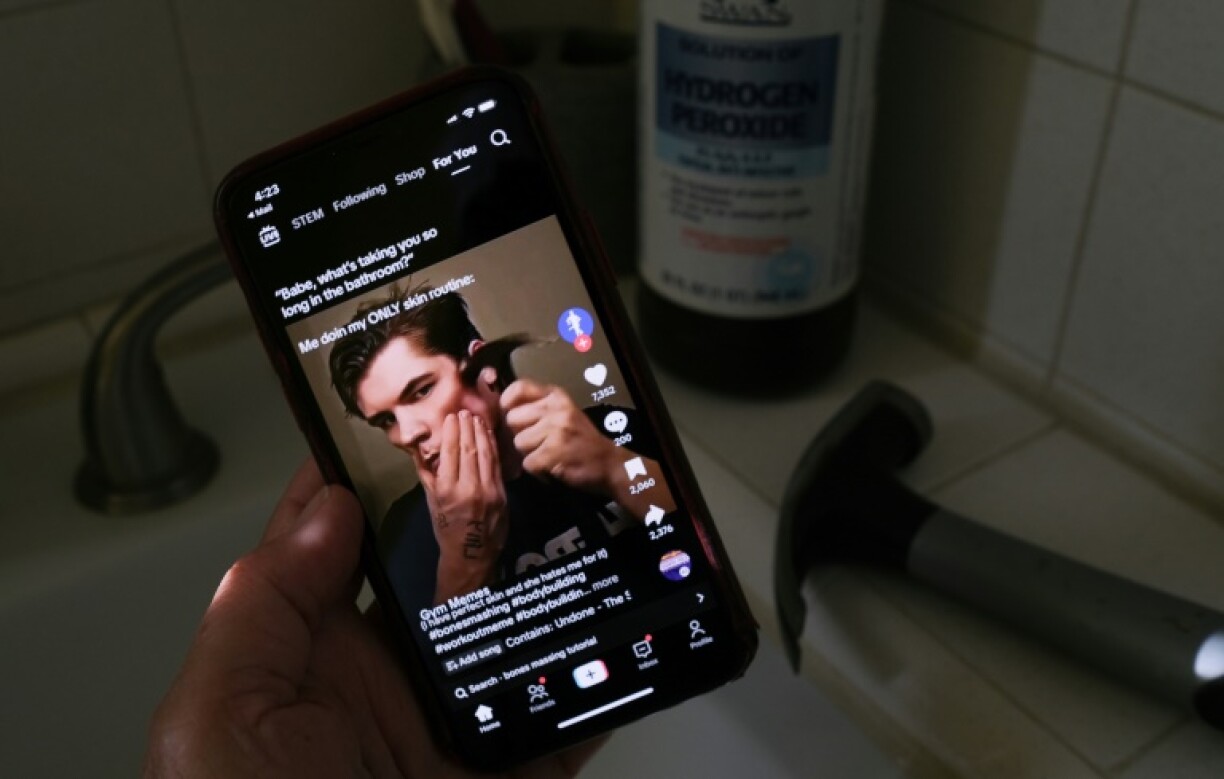
In the looksmaxxing community, the central focus is on physical appearance, with social media videos offering advice to young men on how to become more attractive. Influencers in the community promote various techniques and routines, claiming that anyone can significantly improve their looks by following their methods.
In principle, there are two main approaches: softmaxxing and hardmaxxing.
Softmaxxing involves generally harmless methods that can benefit your health, such as going to bed early, following a skincare routine, exercising regularly, and paying attention to your appearance and overall well-being.
Hardmaxxing, on the other hand, involves more extreme measures, such as cosmetic surgery, filler injections, and leg-lengthening procedures. It also often encourages at-home techniques without professional supervision.
One such technique is "bone smashing", which involves repeatedly striking one's face with an object to alter the shape of the facial bones. The idea is that numerous small fractures will heal and fuse together, thereby changing bone structure.
Plastic surgeon Ramin Assassi, who brings nearly 18 years of experience in the field, strongly advises against this practice, warning that the outcomes are unpredictable. Rather than producing the desired changes to the facial structure, it can result in uneven bone healing and significant facial asymmetry.
Reacting to some of the looksmaxxing video, Dr Assassi believes many of these videos to show the results of cosmetic procedures rather than natural transformation, as these influencers would claim.
Some influencers post videos of jaw exercises said to make the jawline more defined. Others claim that pressing the tongue against the roof of the mouth can push the chin forward. Before-and-after images are especially popular as they appear to demonstrate significant changes resulting from these techniques. However, Dr Assassi is sceptical, arguing that many of these images rely on fillers, filters, and other tricks to create the illusion of improvement.
He claims that these methods do not deliver the promised results. While facial exercises may improve blood circulation and muscle activity, they cannot alter a person's underlying facial structure. Real changes to the position of the chin require surgery, during which the bone is cut, repositioned, and fixed in place with plates and screws.
Above all, Dr Assassi warns against attempting cosmetic procedures without professional supervision. Some influencers encourage their followers to inject substances themselves, claiming that this is a cheaper alternative to professional treatment.
Many of the products used can be purchased online, and the procedures are sometimes carried out by people who lack the necessary medical qualifications.
Dr Assassi stresses that anyone considering such treatments should consult a properly trained specialist. He believes that cosmetic procedures should only be carried out by a qualified physician who has received specialist training in the relevant field.
Many of these videos advertise products, coaching services and apps that claim to help users improve their appearance. Apps that enable users to rate their own faces are particularly common. They score a person's attractiveness using a points-based system. This trend is both profitable and deeply pressuring, especially for young men.
Dr Catherine Tebaldi of the Culture and Computation Lab at the University of Luxembourg criticises this culture of comparison and ranking. She believes that the central premise of looksmaxxing is that success in love, work, and life largely depends on physical appearance.
"It is incredibly stressful for young people, and it is sad", she stresses, as the movement places an almost exclusive emphasis on outward appearance. As a linguistic anthropologist, Dr Tebaldi has spent years studying similar online communities.
In many cases, the issue extends beyond the sharing of beauty advice. Videos often use terms such as "subhuman" to describe those who fail to achieve a certain score or meet specific appearance standards.
Misogynistic and racist narratives are also common. The underlying message is that men can only succeed with women if they conform to specific beauty ideals and that women are only interested in men who meet these standards. Dr Tebaldi argues that the movement also promotes hypermasculinity.
Hardmaxxing is an extreme example centred on the pursuit of a stronger, tougher, and more masculine appearance. According to Dr Tebaldi, this often overlaps with ideologies that emphasise male dominance. "At that point, it's no longer about health or beauty", she says.
Researchers are now examining whether these videos are being viewed and shared in Luxembourg too. Two Master's students supervised by Dr Tebaldi at the University of Luxembourg are investigating this phenomenon for their dissertations.