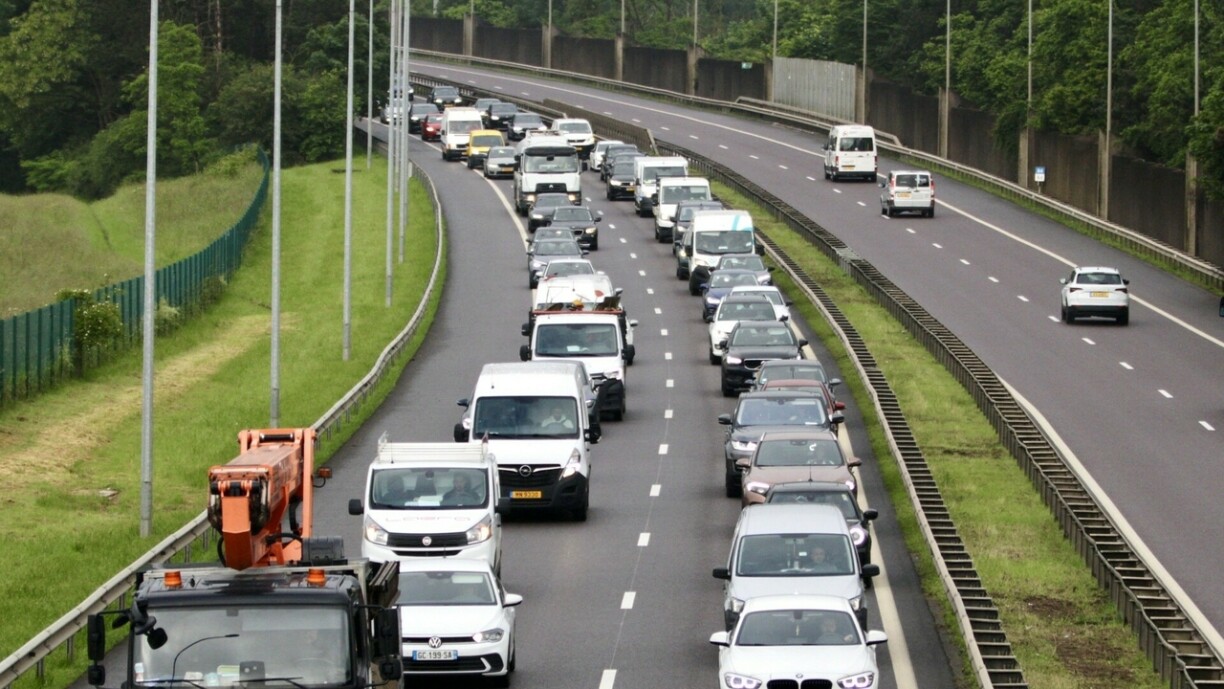
Traffic on the A31 motorway, the preferred route for cross-border workers commuting from France to Luxembourg, has seen a marked increase in recent months, with volumes rising by as much as 10%.
According to the Regional Directorate for Environment, Development, and Housing (Dreal), the continued rise in travel between France and Luxembourg is leading to saturated transport infrastructure between the two countries, while economic forecasts suggest that this trend is set to continue.
The number of French cross-border workers has risen from just under 87,000 at the end of 2015 to more than 129,000 by the end of 2025 – a jump of 48% over the decade. Projections indicate that more than 135,000 French residents will be employed in Luxembourg by 2030.
The majority of these commuters will live in the northern Lorraine area, meaning they face punishing journeys: according to a study by the Chamber of Employees, most can expect to spend more than nine and a half hours each week (one hour and 54 minutes per day) on their commute.
At the Zoufftgen border crossing alone, more than 64,000 vehicles now pass through each day, with roughly 10% of that figure accounted for by heavy goods vehicles. In comparison, daily traffic at this location stood at 58,000 vehicles in 2015, meaning the volume has grown by about 10% in just ten years.
Further south in Thionville, the situation is even more striking. Each day, over 85,000 vehicles cross the Moselle river via the Beauregard viaduct, with 8.5% being lorries. In 2015, this daily total was already above 79,000 vehicles, reflecting a 7.5% increase over the decade.
This sharp rise in motorway traffic has prompted the government to pursue the A31bis project. The main aim is to address the chronic congestion impacting both cross-border workers and local residents in the “northern sector” from Thionville to the border. Officials are seeking to pre-empt future traffic jams, which are expected to become even longer and more frequent, particularly through the Thionville area.
The government hopes to expand the motorway to six lanes, three in each direction, between Thionville and the Luxembourg border. In addition, a bypass for Thionville is on the table, given that the A31 currently serves as a ring road for the city, with numerous local interchanges. Between Illange and the Kinépolis cinema complex in Thionville, the motorway connects to seven local destinations, each of which becomes a traffic pinch point during rush hour.