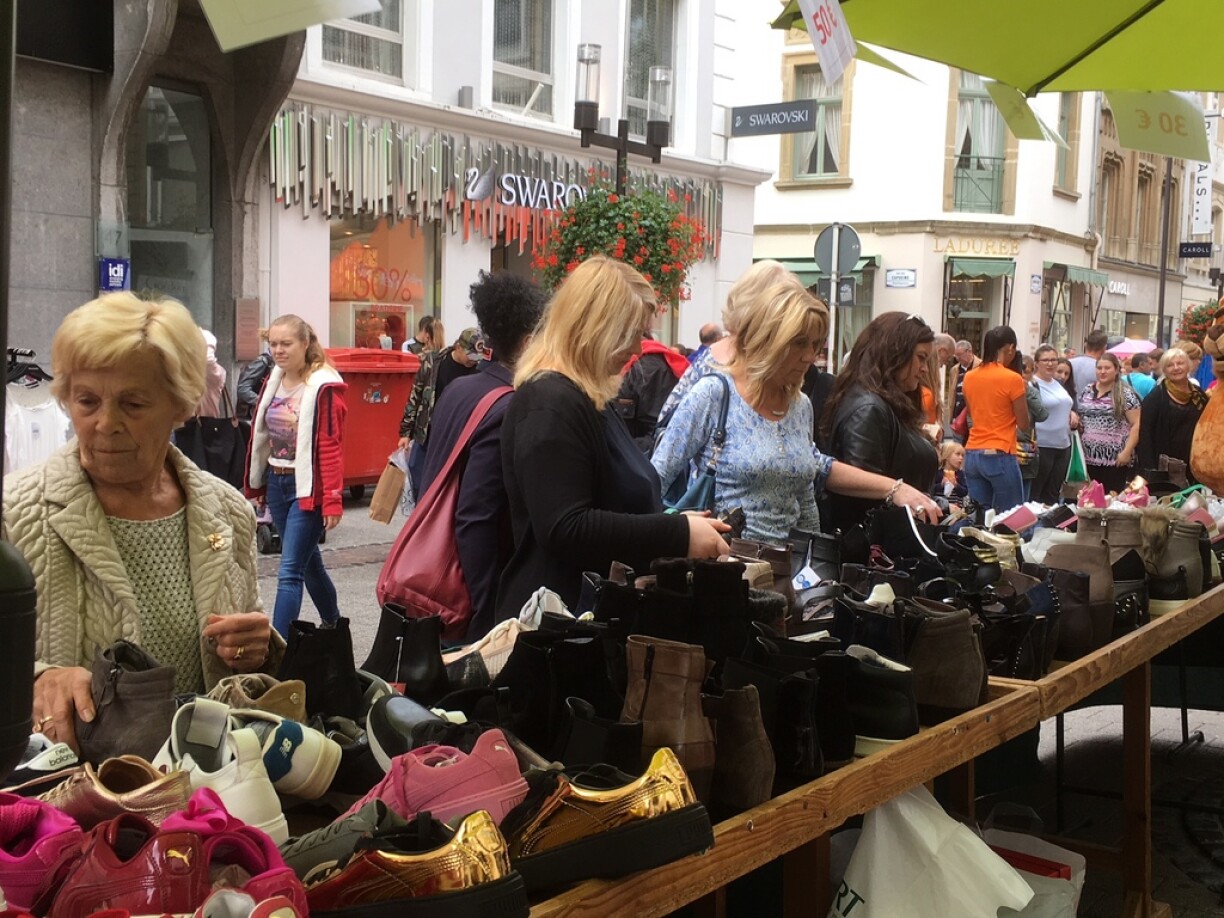
The face of Luxembourg City has quite obviously changed in the past ten years, let alone the past 90 years. One thing remains constant, and that is one of Luxembourg's foremost traditions, the braderie market.
The braderie takes place the first Monday of September and certainly has an interesting history.
The first market was launched in 1929 - in the middle of the worldwide interwar economic crisis. The young commercial union, founded in 1906, launched the braderie in a time that was markedly different from today. The current braderie may be entirely different, but the date remains an important one for participating retailers.
Between 8am and 7pm, the Luxembourg City Commercial Union (UCVL) will not disappoint in keeping with tradition, and the streets of the capital will be filled with stands outside shops. A total of 360 stands representing 2,101 linear metres will be selling off cheaper wares in the city centre, the Central station neighbourhood, other areas, and throughout the country.
As for how the braderie works, retailers pay for slots according to the space requested and the area, and can pay €450 for four metres in the city centre, a price reduced to €300 for UCVL members. These prices have also remained unchanged for the past few years.
Given the fact that the braderie celebrates its 90th anniversary this year, the UCVL is of course celebrating the special year. The UCVL has worked hard to offer a number of different activities for the entire family - all revolving around the theme of the 1920s. There will be a retro DJ, black and white photographs, dancers, and a guingette, a drinking establishment harking back to the decade.
There will be a special emphasis on jazzing up the Central station neighbourhood, which is perhaps suffering as a result of the ongoing tram construction works. The city authorities will give the area a makeover, putting a red carpet along Avenue de la Liberté, installing food trucks on Place de Paris, and games for children on Rue Origer.
There will also be a creator's village on Place d'Armes alongside musical performances, and, of course, cake at 10.30am.
If the figures are true and we can expect between 150,000 and 200,000 people to attend, the question of accessibility remains important. And the capital definitely goes to great lengths to ensure that the city is accessible. Buses will be free of charge on Monday (in addition to Saturday and Sunday), and the City of Luxembourg has also reorganised bus lines to adapt to the market layouts.
In addition to the Park & Rides located all over the city, the Place de l'Europe (Kirchberg) and Fort Wedell (Central station) car parks will be free of charge, and the first 250 customers of the Hamilius car park will have free parking too. Cycling Vél'OH bikes will remain accessible as well. However, the Fort Neiperg car park will remain closed as it requires a few more weeks for works to complete.
As Anne Darin, the president of the UCVL, explained, Luxtram has also contributed by pausing its roadworks for the day of the braderie, allowing retailers on Avenue de la Liberté to set up stands.
The current enthusiasm for the braderie does not neglect the consideration of the difficult period that retail in the capital is currently facing. Consumer habits (buying online or a preference for shopping centres) are reasons that retailers are struggling, according to alderman Serge Wilmes. Wilmes also cited Statec figures, which reveal that three-quarters of under-25 year olds buy online. Wilmes believes that retailers must consider their offer to customers, develop new concepts, and learn from experience. One idea praised by Wilmes is an initiative merging both a cafe and a clothing store.
Nevertheless, the City authorities are against intervening in a mean to prioritise some types of businesses in particular. Here, the liberal laisser-faire doctrine clashes with the alderman's dedication to the subject, as Wilmes has authored a number of draft bills suggesting municipalities preempt empty commercial units.
The city's authorities are still keen to focus on local businesses in neighbourhoods and has recently commissioned a qualitative study on the trends and behaviour of customers. The study will be presented in the autumn. It is perhaps doubtless that areas like Bonnevoie and Limpertsberg will see retail develop. How exactly the braderie might look in another 90 years is anybody's guess.