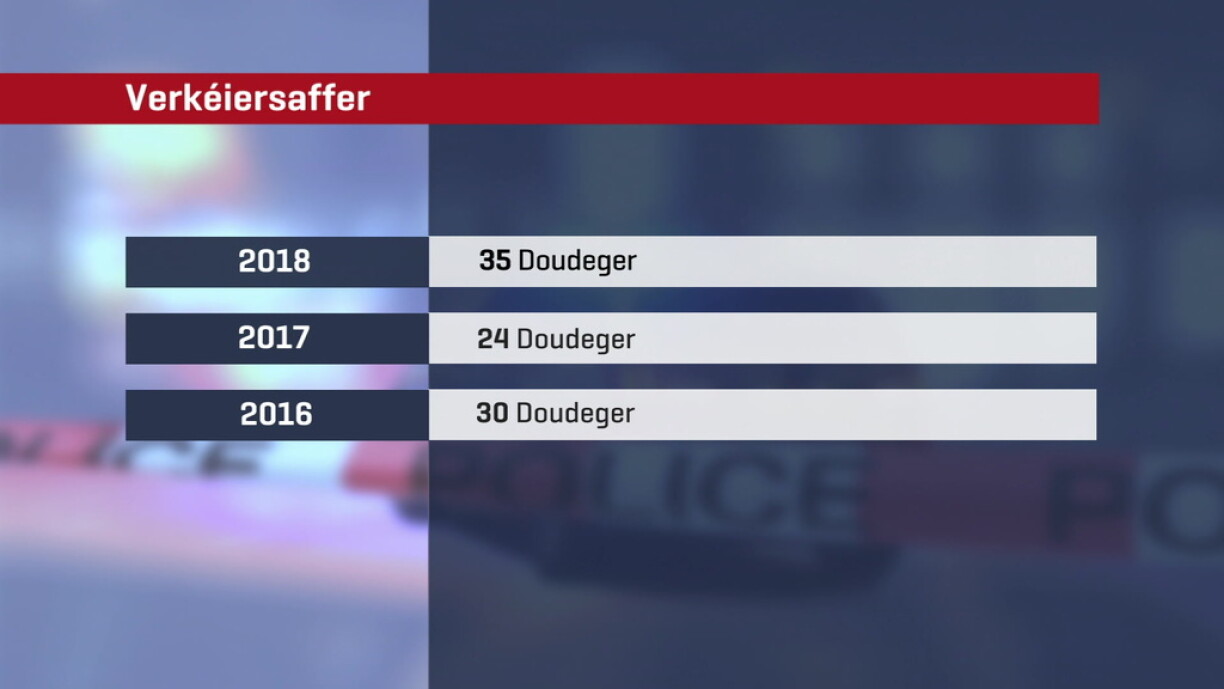
Raymond Schintgen, the president of the national association for road crash victims ("Association Nationale des Victimes de la Route" - AVR) called 2018 a "black year" in terms of road safety. 35 people died over the course of 365 days. Behind each number in the statistic, there lies a family tragedy.
The AVR has expressed its disappointment at the new government's coalition agreement. In an RTL interview, Schintgen stated that reducing traffic fines for smaller traffic violations would send the wrong message. Instead, Schintgen believes that the government should at east consider simultaneously upping the fines for more serious infractions and/or adjusting fines to the salary of the person who committed the traffic violation.
Transport minister François Bausch has pointed out that several casualties were in fact suicides or the result of people falling ill behind the wheel.
Schintgen on the other hand believes that the combination of speed and alcohol is still one of the deadliest combinations often underestimated by drivers. Young drivers are especially vulnerable to this.
The president of the national association for road crash victims believes that radar sections, a new generation of speed check technology, could do much to curb the number of crashes in Luxembourg. Radar sections calculate the driver's average speed over a stretch of road, rather than at just one specific spot.
Luxembourg's speed check camera apparatus have been operational for almost three years now. The government is currently also improving road safety by installing crash barriers on tree-lined roads.
Paul Hammelmann of the road safety association believes that reducing maximum speeds on country roads from 90 km/h to 80 km/h would be an important step.
The ministry of transport will release a more detailed analysis of road safety in 2018 later in the year.





