Employers' representatives argue that absenteeism presents a significant issue in Luxembourg's workforce. The real scale of the problem, however, depends on whose data is taken into consideration.
Since the Covid-19 pandemic, the number of sick days has increased by 40%, the Crafts and Trades Federation highlighted at their recent New Years' reception. This figure is based on an internal survey, which a parent organisation of the Luxembourg Employers' Association (UEL) conducted across 900 companies last year.
However, the latest official statistics on absences in the workplace, compiled by the General Inspectorate of Social Security (IGSS) and the Social Security Ministry, do not corroborate this alleged increase.
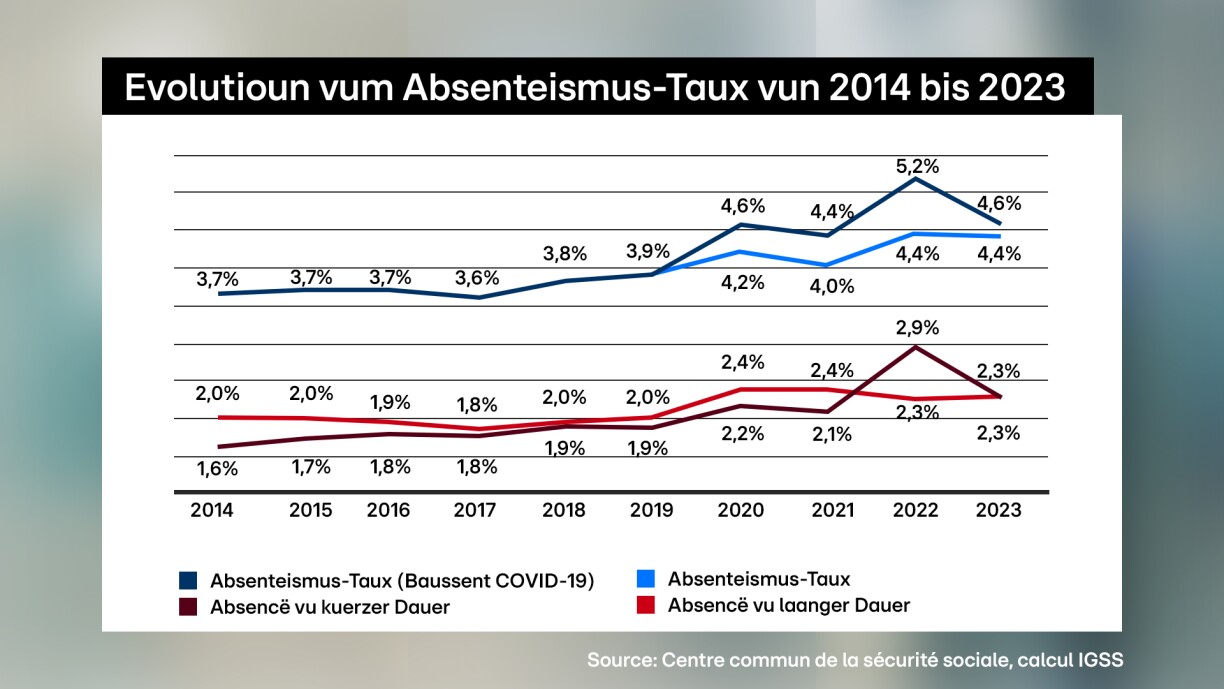
Published in October 2024, the most recent figures cover the sick days in the private sector up until 2023. That year, absenteeism stood at 4.6%, which actually corresponds to an 11%-decrease from 2022.
The total costs for absenteeism in 2023 is estimated to be €1.17 billion, 3% less than the year before but 26% higher than in 2021.
Read also: 'This government will not introduce a day off', says Martine Deprez
It seems clear that the number of sick notes has increased in Luxembourg. In 2014, the rate of absences stood at 3.7%. Since Covid, the rate has not fallen below 4%, even if one were to leave out the exceptional sick notes, isolations, or quarantines due to coronavirus infections.
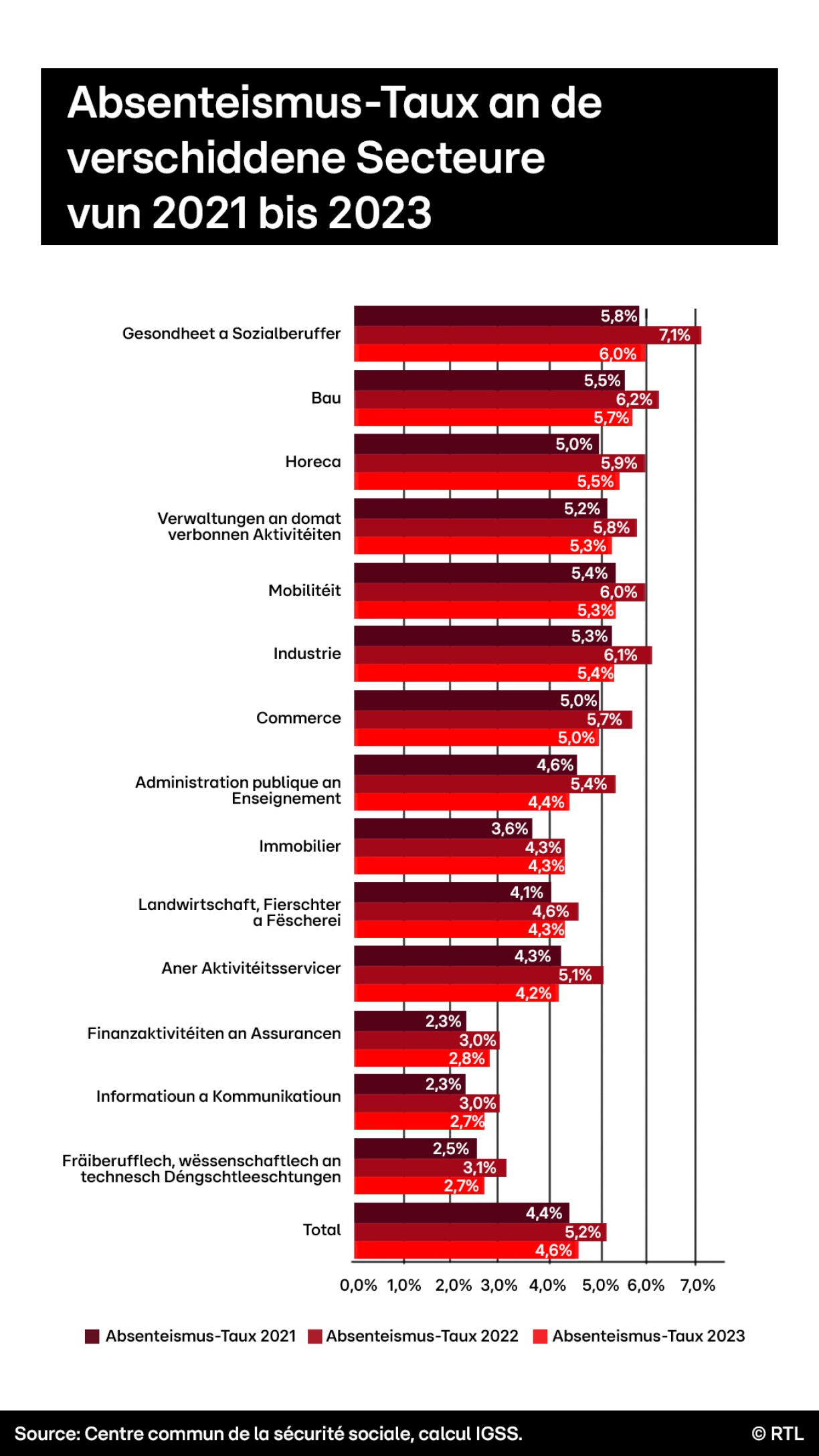
The IGSS also highlights that certain sectors are disproportionately affected by absenteeism. Health and social professions recorded the highest absenteeism rate in 2023, at 6%. This might be due to employees' increased exposure to contagious illnesses or their aptitude to stay home as a precaution. They are closely followed by construction and the hospitality sector.
Statistically speaking, manual labourers are more significantly more likely to take sick leave. The same applies to women who are not residents in the Grand Duchy, though this is a trend that has been observed for years and is generally linked to caregiving responsibilities for sick children.
The IGSS annually produces a comprehensive report on absenteeism in Luxembourg, including details on illnesses and the duration of sick leaves. The so-called Absenteeism Observatory, which was created during a former CSV-LSAP government, is no longer active in its original form.