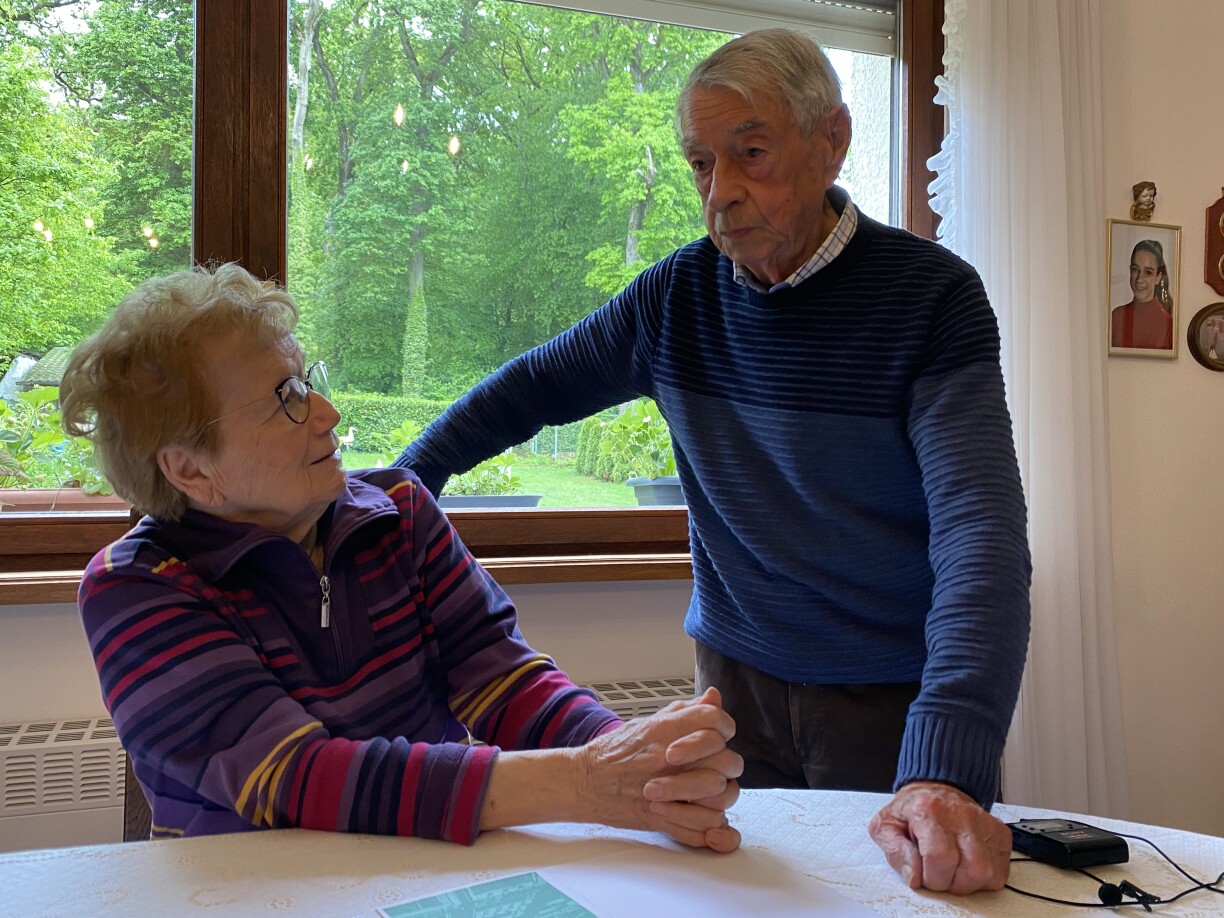
Eighty-six years after the Wehrmacht marched into Dudelange, Aloyse Schartz still remembers the day clearly. In an interview with RTL, the 93-year-old recalls how his family fled Luxembourg, spent weeks in France, and eventually returned to find their home destroyed.
It was Friday, 10 May 1940. Aloyse Schartz was six years old when the German army invaded Dudelange. His father, a steelworker, came home later than usual from his night shift that day.
"The Germans are here", he called out to his wife and son. "They're in Bettembourg, near the Cellula site", Schartz recounted.
Later that afternoon, between 2pm and 3pm, people were told to get indoors. "Everyone into the houses. The French are coming. They’re already by Dr Goerens with a machine gun", Schartz recalled.
Now aged 93, he still remembers the atmosphere clearly: "Many people hid in their cellars. We didn't. We stayed in our flat and sat by the window."
On Saturday morning, 11 May, at 11am, someone rang the doorbell at the Schartz family home. It was Aloyse's aunt.
"What? Are you still in bed? Half of Dudelange has already left, behind the Maginot Line. We'll be safe there", she told them, according to Schartz.
A suitcase was quickly packed and Aloyse's father attached it to his bicycle. "A small basket was filled too, and I took my alarm clock and my little travel bag with me", Schartz recalled, visibly moved.
The family crossed the border at Volmerange-les-Mines. He remembered in detail:
"We walked all day, all the way to Amnéville. We slept in a school there. The next day, we continued by train. At every major station, the Red Cross was there, handing out coffee and chocolate. In one village, we were given a large room with a bed and a coffee machine. My parents were sad", Schartz said.
Schartz and his family eventually ended up near Nevers, in central France, in the Bourgogne-Franche-Comté region.
"There were barracks there, and that's where we lived. The men had to go to work. My father painted the big mines that floated on the water", he said.
One day, his grandmother was supposed to look after him while his mother and aunt went shopping in Nevers. Suddenly, the young boy slipped away.
Schartz told this memory as he remembered vividly: "I had remembered the way to Nevers. When I reached them, my mother asked me whether my grandmother knew where I was. I said no. So she said, 'Come on then, let's get home quickly.'"
The Schartz family spent two months in France. His grandmother wanted to return to Luxembourg. After several days of her insisting, Aloyse's father had had enough and went to ask the Germans whether they would take the family home.
Schartz recalled that the German soldier asked why the family had fled, to which his father replied that they had been in a war zone and had no choice but to leave. According to Schartz, the soldier understood.
The family eventually arrived in Rollingergrund.
Aloyse Schartz and his parents later stayed in Wasserbillig, where two of his uncles from his father's side lived. The family had a grocery shop there.
"My father came from a family of 13 children: 12 boys and one girl. My father was the 12th child, and the 13th was a girl. They had a big house, so we were well looked after there", Schartz said.
Back in Dudelange, however, the Schartz family's flat had been destroyed by bombing. When Aloyse's father asked what they were supposed to do, the mayor replied: "Then you'll have to sleep on straw at the school."
"My father never forgave him for that", Schartz said.
Schartz often played with friends on the slag heap. He was there one day when aircraft bombed Dudelange.
Schartz recalled that he and his classmates only had school in the morning, leaving the afternoons free. One day, he was on the slag heap with a classmate, watching the planes overhead, when they suddenly saw white streaks falling from the sky. Then came the explosion.
"Damn, they're bombing the city. Then we ran home as fast as we could", Schartz said.
Among Schartz's memories of the war years is also the visit of Prince Felix and Prince Jean to Dudelange on 12 September 1944, shortly after the liberation, when hundreds of residents gathered along the streets to welcome them.
Schartz has spent a lifetime in the shadow of those memories. He married Tina on 21 August 1961, and the couple had one daughter, Rita Schartz. In 1980, his parents died within just four weeks of each other: his father, Ferd Schartz, at the age of 74 and his mother, Olga Schlesser, at 72.