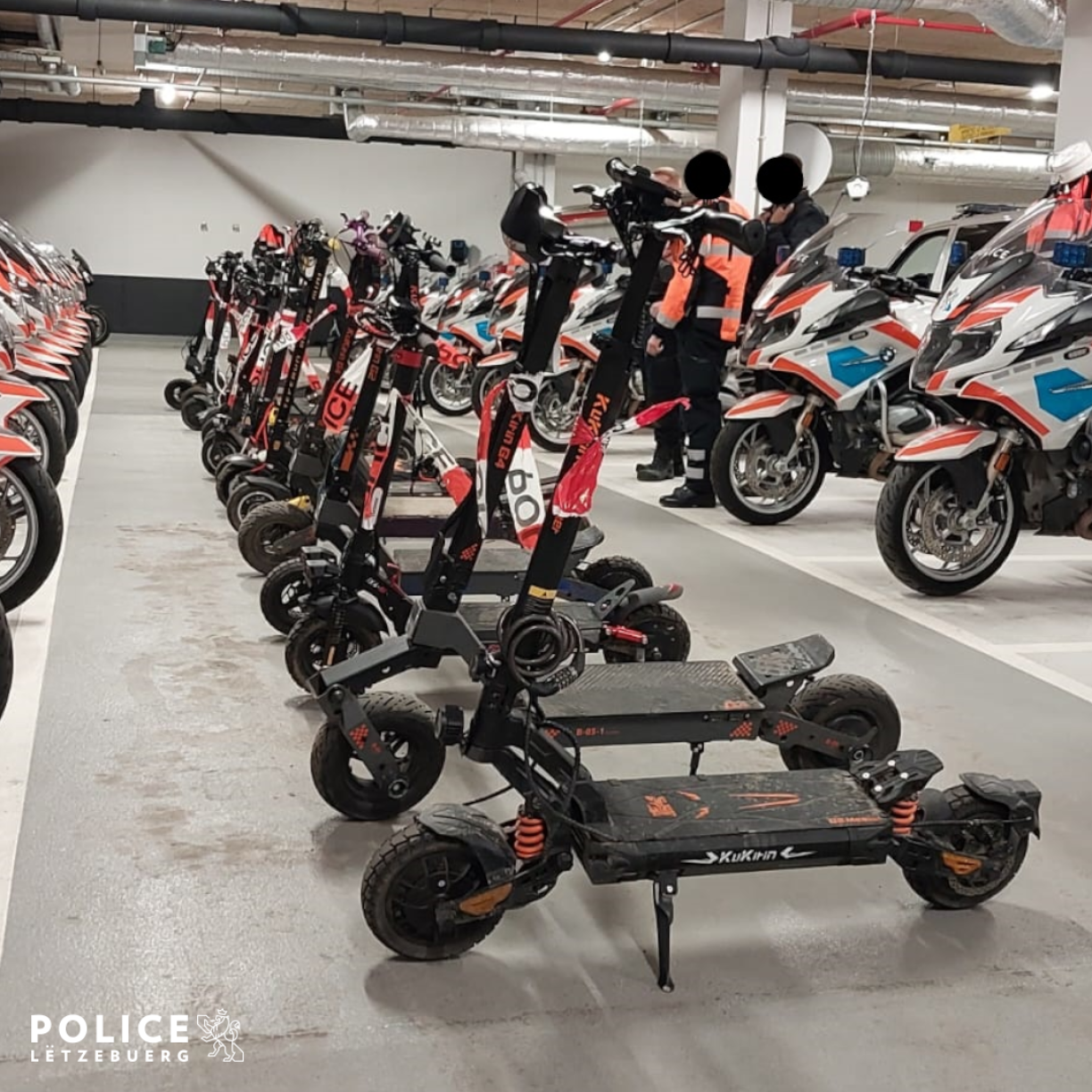
Last week, an e-scooter rider suffered life-threatening injuries after losing control of his vehicle near Waldbillig. In February, 14 out of 15 inspected e-scooters were seized by authorities after being found to have technical modifications to increase speed limits or defects in breach of road traffic regulations. Together, these two incidents paint a worrying picture of the risks that e-scooters are starting to pose on Luxembourg's roads.
E-scooters fall under the category of electric micro-vehicles and are treated as bicycles under road traffic regulations. This means that e-scooters are subject to a 25km/h speed limit which applies across Europe for all riders. In practice, however, things are more complicated.
Models sold outside Europe are not always subject to the same restrictions, and those vehicles do find their way onto Luxembourg's roads. Denis Zago, who sells e-scooters in Luxembourg, points to a key difference between the two: European models are typically limited mechanically, while non-European versions rely on software restrictions that are far easier to manipulate.
Beyond speed, the rules are clear on equipment. Front and rear lights, a bell and good visibility are all mandatory. A helmet is not legally required, but is strongly recommended. The Luxembourg Association for Road Accident Prevention is unambiguous on the risks, noting that e-scooters can be even more dangerous than bicycles, particularly at high speed.
Another recurring issue in day-to-day traffic is the use of pavements by e-scooter riders. Like cyclists, they are permitted to use cycle paths or the road, but pavements are off limits. It is reserved for pedestrians, as Luxembourg Association for Road Accident Prevention director Isabelle Medinger is keen to remind riders.