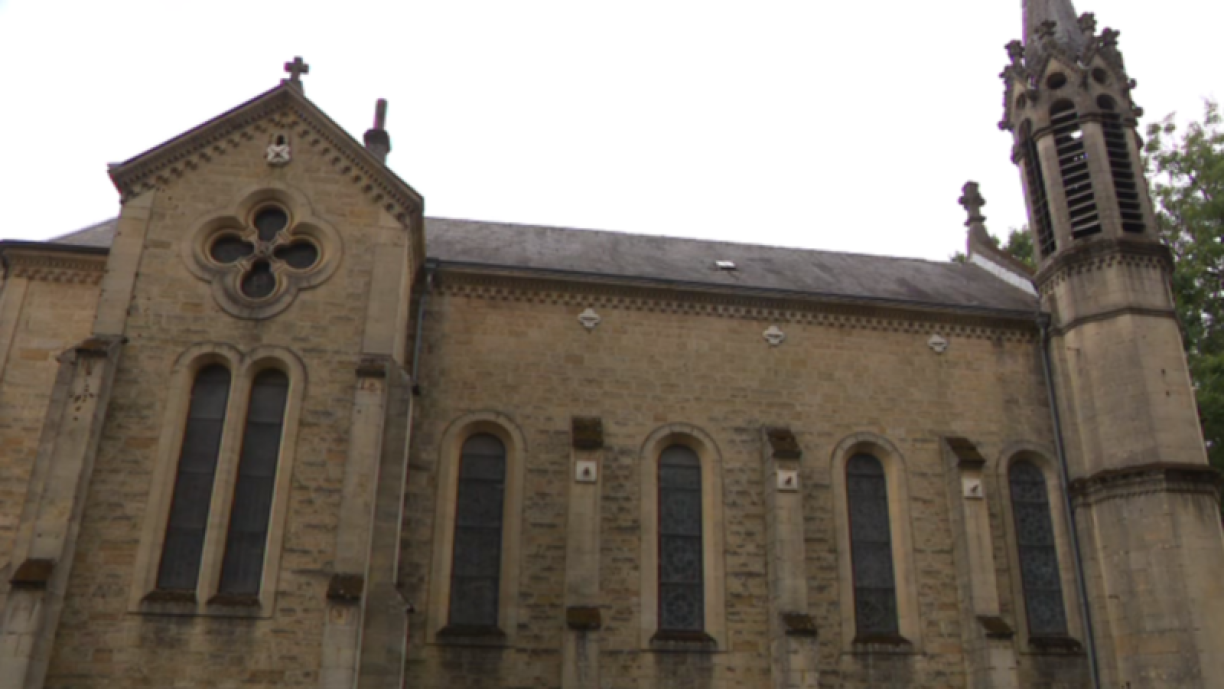
It is the first church to be deconsecrated in Luxembourg, and has been a national heritage property for the last two years.
The church is built entirely from locally sourced materials. A portion of the stones hail from a blast furnace dismantled in 1881; the wood comes from the forests surrounding Lasauvage. The windows of the structure are the originals from 1893.
These days, the church requires restoration work. Primarily the structure needs to be stabilised - the church stands on a former slag heap and has developed cracks over time. The local council felt it was necessary to prevent the decline of the old building.
Tom Ulveling, the first alderman of Differdange, said the church formed part of the local community's heritage and could not be allowed to collapse. He praised the design of the building, saying a village without a church is no longer a village, and expressed the desire to maintain the structure for generations to come.
The National Service for Sites and Monuments has one employee in charge of religious heritage sites: Elisabeth Koltz, who discussed the situation with RTL. She said the most important phase in conservation and renovation at the moment is the study phase.
In the first phase of a project, the structure of the stones and the deformation of the building are analysed. In the second phase, experts take on board the inside of the church.
A soil survey conducted at the church revealed that the ground was not the original and had been added in the 1960s. Studies are still ongoing to check if any of the original ground remains. Neo-Gothic churches tend to be extremely colourful, with many murals and paintings which all link together across the inside of the building - analysis of these can help to date other parts of the building.
It is difficult to estimate how long the renovation project will take - they can typically take up to two years to complete. Mass is currently not held in the church, but the municipality can hold non-religious ceremonies, exhibitions, conferences and so on. St Barbara's is an example of a heritage property which will not vanish quickly.
In the cemetery in Lasauvage a number of immaterial heritage pieces can be found: the old stone crosses. Sculptor Tom Flick said these sculptures are evidence of a dying craftsmanship, pointing out that craftsmen capable of restoring or creating such artefacts are few and far between. Granite crosses such as these would once have been made by hand using a hammer and chisel, but these days can be recreated using moulds.
Heritage Series 1: Which buildings should Luxembourg protect?
Heritage Series 2: Larochette - a small municipality bequeathed with much architectural heritage
Heritage Series 3: The "Péiteschhaus" renovation in Bascharage





