An international congress for mobile libraries is taking place at the National Library of Luxembourg in Kirchberg this weekend. Alongside the official programme, the gathering also includes an event open to the general public.
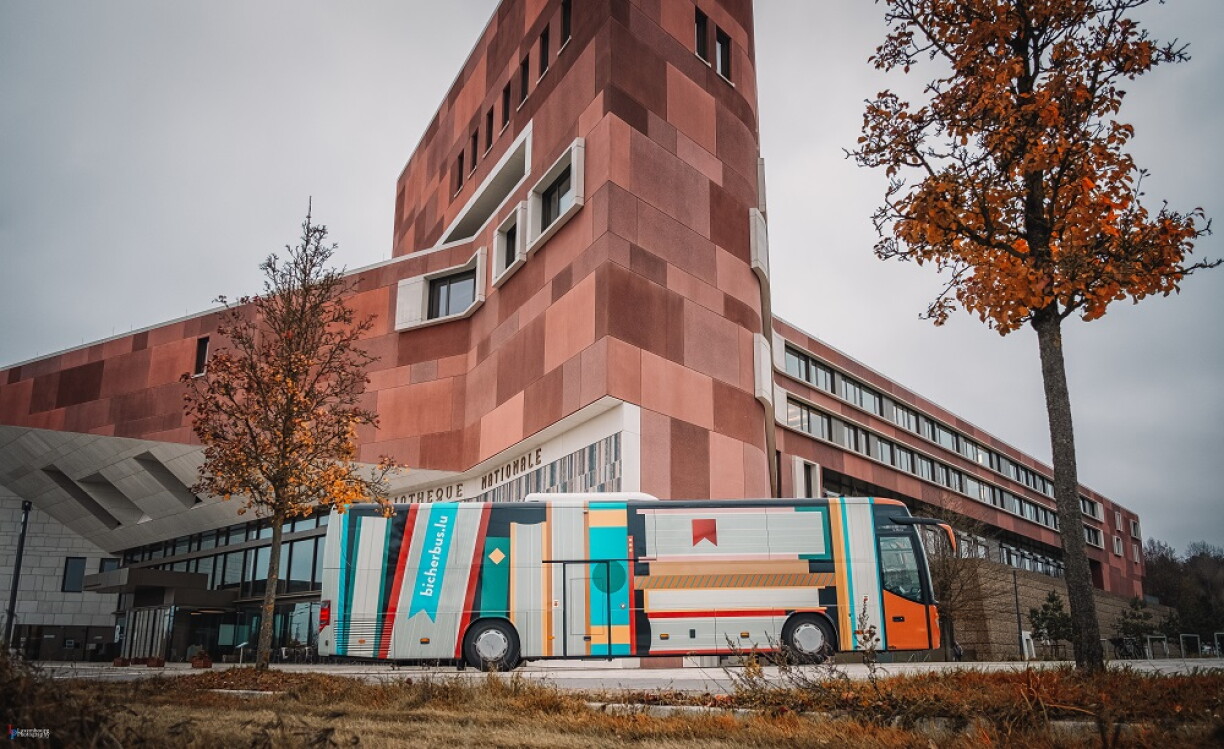
On Sunday 6 September, mobile libraries from across Europe will be parked outside the Coque, giving visitors the chance to explore them from the inside. Michel Molinaro, head of the Bicherbus service, explains the purpose of the congress and what visitors can expect.

The international mobile library congress is primarily intended as a platform for exchange between different mobile library services. It covers current challenges, new concepts, digitalisation, sustainability, new vehicles, and alternative propulsion technologies, as well as the question of how we can reach even more people with our services in future.
International exchange is particularly valuable because, although mobile libraries operate in very different regions, they often face similar challenges. There is no need to reinvent the wheel every time. We can learn a great deal from other people's experiences, ideas and solutions, and adapt them to our own circumstances. Everything starts with an encounter, and encounters give rise to new ideas and sometimes even exciting projects.
We are delighted to welcome participants and mobile libraries from a number of European countries to Luxembourg. Germany, Belgium, the Netherlands, Poland, and Sweden are among those represented, to name just a few.
Mobile libraries bring the library to the people. Particularly in rural areas, where distances are greater and there may be no local library, a mobile library ensures access to books, information, education, and culture.
These mobile services also play an important social role. Beyond access to media, they provide human contact and an opportunity to participate in social and cultural life, particularly in isolated regions where opportunities for social interaction and exchange are often limited.
The Bicherbus's greatest strength is clearly its mobility. Luxembourg may be a small country, but we have a relatively limited number of public libraries. The Bicherbus can bridge this geographical gap and bring the library directly to people. This gives people who do not have a library nearby access to culture and literature as well.
We currently serve 82 towns and villages across the country on 15 routes. This means that people who do not have a permanent library in their immediate area can still access a library service on a regular basis.
It is also important to stress that the Bicherbus is aimed at people of all ages, from 0 to 99. Many people still assume that the Bicherbus is exclusively for children, but that is not the case. People can borrow items directly from the bus, or reserve documents via a-z.lu and then collect them from the stop of their choice.
Registration with the Bicherbus is free and can be completed directly on board. Registration with the Bicherbus is separate from registration with the National Library and the two are managed independently.
Further information is available on our website at www.bicherbus.lu.
We currently have 1,650 registered readers.
On Sunday, visitors will be able to see something outside the Coque that does not happen every day in Luxembourg: mobile libraries from several European countries gathered together in one place. Visitors will not only be able to look at the vehicles from the outside, but also step aboard and discover the very different concepts behind them.
The exhibition will be open to the public on the forecourt of the Coque from 11am to 2pm. Admission is free and everyone is welcome.
The Bicherbus is more than simply a place to borrow books. It is also a place for people to meet, interact, and connect. At a time when more and more services are becoming digital and impersonal, this human connection is one of our greatest strengths.
At the same time, the Bicherbus provides free access to information, education, culture, leisure, and the enjoyment of reading.