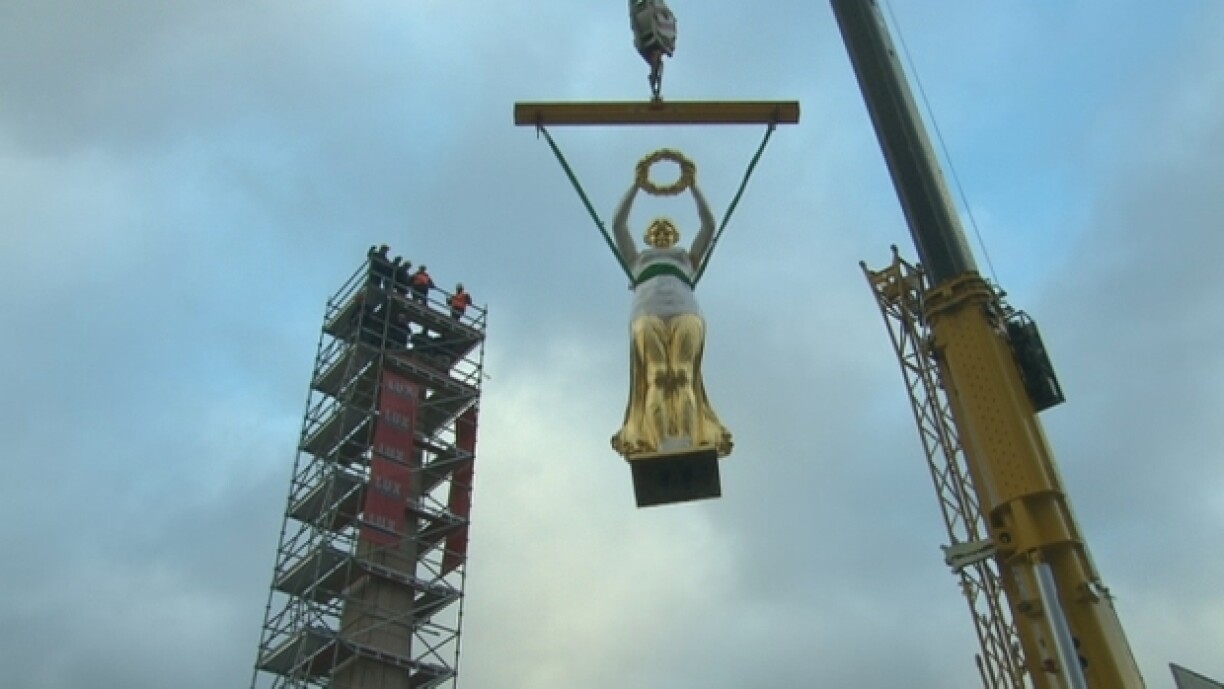
According to Michel Polfer, the director of the National Museum of History and Art (MNHA), the new law on protecting cultural heritage represents progress on a number of levels. Specifically, the law offers several important elements in regards to the practical work of museums, namely providing a state guarantee, a non-seizure guarantee, and a heritage fund.
The law is also very clear in terms of regulations surrounding importing and exporting cultural goods. For instance, the exportation of the Gëlle Fra, as in 2010 for the Shanghai World Expo, would no longer be possible under the terms of the new legislation. According to the new law, the Gëlle Fra is considered a national treasure. Other countries have long implemented similar heritage protection laws, but the move is very recent in Luxembourg.
The statue's new status means that a special commission must provide authorisation if a cultural good is to be exported, whether permanently or temporarily. According to Polfer, this special acknowledgement will protect rare cultural goods, as the commission's criteria are incredibly strict. He cited another example which is based in the museum, namely a Benz vehicle - the first car to have operated in Luxembourg.
Whilst the list is currently rather short, but the new law means that the list will grow rapidly as the legislation has strengthened the notion of national treasures. The non-seizure guarantee is especially important for museums, as it means that a country borrowing an object from a public collection must return it. More and more countries are demanding that this this guarantee be enshrined legally, as they are otherwise likely to refuse lending objects if the borrowing party does not acknowledge the importance of non-seizure. Finally, the heritage funds will be used to acquire protected cultural objects. The state will also have the right to buy before other parties with the new legislation.





