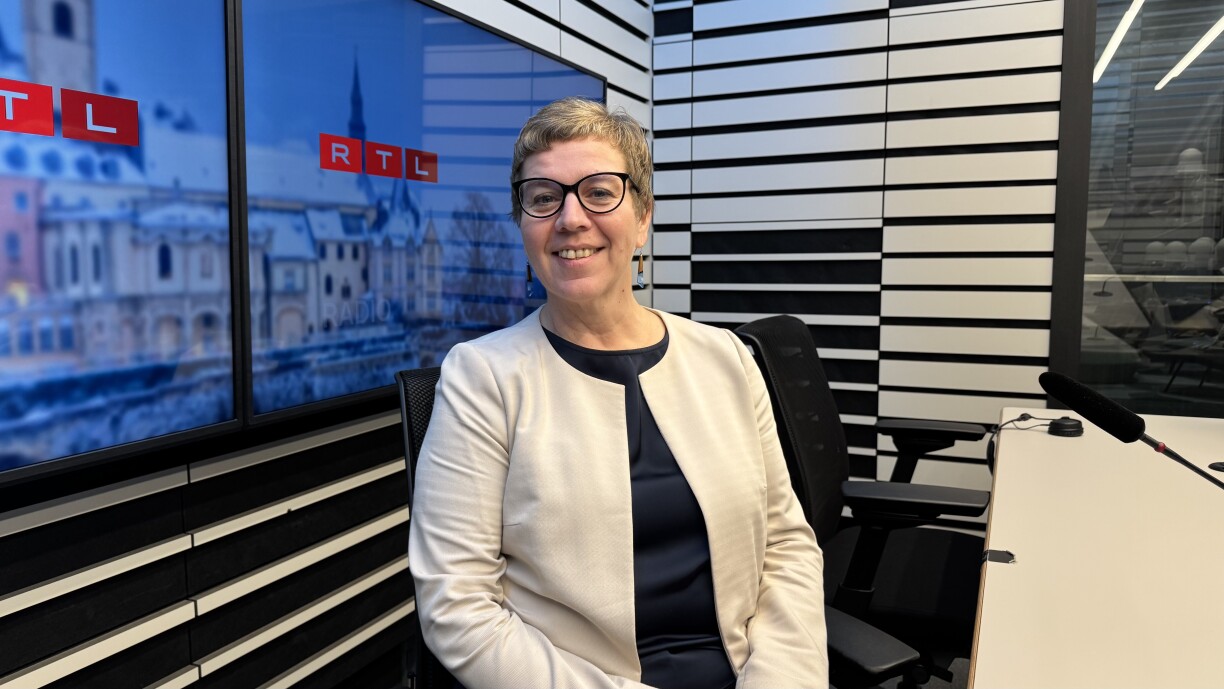
Speaking to RTL on Thursday morning, Health Minister Martine Deprez said Luxembourg's healthcare system must become more efficient as the CNS faces a growing deficit, long-term pressure from an ageing population, and slower employment growth.
"Let's not kid ourselves: our system will not become less expensive", Health Minister Martine Deprez said on RTL on Thursday morning.
She stressed that Luxembourg must avoid a two-tier healthcare system, but said the system had to become more efficient.
For the past two years, the financial deficit of the National Health Fund (CNS), has been growing. This year, the deficit is expected to reach around €130 million, while reserves could fall below the legal threshold of 10% of total expenditure next year.
At Wednesday's quadripartite meeting, several possible measures were discussed, representing around €95 million. Deprez insisted that these were not austerity measures, but measures aimed at reducing expenditure.
According to the minister, the aim is to make the system more efficient without worsening conditions for insured people. In the case of medicines, she said this could involve dispensing individual doses, using blister packs, avoiding the automatic distribution of full boxes, or prioritising less expensive medicines where medically appropriate.
Asked whether more expensive medicines were not usually better, Deprez said international recommendations showed that, for certain conditions, treatment could begin with less expensive medicines and only move on to more costly options if the initial treatment did not work. She mentioned diabetes, heart disease, and other illnesses as examples.
Fraud is also to be tackled more firmly, particularly by identifying doctors who issue unusually high numbers of sick notes or prescriptions. Deprez stressed, however, that this would be done statistically using billing data, rather than through personal surveillance. The aim would be to identify providers who are significantly above the average and then hold discussions with them.
When it comes to insured people, Deprez said the issue was different. In her view, abusive absenteeism by insured people is not fraud, as she put it, and should be treated as a separate matter.
Another measure concerns hospital stays, which the authorities want to shorten where possible. Deprez acknowledged that this should already be the goal of every hospital, but said it also required proper structures after discharge.
In some cases, patients remain in hospital for an extra day because nothing is in place at home to ensure follow-up care. The ministry is therefore working on hospitalisation at home, including the possibility of 24-hour monitoring and intervention if needed.
Asked whether Luxembourg had needed a financial hole in the CNS before taking what might seem like obvious measures, Deprez defended those responsible for the CNS, saying its finances are reviewed every year.
Last year, it was decided that action was needed, leading to the creation of a strategic committee and working groups, she said. The results of that work are now on the table and should be implemented as quickly as possible, Deprez said.
The aim is to reduce pressure on the health insurance system by €95 million. However, if the measures are not enough and reserves fall below the legal threshold, Deprez said contribution increases could not be ruled out.
This option was already on the table last year, she said. At the time, the idea was to increase contributions by a total of 0.25 percentage points, split equally between insured people and employers, 0.125 percentage points each.
According to Deprez, such an increase would currently be enough to stabilise the situation for a while, but the government first wants to put expenditure-reducing measures in place and see how far they go.
Another option is for the state to step in, as it is already doing through an additional €39 million for 2026 and 2027, as well as €20 million linked to maternity costs. Deprez said the state had been the first to take responsibility in this regard. A further review with the social partners is planned for spring 2028 to assess whether the state budget will need to be called upon again, she said.
Deprez also acknowledged the longer-term financial pressure on the system. Employment growth is weaker than in previous years, while demographic forecasts point to a sharp rise in the number of older residents.
By 2050, the number of people aged over 80 is expected to almost triple compared with 2019, while the number of people aged over 65 could rise from 88,000 in 2019 to almost 200,000.
The minister said this was a concern and meant the system had to be properly organised. Luxembourg must maintain a healthcare system and avoid a two-tier model, she said, while ensuring that everyone receives the care they genuinely need.
Healthcare, she added, already costs a great deal and will not become cheaper in the future.
Following the quadripartite meeting, the Luxembourg Association of Doctors and Dentists (AMMD) said the conditions had still not been met for it to sign the new agreements with the CNS. The AMMD argues that Deprez must fulfil demands it says were among the election promises of the Christian Social People's Party (CSV).
Deprez said the government was implementing the coalition agreement. This meant maintaining a conventional healthcare system, avoiding two-tier medicine, reducing waiting times, and bringing medical care closer to patients.
She said these issues were being discussed with the AMMD in five working groups, with an interim review expected at the end of May.
The minister acknowledged that, apart from the bill on medical companies, the relevant points from the coalition agreement had not yet been tabled as legal texts. However, she said they were being prepared and that concrete proposals would be put forward at upcoming meetings.
Another key AMMD demand concerns new mechanisms for setting tariffs. One central issue is the so-called lettre-clé, a monetary value which, when multiplied by coefficients assigned to different medical procedures, determines tariffs.
Deprez said the government was working on this issue, but stressed that the lettre-clé does not only concern doctors, but all healthcare providers. She described the negotiations as "tough".
According to the minister, the AMMD wants a strict automatic mechanism, while she and the social partners represented in the CNS want a more uniform system for all providers.
The AMMD has also criticised the principle of "useful and necessary", arguing that it allows the CNS to slow down tariff revaluations. Deprez said the principle simply means that patients should receive what they genuinely need.
She acknowledged that scientific assessments can take "a little while", but insisted that the system must retain control over what patients actually require. If that control were removed, she warned, someone else would effectively decide what care should be provided.
Deprez also explained that, within the CNS, tariff values can only be increased or kept unchanged. However, the state can intervene through the state budget to adjust the lettre-clé, as has happened in the past for laboratories and doctors.