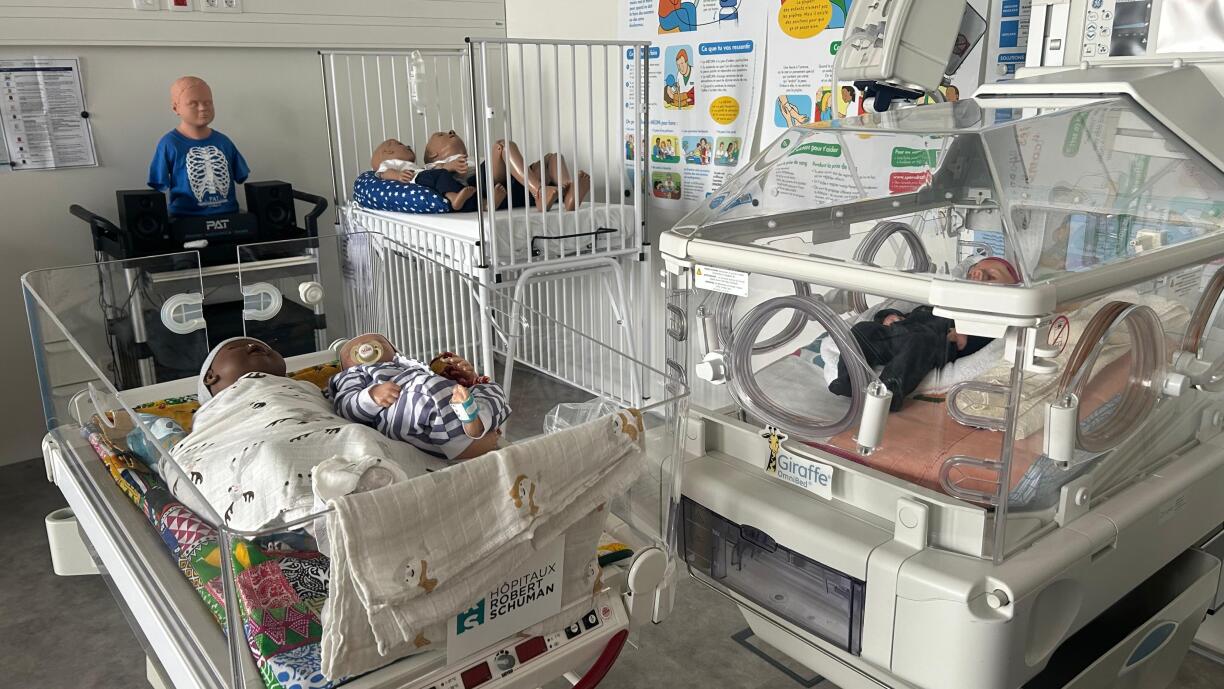
RTL visited SimUL at the University of Luxembourg, where students and healthcare professionals practise clinical situations under realistic conditions.
SimUL stands for "simulation-based healthcare education" and is the University of Luxembourg's healthcare simulation unit. In short, it is a modern education and training platform where students and healthcare professionals can practise clinical situations under realistic conditions, without putting a real patient at risk.
At the unit, students can learn the basics of healthcare professions, from stitching wounds and measuring blood pressure to giving injections and carrying out scans, endoscopies, or ultrasounds.
The simulation unit is mainly intended for students of medicine, nursing, and midwifery, and is otherwise not open to the public.
According to Dr Christian Grevisse, E-Learning Specialist at the University of Luxembourg, all the rooms in the simulation unit follow the same basic idea: students should first rehearse procedures in a simulated setting before performing them on a patient.
According to Dr Christian Grevisse, E-Learning Specialist at the University of Luxembourg, the rooms combine simulated patients with real hospital equipment, some of which is no longer used in hospitals but remains suitable for training.
Grevisse explained that the unit includes rooms for paediatrics, general care, midwifery, intensive care, and digital learning. In the midwifery room, he said, students can train for situations ranging from pregnancy monitoring and birth to postnatal care.
He also highlighted the use of hyper-realistic mannequins, which look and feel close to real patients. He explained that this helps students prepare not only for technical procedures, but also for the emotional and human side of patient care.
According to Grevisse, each simulation is built around specific learning objectives. Trainers decide what students should learn and then create scenarios with the relevant symptoms, reactions, and clinical challenges, he said.
Grevisse also presented the virtual hospital, where students can practise intensive care, anaesthesia, and resuscitation scenarios, monitor vital signs, and train decision-making under pressure.
In the Digital Learning Suite, Grevisse said students use technical simulators, including for ultrasound training. He also described the anatomy room, where traditional models are combined with modern tools such as a virtual dissection table.





